
Stake attention in this memory
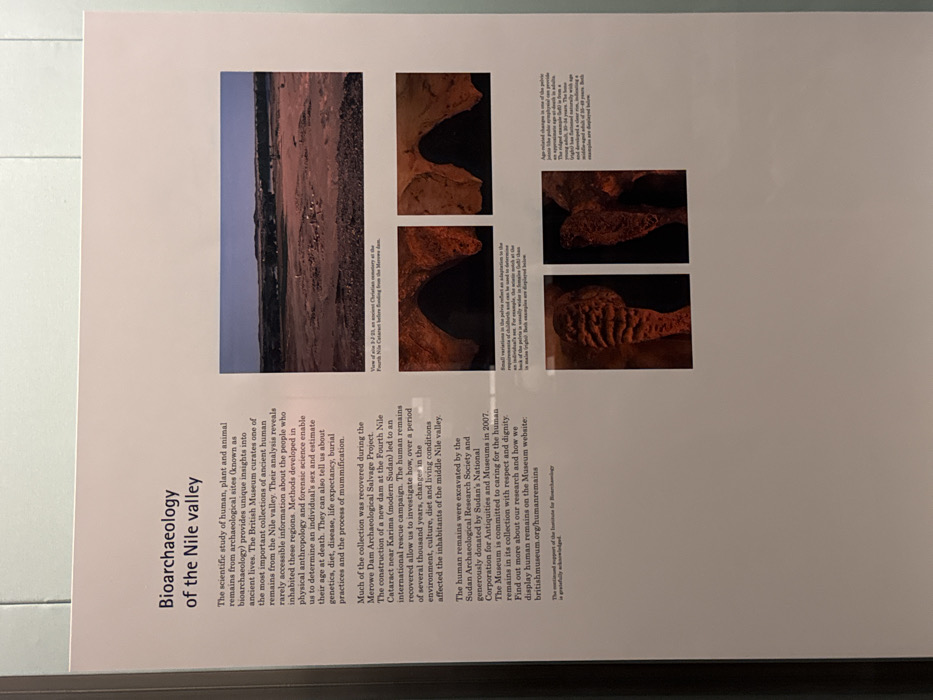
This media file captures a museum display board titled "Bioarchaeology of the Nile valley," located in the British Museum in London, United Kingdom. The exhibit explains bioarchaeology as the scientific study of human, plant, and animal remains from archaeological sites, offering insights into ancient lives, and details how physical anthropology and forensic science determine sex, age at death, genetics, diet, disease, life expectancy, burial practices, and mummification. The display includes text explaining that much of the collection was recovered during the Merowe Dam Archaeological Salvage Project due to the construction of a new dam at the Fourth Nile Cataract near Karima, modern Sudan. These human remains, excavated by the Sudan Archaeological Research Society and donated in 2007, help investigate how environment, culture, diet, and living conditions affected ancient inhabitants. The museum emphasizes its commitment to caring for these remains with respect and dignity, directing visitors to "britishmuseum.org/humanremains" for more information. Visually, the display features a large landscape image, possibly taken at dusk or dawn, showing a vast, arid area identified by its caption as "View of site JV-23, an ancient Christian cemetery at the Fourth Nile Cataract before flooding from the Merowe dam." Below this, there are five smaller images, predominantly depicting human bone fragments, likely from the pelvis. Captions beneath these images explain "small variations in the pelvis reflect an adaptation to the requirements of childbirth and can be used to identify sex," with examples of male and female pelvises. Another caption details "age-related changes to one of the pelvic bones, the pubic symphysis," showing examples from young adult, middle-aged, and older individuals to illustrate age estimation.
Loading AttnAds…
No transactions found