Sign in
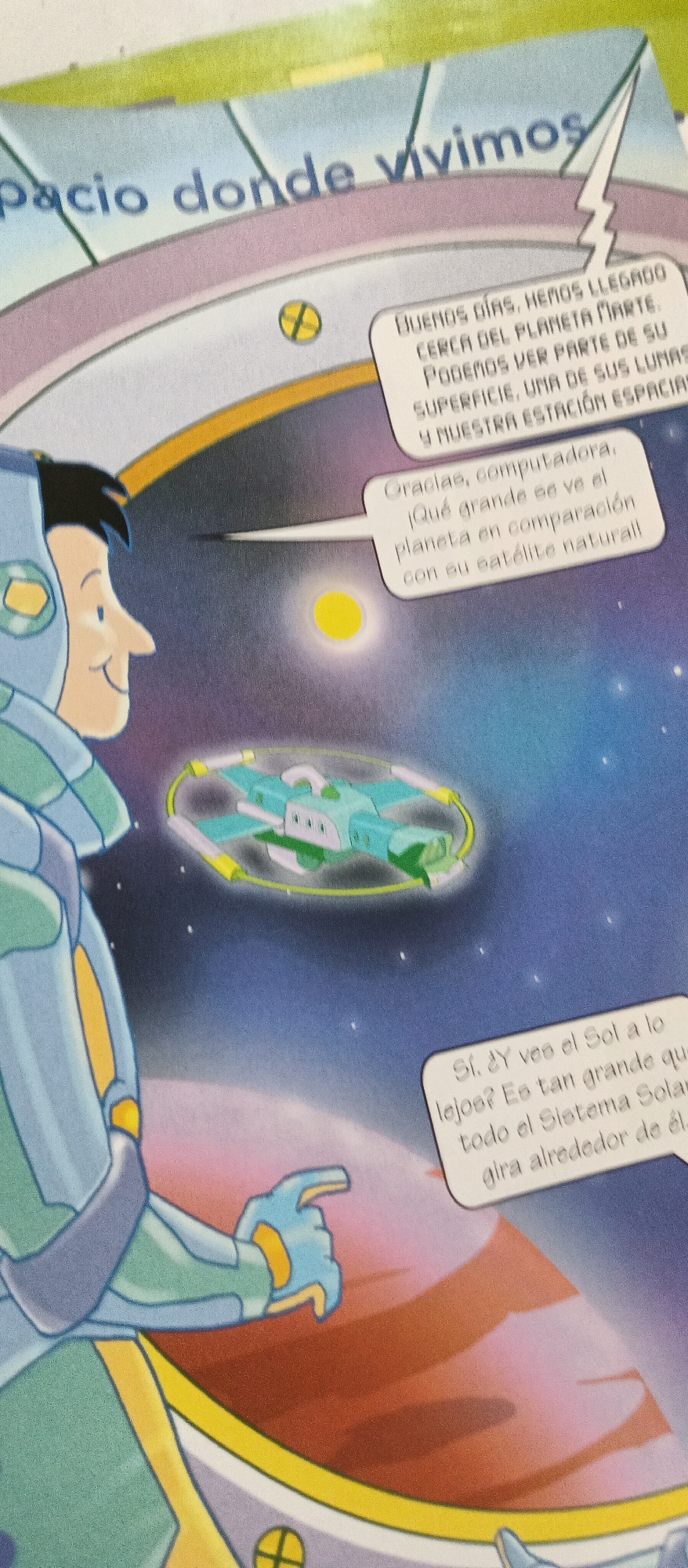
The image depicts an illustration from a children's book or comic, featuring an astronaut in a blue and green spacesuit looking at a celestial scene. The astronaut is on the left side of the frame, facing right, with a smiling expression. They are looking towards a small, light blue spacecraft with yellow accents that is suspended in space. In the background, there is a planet with a reddish-pink hue, a bright yellow sun, and a starry sky.

Two speech bubbles are visible. The first, from the top right, reads: "BUENOS DIAS, HEMOS LLEGADO CERCA DEL PLANETA MARTE. PODEMOS VER PARTE DE SU SUPERFICIE, UNA DE SUS LUNAS Y NUESTRA ESTACIÓN ESPACIAL." This translates to "GOOD MORNING, WE HAVE ARRIVED NEAR THE PLANET MARS. WE CAN SEE PART OF ITS SURFACE, ONE OF ITS MOONS AND OUR SPACE STATION."

The second speech bubble, originating from near the spacecraft, reads: "Gracias, computadora, ¡Qué grande se ve el planeta en comparación con su satélite natural!" This translates to "Thank you, computer, How big the planet looks in comparison to its natural satellite!"

A third speech bubble, located at the bottom right, contains the text: "SÍ, ¿Y VEE el Sol a lo lejos? Es tan grande que todo el Sistema Solar gira alrededor de él." This translates to "YES, AND DO YOU SEE the Sun in the distance? It is so big that the entire Solar System revolves around it."

The overall scene is set in outer space, with a focus on exploration and learning about planets and the solar system. The mood is one of wonder and discovery. The text suggests the characters are exploring Mars. The specific location context of La Tagua, Venezuela, is not visually evident in the illustration itself, but it is provided as external information.
Ramón

Jun 23, 2026, 1:16 PM

La Tagua, Venezuela

Stake attention in this memory

Curious
Wonder
Adventurous
Inspired
Peaceful

The image depicts an illustration from a children's book or comic, featuring an astronaut in a blue and green spacesuit looking at a celestial scene. The astronaut is on the left side of the frame, facing right, with a smiling expression. They are looking towards a small, light blue spacecraft with yellow accents that is suspended in space. In the background, there is a planet with a reddish-pink hue, a bright yellow sun, and a starry sky. Two speech bubbles are visible. The first, from the top right, reads: "BUENOS DIAS, HEMOS LLEGADO CERCA DEL PLANETA MARTE. PODEMOS VER PARTE DE SU SUPERFICIE, UNA DE SUS LUNAS Y NUESTRA ESTACIÓN ESPACIAL." This translates to "GOOD MORNING, WE HAVE ARRIVED NEAR THE PLANET MARS. WE CAN SEE PART OF ITS SURFACE, ONE OF ITS MOONS AND OUR SPACE STATION." The second speech bubble, originating from near the spacecraft, reads: "Gracias, computadora, ¡Qué grande se ve el planeta en comparación con su satélite natural!" This translates to "Thank you, computer, How big the planet looks in comparison to its natural satellite!" A third speech bubble, located at the bottom right, contains the text: "SÍ, ¿Y VEE el Sol a lo lejos? Es tan grande que todo el Sistema Solar gira alrededor de él." This translates to "YES, AND DO YOU SEE the Sun in the distance? It is so big that the entire Solar System revolves around it." The overall scene is set in outer space, with a focus on exploration and learning about planets and the solar system. The mood is one of wonder and discovery. The text suggests the characters are exploring Mars. The specific location context of La Tagua, Venezuela, is not visually evident in the illustration itself, but it is provided as external information.

Loading AttnAds…

transactions
revenues
stakers
Earliest
Latest
Highest stake

No transactions found

More from this user

More from La Tagua

Ramón

Jun 23, 2026, 1:16 PM

La Tagua, Venezuela

Licensed under Creative Commons Attribution 4.0 International License. You are free to share and adapt this content with proper attribution.