
Stake attention in this memory
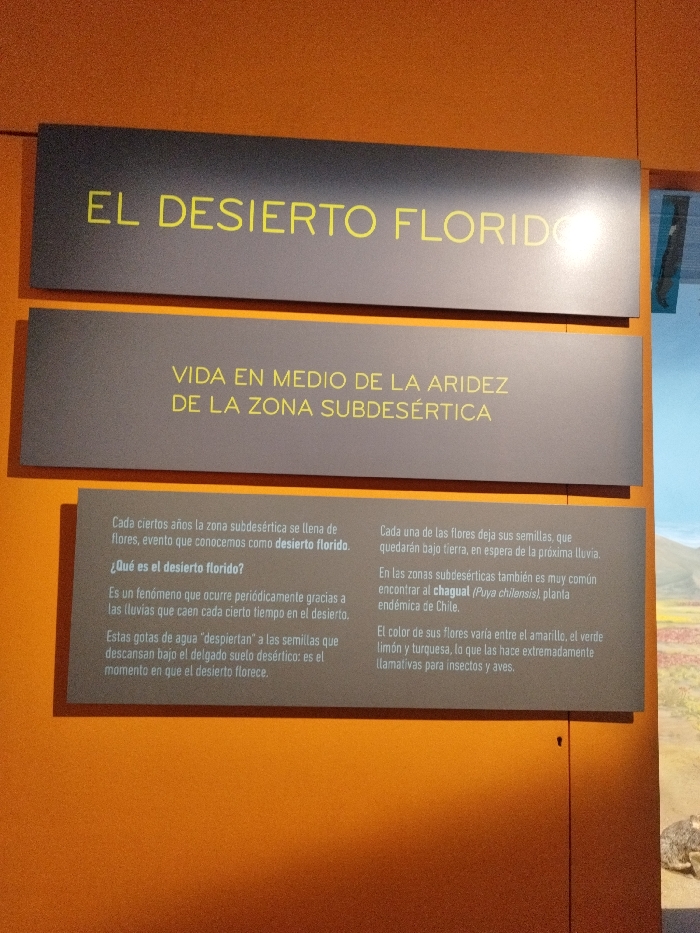
An informational exhibit display is prominently featured on an orange wall, likely within a museum or educational setting in Santiago, Chile. The display consists of three dark gray rectangular panels with text rendered in a light yellow color. The top panel bears the main title: "EL DESIERTO FLORIDO" (The Flowering Desert). The middle panel provides a subtitle: "VIDA EN MEDIO DE LA ARIDEZ DE LA ZONA SUBDESÉRTICA" (Life in the Midst of the Aridity of the Sub-desert Zone). The largest, bottom panel presents detailed information in two columns. The left column explains: "Cada ciertos años la zona subdesértica se llena de flores, evento que conocemos como desierto florido. ¿Qué es el desierto florido? Es un fenómeno que ocurre periódicamente gracias a las lluvias que caen cada cierto tiempo en el desierto. Estas gotas de agua "despiertan" a las semillas que descansan bajo el delgado suelo desértico: es el momento en que el desierto florece." (Every few years, the sub-desertic zone fills with flowers, an event we know as the flowering desert. What is the flowering desert? It is a phenomenon that occurs periodically thanks to the rains that fall at certain times in the desert. These drops of water "awaken" the seeds that rest beneath the thin desert soil: it is the moment when the desert blooms.) The right column of the bottom panel continues: "Cada una de las flores deja sus semillas, que quedarán bajo tierra, en espera de la próxima lluvia. En las zonas subdesérticas también es muy común encontrar al chagual (Puya chilensis), planta endémica de Chile. El color de sus flores varía entre el amarillo, el verde limón y turquesa, lo que las hace extremadamente llamativas para insectos y aves." (Each of the flowers leaves its seeds, which will remain underground, waiting for the next rain. In the sub-desertic zones, it is also very common to find the chagual (Puya chilensis), an endemic plant of Chile. The color of its flowers varies between yellow, lime green, and turquoise, making them extremely attractive to insects and birds.) A bright spot of light, possibly glare from an overhead light source, is visible on the upper right side of the top panel. The right edge of the bottom panel reveals a sliver of a background image, suggesting a diorama or scenic backdrop to the exhibit. The overall impression is an informative and engaging presentation about a unique natural phenomenon
No transactions found