Stake attention in this memory
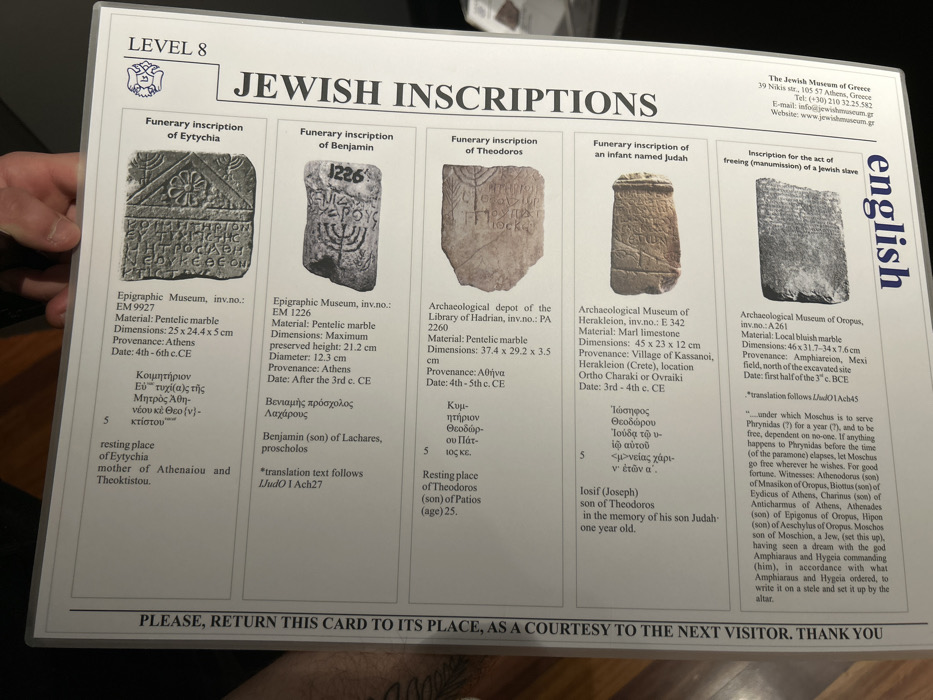
The image displays a laminated white educational card or information sheet held by a person's hands, with their fingers partially visible on the left side of the card. The card is titled "JEWISH INSCRIPTIONS" at the top center, with "LEVEL 8" and a stylized menorah logo in the top left corner. On the far right side, the word "english" is printed vertically, indicating the language of the content. At the top right of the card, contact information for "The Jewish Museum of Greece" is provided, including the address (39 Nikis str., 105 57 Athens, Greece), phone number ((+30) 210 32.25.582), email (info@jewishmuseum.gr), and website (www.jewishmuseum.gr). The main body of the card is divided into five vertical columns, each dedicated to a specific Jewish inscription. Each column features a black-and-white photograph of the inscription stone, followed by detailed information and an English translation. 1. **Funerary inscription of Eytychia:** * **Image:** A rectangular stone slab with a carved floral rosette motif within a triangular pediment at the top, and Greek text below it. * **Details:** Epigraphic Museum, inv.no.: EM 9927; Material: Pentelic marble; Dimensions: 25 x 24.4 x 5 cm; Provenance: Athens; Date: 4th-6th c. CE. * **Greek Text:** "Κοιμητήριον Εὐτυχί(α)ς τῆς Μητρός Ἀθη- νέου κέ Θεο(ν)- κτίστου". * **English Translation:** "resting place of Eytychia mother of Athenaiou and Theoktistou." 2. **Funerary inscription of Benjamin:** * **Image:** An irregularly shaped stone slab featuring carved Greek text and a menorah symbol at the bottom. The number "1226" is visible in the upper left corner of the stone. * **Details:** Epigraphic Museum, inv.no.: EM 1226; Material: Pentelic marble; Dimensions: Maximum preserved height: 21.2 cm, Diameter: 12.3 cm; Provenance: Athens; Date: After the 3rd c. CE. * **Greek Text:** "Βενιαμής πρόσχολος Λαχάρους". * **English Translation:** "Benjamin (son) of Lachares, proscholos". * **Note:** "*translation text follows IJudo I Ach27". 3. **Funerary inscription of Theodoros:** * **Image:** A rectangular stone slab with carved Greek text and a menorah symbol at the top. * **Details:** Archaeological depot of the Library of Hadrian, inv.no.: PA 2260; Material: Pentelic marble; Dimensions: 37.4 x 29.2 x 3.5 cm; Provenance: Αθήνα; Date: 4th-5th c. CE. * **Greek Text:** "Κυμητήριον Θεοδώρ-ου Πάτ-τος κει". * **English Translation:** "Resting place of Theodoros (son) of Patios (age) 25." 4. **Funerary inscription of an infant named Judah:** * **Image:** A small, rounded stone object, possibly a funerary urn, with carved text and a menorah symbol at the top. * **Details:** Archaeological Museum of Herakleion, inv.no.: E 342; Material: Marl limestone; Dimensions: 45 x 23 x 12 cm; Provenance: Village of Kassanoi, Herakleion (Crete), location Ortho Charaki or Ovraiki; Date: 3rd-4th c. CE. * **Greek Text:** "Ἰώσηφος Θεοδώρου Ἰούδα τῷ υἱῷ αὐτοῦ <μνείας χάρι-ν' ἐτῶν α΄." * **English Translation:** "Iosif (Joseph) son of Theodoros in the memory of his son Judah one year old." 5. **Inscription for the act of freeing (manumission) of a Jewish slave:** * **Image:** A rectangular stone slab densely covered with carved Greek text. * **Details:** Archaeological Museum of Oropus, inv.no.: A261; Material: Local bluish marble; Dimensions: 46 x 31.7-34 x 7.6 cm; Provenance: Amphiareion, Mexi field, north of the excavated site; Date: first half of the 3rd c. BCE. * **Note:** "*translation follows JudO1Ach45". * **English Translation:** "under which Moschus is to serve Phrynidas (?) for a year (?), and to be free, dependent on no-one. If anything happens to Phrynidas before the time (of the paramone) elapses, let Moschus go free wherever he wishes. For good fortune. Witnesses: Athenodorus (son) of Mnasikon of Oropus, Biottus (son) of Eydicus of Athens, Charinus (son) of Anticharmus of Athens, Athenades (son) of Epigonus of Oropus, Hipon (son) of Aeschylus of Oropus. Moschos son of Moschion, a Jew, (set this up), having seen a dream with the god Amphiaraus and Hygeia commanding (him), in accordance with what Amphiaraus and Hygeia ordered, to write it on a stele and set it up by the altar." At the bottom of the card, a message reads: "PLEASE, RETURN THIS CARD TO ITS PLACE, AS A COURTESY TO THE NEXT VISITOR. THANK YOU". The background behind the card is blurred and indistinct, suggesting an indoor setting.
Loading AttnAds…
No transactions found