Stake attention in this memory
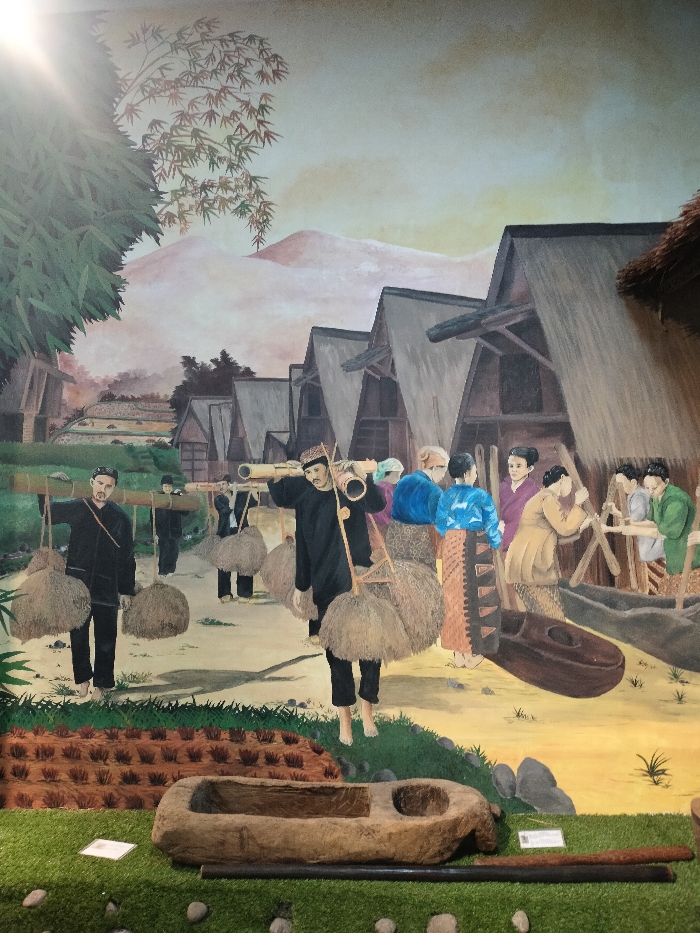
The image displays a museum-style diorama featuring a large mural depicting a traditional village scene, complemented by real artifacts in the foreground. The mural illustrates a vibrant rural community with a backdrop of soft-hued mountains and terraced agricultural fields. Traditional houses with steeply pitched roofs line a central pathway. On the left, lush bamboo foliage is visible. In the mural, several men, dressed in dark traditional attire, are actively engaged in transporting goods. They carry large, bundled loads, likely hay or straw, balanced on their shoulders with wooden poles, a method known as a "pikulan." Their bare feet suggest a close connection to the land. On the right side, a group of women, dressed in colorful traditional sarongs and tops, are gathered near a house. Some appear to be processing goods, possibly pounding rice or performing other domestic tasks, beside a dark, trough-like object on the ground. The lighting in the mural suggests either an early morning or late afternoon, casting warm, subtle tones across the sky. The overall impression is one of peaceful, industrious village life. In the foreground, on artificial green grass, real-life artifacts are displayed. A large, weathered stone trough, known as a "lesung" (traditional rice mortar), features two depressions. Beside it lies a long, dark wooden pestle, or "alu," used with the lesung for pounding grains. Small white informational placards are visible near these objects, though the text on them is unreadable. Small decorative stones are scattered on the artificial turf. This exhibit, located in Bogor, Indonesia, beautifully blends painted imagery with tangible objects to convey the essence of traditional village life and agricultural practices.
No transactions found