Sign in
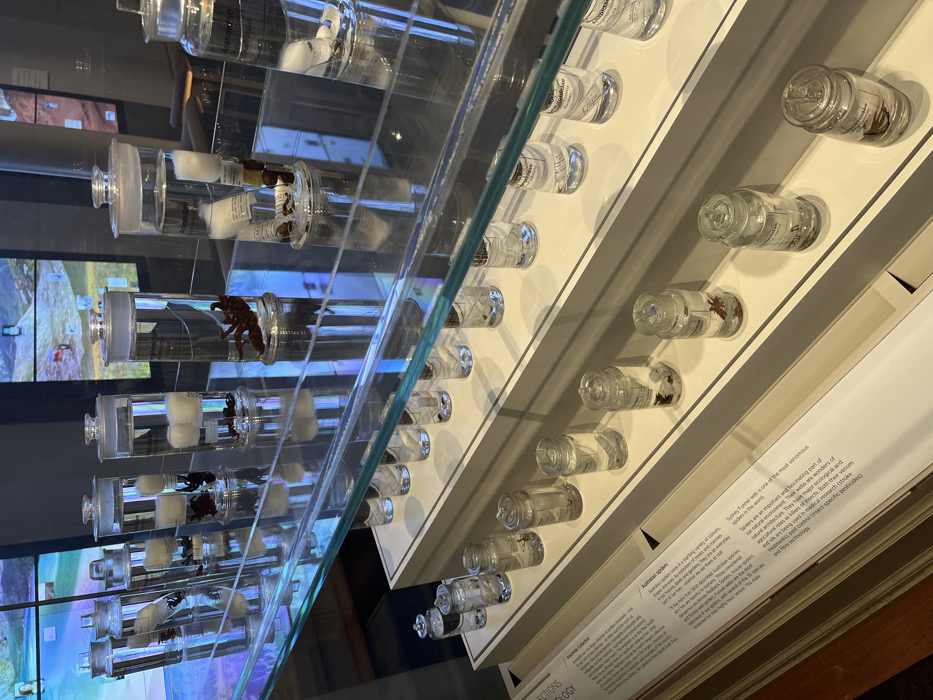
This image captures a scientific or educational display, likely within a museum or exhibition, showcasing preserved insect and arachnid specimens. The setting appears to be indoors with controlled lighting. The main subjects are numerous clear glass or plastic containers, arranged in two distinct rows.

On the left, several tall, cylindrical vials are stacked vertically, each containing one or more preserved creatures, such as a large, dark spider-like specimen (possibly a tarantula or large arachnid) and other smaller insects. Some of these vials also contain white cotton-like material. A clear glass barrier runs diagonally across the frame, separating these taller specimens from those on the right.

To the right, a white multi-tiered display shelf holds a long row of smaller, jar-like containers, each preserving various smaller insects or arachnids, many suspended in liquid. The overall arrangement suggests a systematic collection for study or public viewing. Reflections of screens displaying what appear to be nature scenes or educational content are visible on the glass surfaces in the background and within the display.

Visible text from the display panels confirms the context, including phrases like "ECTIONS LOGY" (likely part of "COLLECTIONS" and "ENTOMOLOGY" or "ARACHNOLOGY"), "Australian Collection," and specific mentions of "Australian spiders" and the "Sydney Funnel-web," describing it as "one of the most venomous spiders in the world." The text further elaborates on their "ecological and natural architects" role, their function as "killers of insects," and the use of their "venom and silk... in medical research (stroke therapy) and fibre technology," and "pesticides." The location context of Darlinghurst, Australia, aligns with the focus on Australian species.
FM-VfnHd2

Jan 9, 2025

Darlinghurst, Australia

Stake attention in this memory

This image captures a scientific or educational display, likely within a museum or exhibition, showcasing preserved insect and arachnid specimens. The setting appears to be indoors with controlled lighting. The main subjects are numerous clear glass or plastic containers, arranged in two distinct rows. On the left, several tall, cylindrical vials are stacked vertically, each containing one or more preserved creatures, such as a large, dark spider-like specimen (possibly a tarantula or large arachnid) and other smaller insects. Some of these vials also contain white cotton-like material. A clear glass barrier runs diagonally across the frame, separating these taller specimens from those on the right. To the right, a white multi-tiered display shelf holds a long row of smaller, jar-like containers, each preserving various smaller insects or arachnids, many suspended in liquid. The overall arrangement suggests a systematic collection for study or public viewing. Reflections of screens displaying what appear to be nature scenes or educational content are visible on the glass surfaces in the background and within the display. Visible text from the display panels confirms the context, including phrases like "ECTIONS LOGY" (likely part of "COLLECTIONS" and "ENTOMOLOGY" or "ARACHNOLOGY"), "Australian Collection," and specific mentions of "Australian spiders" and the "Sydney Funnel-web," describing it as "one of the most venomous spiders in the world." The text further elaborates on their "ecological and natural architects" role, their function as "killers of insects," and the use of their "venom and silk... in medical research (stroke therapy) and fibre technology," and "pesticides." The location context of Darlinghurst, Australia, aligns with the focus on Australian species.

transactions
revenues
stakers
Earliest
Latest
Highest stake

No transactions found

More from this user

More from Darlinghurst

FM-VfnHd2

Jan 9, 2025

Darlinghurst, Australia

Licensed under Creative Commons Attribution 4.0 International License. You are free to share and adapt this content with proper attribution.