
Sign in
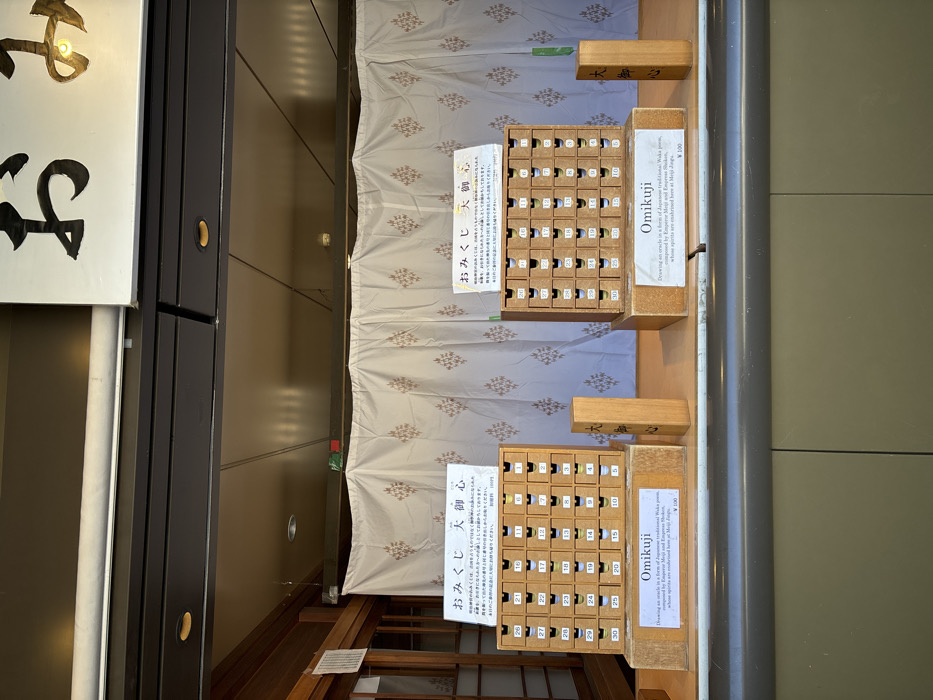
This image captures a display of Omikuji, traditional Japanese fortune-telling slips, likely at the entrance of a shrine or commercial establishment in Shibuya, Japan.

The scene features two prominent wooden dispensers, each containing small numbered drawers. These are clearly labeled "Omikuji" in both Japanese ("おみくじ 大御心" - Omikuji Oomikokoro, meaning "Divine Will" or "Emperor's Heart/Mind") and English. Each dispenser holds numerous individual compartments, numbered from approximately 1 to 30, from which visitors can draw their fortune. A small wooden stand next to each dispenser also has Japanese text.

An English explanation card, partially visible, states: "Omikuji: Drawing an oracle in a form of Japanese traditional Waka poem, composed by Emperor Meiji and Empress Shoken, whose spirits are enshrined here at Meiji Jingu." This suggests the Omikuji are specifically linked to the Meiji Jingu shrine. The price for an Omikuji is clearly displayed as "¥100".

Behind the Omikuji display hangs a light-colored curtain adorned with a repetitive, subtle pattern, likely a traditional Japanese motif. The surrounding area appears to be an interior or covered walkway, with wooden elements forming part of the structure, including what might be steps or flooring visible at the bottom. To the far left, a large sign with bold Japanese calligraphy, where "おみ" is visible, hints at the establishment's name or purpose. The lighting suggests an indoor setting or a sheltered outdoor area. No people are visible in the frame, giving a sense of quiet readiness for visitors.
FM-Zb6dS2

Feb 25, 2025

Shibuya, Japan

Stake attention in this memory

This image captures a display of Omikuji, traditional Japanese fortune-telling slips, likely at the entrance of a shrine or commercial establishment in Shibuya, Japan. The scene features two prominent wooden dispensers, each containing small numbered drawers. These are clearly labeled "Omikuji" in both Japanese ("おみくじ 大御心" - Omikuji Oomikokoro, meaning "Divine Will" or "Emperor's Heart/Mind") and English. Each dispenser holds numerous individual compartments, numbered from approximately 1 to 30, from which visitors can draw their fortune. A small wooden stand next to each dispenser also has Japanese text. An English explanation card, partially visible, states: "Omikuji: Drawing an oracle in a form of Japanese traditional Waka poem, composed by Emperor Meiji and Empress Shoken, whose spirits are enshrined here at Meiji Jingu." This suggests the Omikuji are specifically linked to the Meiji Jingu shrine. The price for an Omikuji is clearly displayed as "¥100". Behind the Omikuji display hangs a light-colored curtain adorned with a repetitive, subtle pattern, likely a traditional Japanese motif. The surrounding area appears to be an interior or covered walkway, with wooden elements forming part of the structure, including what might be steps or flooring visible at the bottom. To the far left, a large sign with bold Japanese calligraphy, where "おみ" is visible, hints at the establishment's name or purpose. The lighting suggests an indoor setting or a sheltered outdoor area. No people are visible in the frame, giving a sense of quiet readiness for visitors.

transactions
revenues
stakers
Earliest
Latest
Highest stake

No transactions found

More from this user

More from Shibuya

FM-Zb6dS2

Feb 25, 2025

Shibuya, Japan

Licensed under Creative Commons Attribution 4.0 International License. You are free to share and adapt this content with proper attribution.