
Stake attention in this memory
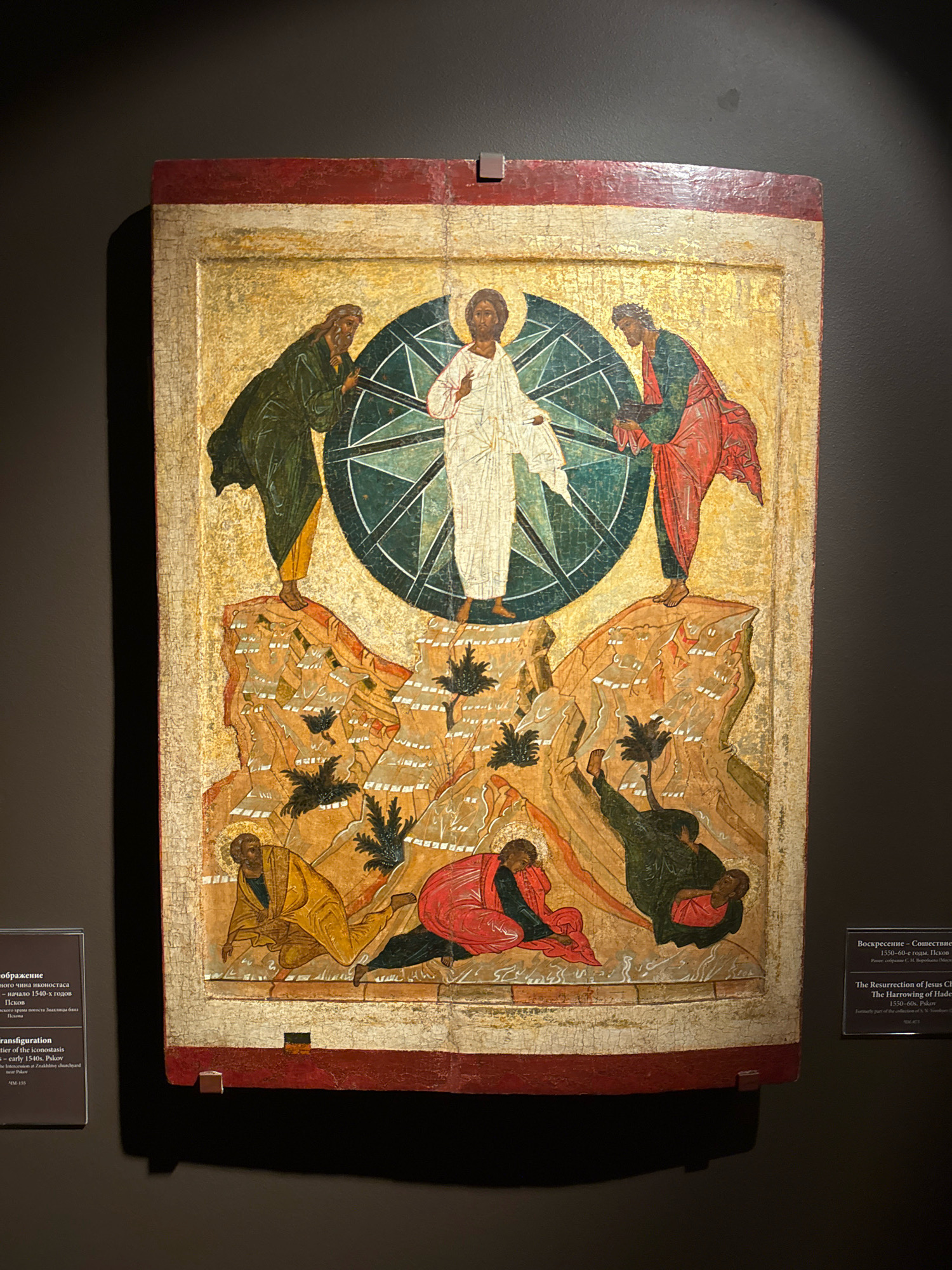
This is a photograph of an Eastern Orthodox icon, displayed on a dark gray wall, likely in a museum. The icon depicts a religious scene with figures and symbolic elements. In the center of the icon, a radiant figure in white robes stands within a circular, segmented halo or mandorla, which is colored in shades of dark green and teal with white radiating lines. This central figure is likely Jesus Christ. To the left and right of this central figure are two other figures, also standing and facing inward. The figure on the left wears a dark green robe and a brown garment underneath, with long hair and a beard. The figure on the right wears a red robe and a green garment underneath, with dark hair. These two figures appear to be looking at or interacting with the central figure. Below these figures, the landscape is rendered as rocky, barren terrain with hints of white and brown. There are dark, stylized plant forms scattered across this rocky area. At the bottom of the icon, three figures are depicted in various states of repose or distress, seemingly emerging from or lying on the ground. One figure in a yellow robe kneels. Another figure in a red robe is partially prostrate. A third figure in a dark green robe is lying on its back, with one leg extended. The overall color palette is earthy, with prominent use of gold, ochre, red, and green. The icon itself is framed by a reddish border and exhibits signs of age, with cracking visible on its surface. Two informational plaques are visible to the left and right of the icon. The plaque on the left is partially obscured, but it appears to provide information about the artwork, possibly including its title and origin. The plaque on the right, in both Russian and English, identifies the artwork as "Воскресение – Сошествие" (Resurrection – Descent) and "The Resurrection of Jesus Christ – The Harrowing of Hades." It is dated 1550-60s and attributed to Pskov, and notes it was formerly part of the collection of S. N. Vtorov and is from the Znamensky Churchyard near Pskov. This plaque places the artwork within a historical and geographical context, suggesting its origin in Pskov, Russia. Although not explicitly stated, the display setting suggests the icon is likely located in Moscow, Russia, a common location for such museum collections.
Loading AttnAds…
No transactions found