
Stake attention in this memory
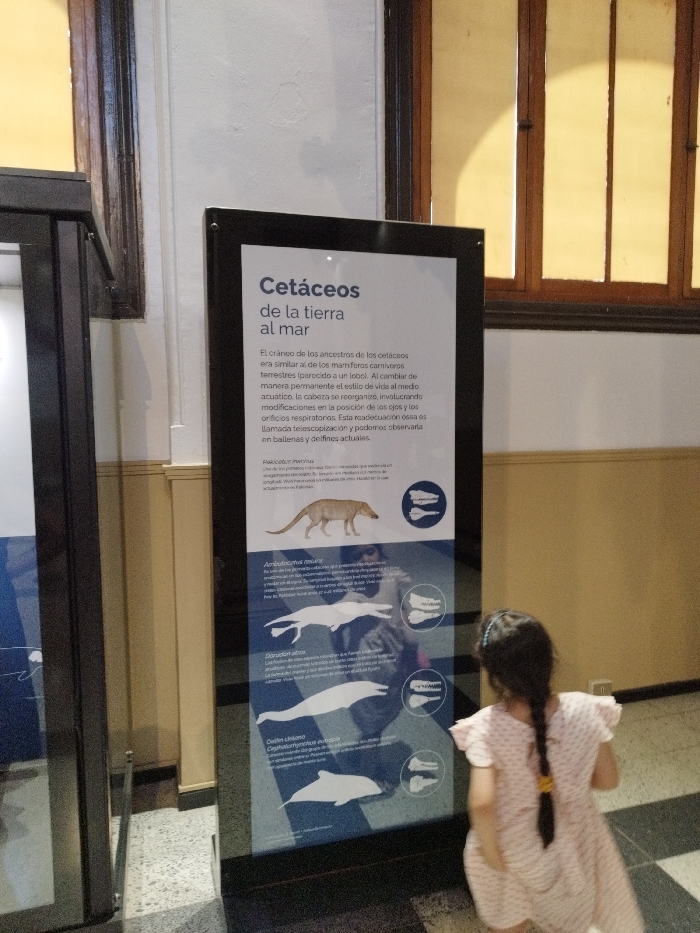
This image captures a moment inside what appears to be a natural history museum or exhibition hall in Santiago, Chile. The primary subject is a tall, illuminated display board detailing the evolution of cetaceans, titled "Cetáceos de la tierra al mar" (Cetaceans from land to sea). A young girl, seen from behind, with her hair in a braid and wearing a light-colored, patterned dress, stands in front of the display, seemingly engrossed in its content. The exhibit provides information in Spanish about the evolutionary transition of cetacean ancestors from land to sea. The text explains that the skull of early cetacean ancestors was similar to terrestrial carnivorous mammals (like a wolf). As they adapted to an aquatic lifestyle, their heads reorganized, involving modifications to the position of the eyes and respiratory orifices, a process called "telescopización" (telescoping) visible in modern whales and dolphins. Below the main text, a series of illustrations depict the progression of different species with their corresponding skull structures: 1. A land-dwelling mammal, *Pakicetus inachus*. 2. An amphibious ancestor, *Ambulocetus natans*. 3. An early fully aquatic whale, *Dorudon atrox*. 4. A modern dolphin, identified as *Odón chileno / Cephalorhynchus eutropia*. The background features light-colored walls, a dark wooden window frame with yellow-tinted glass suggesting daylight, and a polished floor. The scene has a quiet, educational atmosphere.
No transactions found