
Sign in
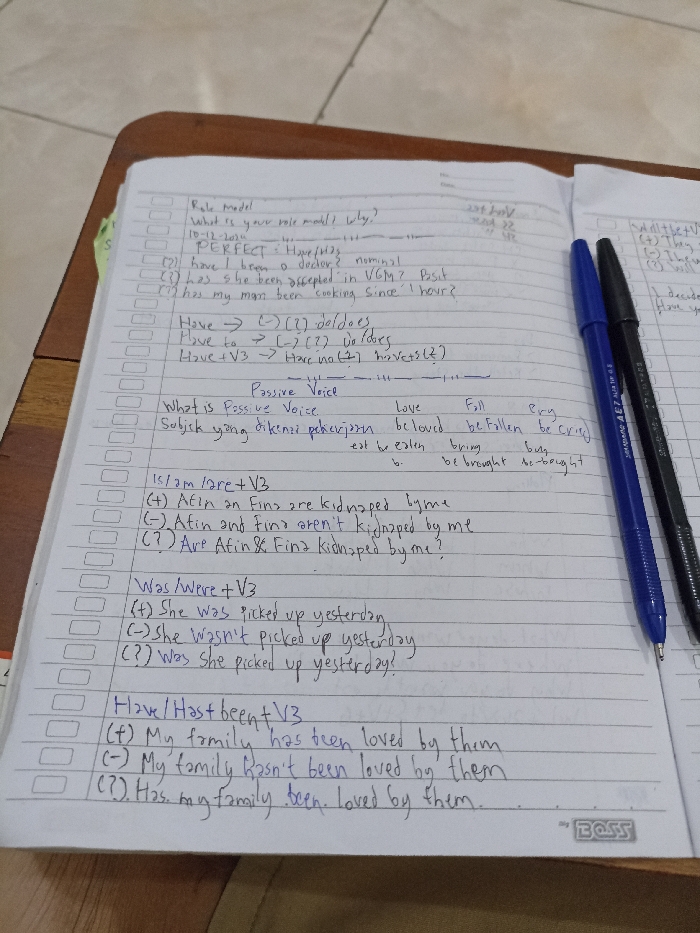
An open, lined notebook with handwritten notes on English grammar lies on a wooden surface. Two pens, one blue and one black, rest on the right page of the notebook. The notes cover various grammatical topics, primarily focusing on the Passive Voice and the Present Perfect tense, alongside a section on "Role Model."

The visible text includes definitions, grammatical structures, and example sentences. The "Passive Voice" section defines "Subjek yang dikenai pekerjaan" (Subject that receives the action) in Indonesian and lists active verbs like "love," "fall," "cry," "eat," "bring," and "buy" with their corresponding passive forms: "be loved," "be fallen," "be cried," "be eaten," "be brought," and "be bought."

Examples for different tenses in the passive voice are provided:
- **Present Simple Passive (Is/am/are + V3):** "(+) Afin and Fina are kidnaped by me," "(-) Afin and Fina aren't kidnaped by me," "(?) Are Afin & Fina kidnaped by me?"
- **Past Simple Passive (Was/Were + V3):** "(+) She was picked up yesterday," "(-) She wasn't picked up yesterday," "(?) Was She picked up yesterday?"
- **Present Perfect Passive (Have/Has + been + V3):** "(+) My family has been loved by them," "(-) My family hasn't been loved by them," "(?) Has my family been. loved by them."

Other notes include "PERFECT = Have / Has" and examples of interrogative sentences with "have" and "has." Small checkboxes appear next to each line of text, some of which are marked. The brand "BOSS" is visible at the bottom right corner of the notebook. The scene suggests a study or learning environment, possibly in Kecamatan Pare, Indonesia.
FM-DWNFF3

Dec 11, 2024, 4:15 AM

Kecamatan Pare, Indonesia

Stake attention in this memory

An open, lined notebook with handwritten notes on English grammar lies on a wooden surface. Two pens, one blue and one black, rest on the right page of the notebook. The notes cover various grammatical topics, primarily focusing on the Passive Voice and the Present Perfect tense, alongside a section on "Role Model." The visible text includes definitions, grammatical structures, and example sentences. The "Passive Voice" section defines "Subjek yang dikenai pekerjaan" (Subject that receives the action) in Indonesian and lists active verbs like "love," "fall," "cry," "eat," "bring," and "buy" with their corresponding passive forms: "be loved," "be fallen," "be cried," "be eaten," "be brought," and "be bought." Examples for different tenses in the passive voice are provided: - **Present Simple Passive (Is/am/are + V3):** "(+) Afin and Fina are kidnaped by me," "(-) Afin and Fina aren't kidnaped by me," "(?) Are Afin & Fina kidnaped by me?" - **Past Simple Passive (Was/Were + V3):** "(+) She was picked up yesterday," "(-) She wasn't picked up yesterday," "(?) Was She picked up yesterday?" - **Present Perfect Passive (Have/Has + been + V3):** "(+) My family has been loved by them," "(-) My family hasn't been loved by them," "(?) Has my family been. loved by them." Other notes include "PERFECT = Have / Has" and examples of interrogative sentences with "have" and "has." Small checkboxes appear next to each line of text, some of which are marked. The brand "BOSS" is visible at the bottom right corner of the notebook. The scene suggests a study or learning environment, possibly in Kecamatan Pare, Indonesia.

Loading AttnAds…

transactions
revenues
stakers
Earliest
Latest
Highest stake

No transactions found

More from this user

More from Kecamatan Pare

FM-DWNFF3

Dec 11, 2024, 4:15 AM

Kecamatan Pare, Indonesia

Licensed under Creative Commons Attribution 4.0 International License. You are free to share and adapt this content with proper attribution.