
Sign in
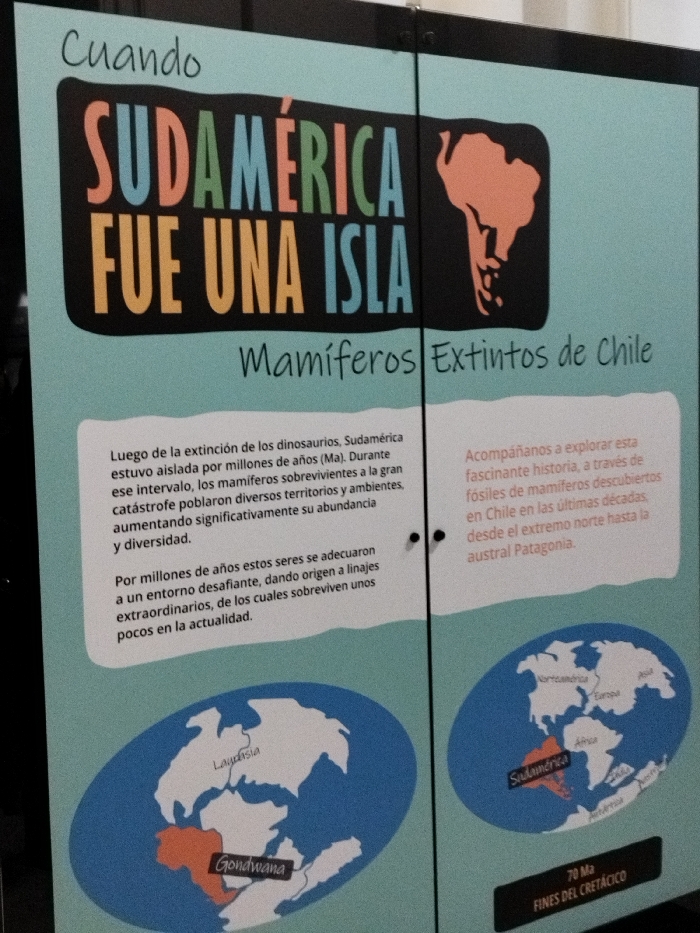
An indoor, light-blue informational display, likely in a museum in Santiago, Chile, features a theme titled "Cuando SUDAMÉRICA FUE UNA ISLA" (When SOUTH AMERICA WAS AN ISLAND) in large, colorful letters. A subtitle reads "Mamíferos Extintos de Chile" (Extinct Mammals of Chile).

The display is divided into sections with text and graphics. To the right of the main title, an orange silhouette of South America is depicted on a dark background.

Two main text blocks explain the exhibit's content:
The left text block details that after the extinction of dinosaurs, South America was isolated for millions of years (Ma). During this period, surviving mammals populated diverse territories and environments, significantly increasing their abundance and diversity. It also mentions that these creatures adapted to a challenging environment, giving rise to extraordinary lineages, few of which survive today.

The right text block invites visitors to explore this fascinating history through mammal fossils discovered in Chile over recent decades, from the northernmost extreme to Australian Patagonia.

At the bottom, two circular graphics illustrate ancient continental configurations. The left graphic shows a landmass labeled "Gondwana" in orange, alongside "Laurasia." The right graphic depicts a more fragmented world at "70 Ma FINES DEL CRETÁCICO" (70 Ma END OF CRETACEOUS), with "Sudamérica" (South America) visible as an orange landmass alongside other continents like North America, Europe, Asia, and Africa. The display itself appears to be made of two panels, possibly doors or hinged sections, with a vertical seam down the middle.
Mrv

Jan 7, 2025

Santiago, Chile

Stake attention in this memory

An indoor, light-blue informational display, likely in a museum in Santiago, Chile, features a theme titled "Cuando SUDAMÉRICA FUE UNA ISLA" (When SOUTH AMERICA WAS AN ISLAND) in large, colorful letters. A subtitle reads "Mamíferos Extintos de Chile" (Extinct Mammals of Chile). The display is divided into sections with text and graphics. To the right of the main title, an orange silhouette of South America is depicted on a dark background. Two main text blocks explain the exhibit's content: The left text block details that after the extinction of dinosaurs, South America was isolated for millions of years (Ma). During this period, surviving mammals populated diverse territories and environments, significantly increasing their abundance and diversity. It also mentions that these creatures adapted to a challenging environment, giving rise to extraordinary lineages, few of which survive today. The right text block invites visitors to explore this fascinating history through mammal fossils discovered in Chile over recent decades, from the northernmost extreme to Australian Patagonia. At the bottom, two circular graphics illustrate ancient continental configurations. The left graphic shows a landmass labeled "Gondwana" in orange, alongside "Laurasia." The right graphic depicts a more fragmented world at "70 Ma FINES DEL CRETÁCICO" (70 Ma END OF CRETACEOUS), with "Sudamérica" (South America) visible as an orange landmass alongside other continents like North America, Europe, Asia, and Africa. The display itself appears to be made of two panels, possibly doors or hinged sections, with a vertical seam down the middle.

transactions
revenues
stakers
Earliest
Latest
Highest stake

No transactions found

More from this user

More from Santiago

Mrv

Jan 7, 2025

Santiago, Chile

Licensed under Creative Commons Attribution 4.0 International License. You are free to share and adapt this content with proper attribution.