Sign in
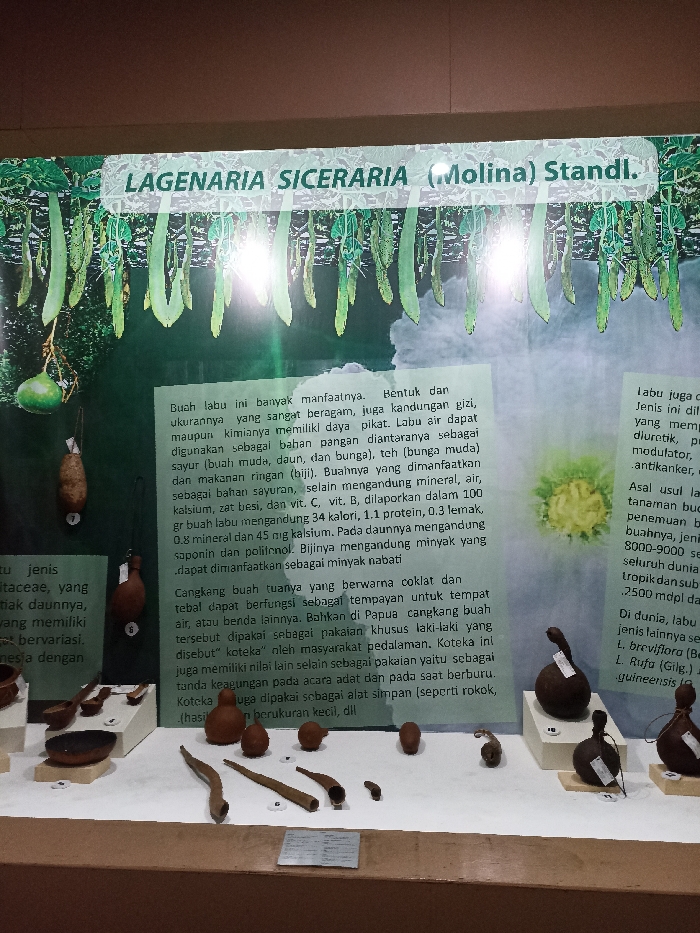
The image shows a museum display about the *Lagenaria siceraria* (Molina) Standl. plant, also known as the Calabash gourd, located in the city of Bogor, Indonesia, at the coordinates provided (latitude: -6.598, longitude: 106.794).  The display is made up of a large, blue poster mounted to a wall and framed with a dark wood trim. The poster displays a large photograph of Calabash gourd vines, and text explaining the uses of the plant, written in Indonesian. Below the poster, there are several gourds, including mature gourds in various sizes and shapes, dried gourd halves, and gourd shells. Some of the gourds are on display in glass cases, while others rest directly on the surface of the display. Some gourd sections are placed on wooden stands. Additionally, there are two small wooden spoons, one larger wooden spoon, and four dry, light-brown branches that may be the stems of gourd vines.  The gourds are variously painted and decorated, suggesting that the plant was used for ritual or cultural purposes. The museum display shows that the Calabash gourd was a culturally significant plant for the people of Indonesia.
FM-DWNFF3

Apr 9, 2025, 4:15 AM

Bogor, Indonesia

Stake attention in this memory

informative
educational
botanical
natural
interesting

The image shows a museum display about the *Lagenaria siceraria* (Molina) Standl. plant, also known as the Calabash gourd, located in the city of Bogor, Indonesia, at the coordinates provided (latitude: -6.598, longitude: 106.794). The display is made up of a large, blue poster mounted to a wall and framed with a dark wood trim. The poster displays a large photograph of Calabash gourd vines, and text explaining the uses of the plant, written in Indonesian. Below the poster, there are several gourds, including mature gourds in various sizes and shapes, dried gourd halves, and gourd shells. Some of the gourds are on display in glass cases, while others rest directly on the surface of the display. Some gourd sections are placed on wooden stands. Additionally, there are two small wooden spoons, one larger wooden spoon, and four dry, light-brown branches that may be the stems of gourd vines. The gourds are variously painted and decorated, suggesting that the plant was used for ritual or cultural purposes. The museum display shows that the Calabash gourd was a culturally significant plant for the people of Indonesia.

Loading AttnAds…

transactions
revenues
stakers
Earliest
Latest
Highest stake

No transactions found

More from this user

More from Bogor

FM-DWNFF3

Apr 9, 2025, 4:15 AM

Bogor, Indonesia

Licensed under Creative Commons Attribution 4.0 International License. You are free to share and adapt this content with proper attribution.