
Stake attention in this memory
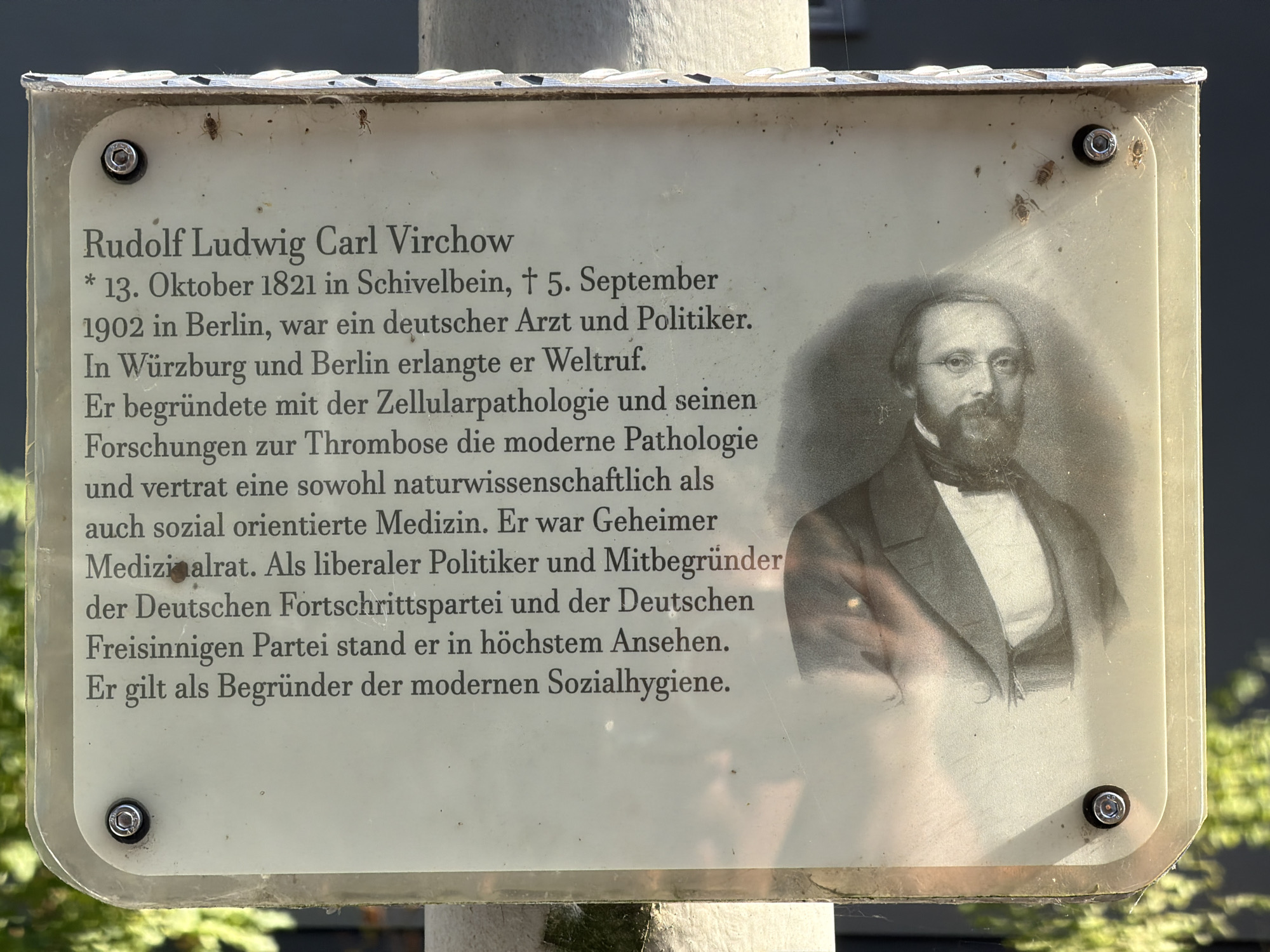
The image shows a memorial plaque mounted on a white pole. The plaque has a translucent surface and is secured with screws. In the upper left portion of the plaque, there is text in German, detailing the life of Rudolf Ludwig Carl Virchow. The text states that he was born on October 13, 1821, in Schivelbein and died on September 5, 1902, in Berlin. It identifies him as a German doctor and politician who gained worldwide recognition in Würzburg and Berlin. The plaque further elaborates that he founded cellular pathology and conducted research on thrombosis, thus shaping modern pathology and advocating for socially oriented medicine. He was also a privy councilor, a liberal politician, and a co-founder of the German Progressive Party, holding a high position in the Free-thinking Party. He is considered the founder of modern social hygiene. To the right of the text, there is a black and white portrait of a man with a beard and glasses, dressed in formal attire, believed to be Rudolf Ludwig Carl Virchow. The plaque is slightly dirty, with some small insects and cobwebs visible on its surface. The background of the image is blurred, with hints of greenery suggesting an outdoor location. The plaque is located outdoors, possibly in a park or public space, as indicated by the presence of trees and foliage. The pole the plaque is mounted on is white and cylindrical. The overall scene is a still, informative display commemorating a historical figure.
Loading AttnAds…
No transactions found