
Stake attention in this memory
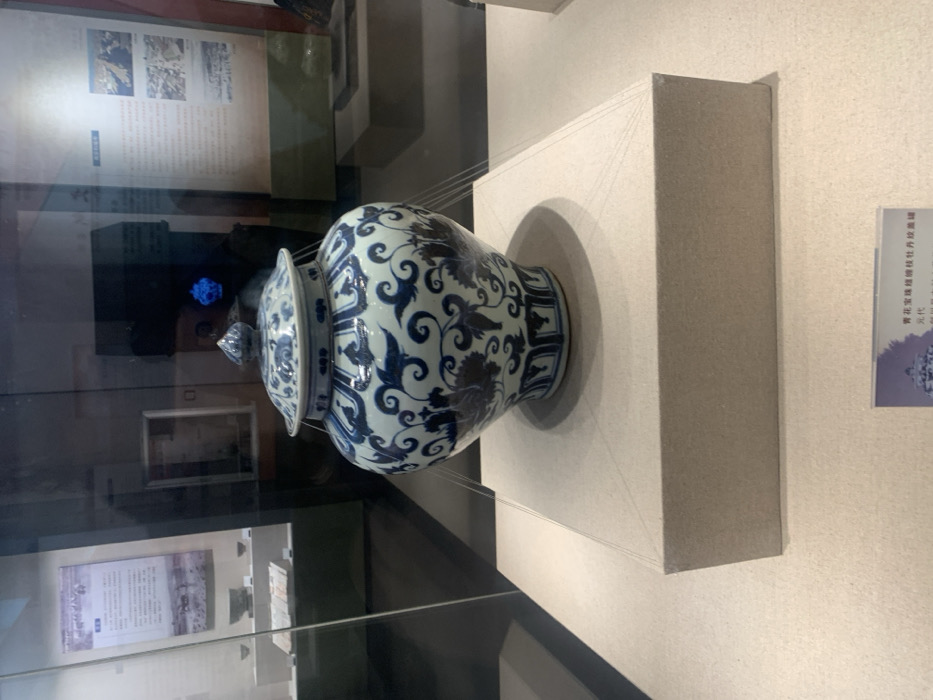
The image displays a blue and white porcelain jar with a lid, presented within a museum or exhibition setting. The image itself is rotated 90 degrees clockwise, showing the scene in a vertical orientation where the original horizontal plane of the display is vertical. The central object is a medium-sized, lidded jar, characterized by its traditional blue and white underglaze decoration. The body of the jar is bulbous, tapering towards a slightly flared foot and a short, narrow neck where the lid rests. The lid is domed with a small, knob-like finial. The predominant decorative motif consists of intricate, flowing blue floral and leafy scrolls, possibly depicting peonies and other plant forms, against a pristine white porcelain background. Bands of geometric or stylized patterns are also visible on the neck and foot of the jar. The jar appears to be in excellent condition, with a glossy finish. The jar is displayed on a light-colored, rectangular pedestal or plinth, which casts a subtle shadow beneath the object. Several thin, transparent wires or strings are visible, extending from different points on the jar down to the display surface of the pedestal, creating a web-like structure. These might be used to stabilize the artifact or to give the illusion that it is suspended or floating. The entire display is enclosed behind a reflective glass case. Reflections on this glass are prominent, showing parts of the surrounding museum environment. On the left side of the image (relative to the rotated view), a large informational panel with text and smaller images is reflected, appearing somewhat blurred and partially obscured. Further into the reflection, there's a dark, rectangular area, possibly another display case or a dark wall, with a distinct, bright blue spot of light reflecting on it. To the right of the jar, a vertical informational placard provides details about the artifact. The text is in Chinese characters. The most prominent lines of text visible are: - **青花宝塔纹梅枝牡丹盖罐** (Qīnghuā bǎotǎ wén méizhī mǔdān gàiguàn) - translating to "Blue and white pagoda pattern plum blossom peony covered jar." - Below this, **元代** (Yuán dài) - indicating the "Yuan Dynasty" as its period of origin. - Further down, **高** (Gāo) - meaning "Height," likely followed by its measurement, though the numbers are not clearly legible. - Another discernible phrase is **景德镇窑** (Jǐngdézhèn yáo) - which refers to the "Jingdezhen kiln," a famous site for porcelain production. The overall impression is that of a valuable historical artifact professionally showcased in a museum, designed to highlight its artistic and historical significance.
Loading AttnAds…
No transactions found