
Sign in
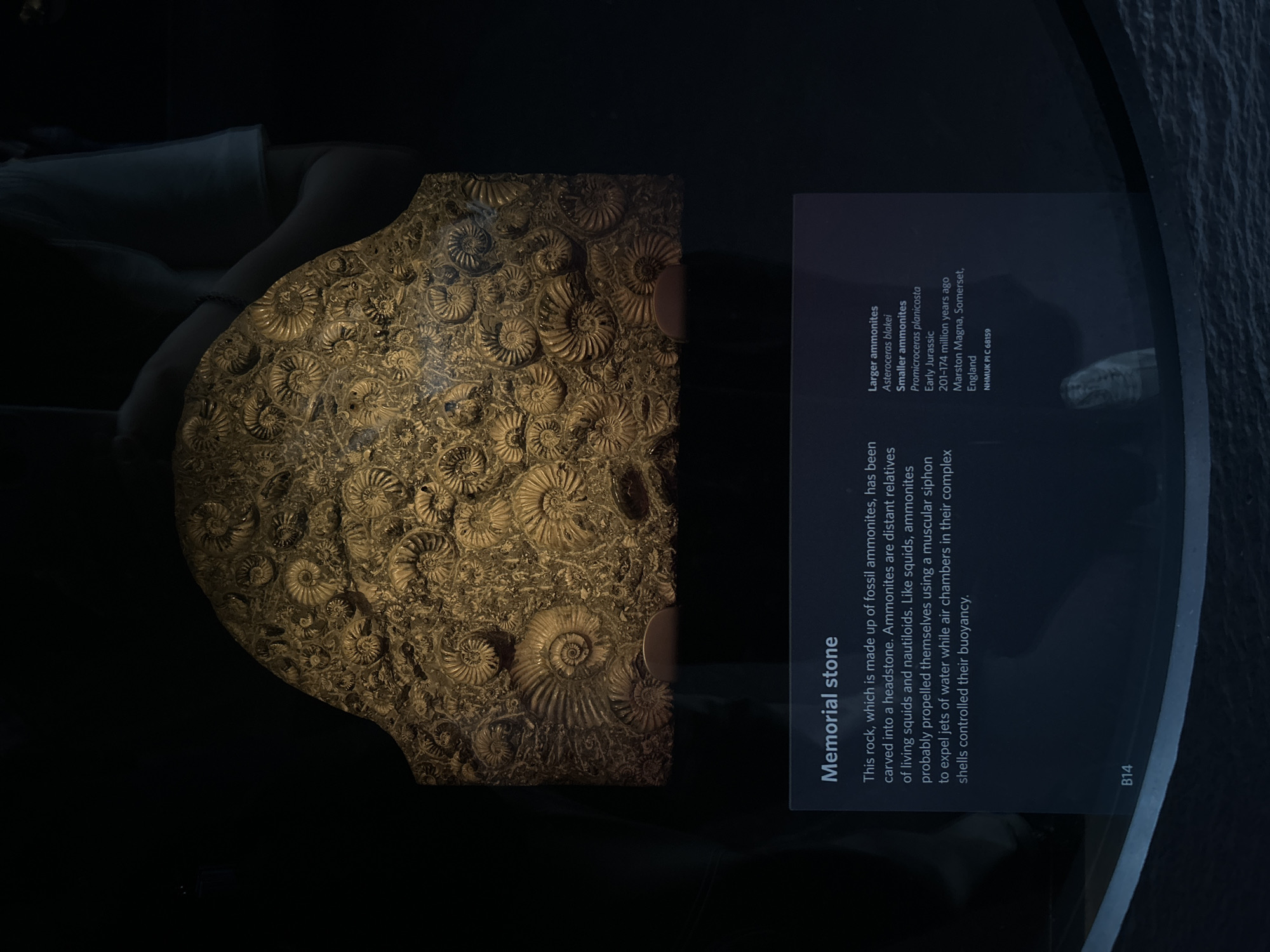
The image shows a memorial stone fossil display at the Natural History Museum, London, United Kingdom. The memorial stone is a large, curved piece of rock heavily encrusted with numerous fossilized ammonites of varying sizes. The ammonites are intricately preserved, displaying their coiled shell structures. The stone is lit from above, highlighting the textured surface and the detailed fossils. Below the stone, a dark display case contains text providing information about the memorial stone, including its composition, the nature of ammonites, their propulsion and buoyancy control, and their geological age and origin. The text on the display case reads: "Memorial stone This rock, which is made up of fossil ammonites, has been carved into a headstone. Ammonites are distant relatives of living squids and nautiloids. Like squids, ammonites probably propelled themselves using a muscular siphon to expel jets of water while air chambers in their complex shells controlled their buoyancy. Larger ammonites Asteroceras blakei Smaller ammonites Promicroceras planicosta Early Jurassic 201-174 million years ago Marston Magna, Somerset, England NHMUK PI C 68159". The background is dark, suggesting a museum setting.
Sardina

Jul 19, 2026, 3:09 PM

London, UK

Stake attention in this memory

ancient
mysterious
awe-inspiring
historical
melancholy

The image shows a memorial stone fossil display at the Natural History Museum, London, United Kingdom. The memorial stone is a large, curved piece of rock heavily encrusted with numerous fossilized ammonites of varying sizes. The ammonites are intricately preserved, displaying their coiled shell structures. The stone is lit from above, highlighting the textured surface and the detailed fossils. Below the stone, a dark display case contains text providing information about the memorial stone, including its composition, the nature of ammonites, their propulsion and buoyancy control, and their geological age and origin. The text on the display case reads: "Memorial stone This rock, which is made up of fossil ammonites, has been carved into a headstone. Ammonites are distant relatives of living squids and nautiloids. Like squids, ammonites probably propelled themselves using a muscular siphon to expel jets of water while air chambers in their complex shells controlled their buoyancy. Larger ammonites Asteroceras blakei Smaller ammonites Promicroceras planicosta Early Jurassic 201-174 million years ago Marston Magna, Somerset, England NHMUK PI C 68159". The background is dark, suggesting a museum setting.

Loading AttnAds…

transactions
revenues
stakers
Earliest
Latest
Highest stake

No transactions found

More from this user

More from London

Sardina

Jul 19, 2026, 3:09 PM

London, UK

Licensed under Creative Commons Attribution 4.0 International License. You are free to share and adapt this content with proper attribution.