
Sign in
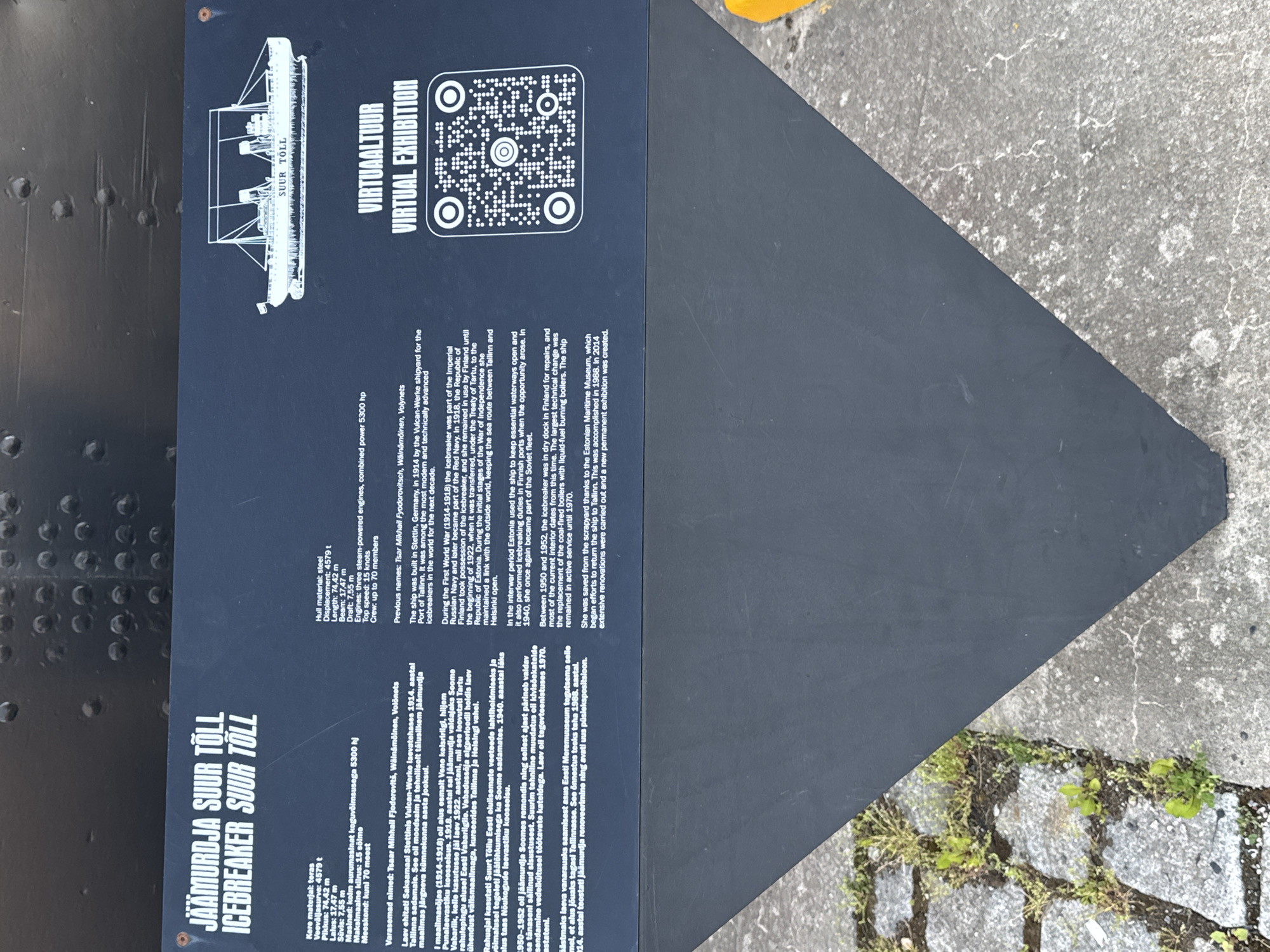
A black informational display board, positioned outdoors, details the icebreaker "Suur Tõll" in Estonian and English. The English title reads "ICEBREAKER SUUR TÕLL" above a white outline drawing of the ship. Text on the board provides ship specifications, including "Hull material: steel," "Displacement: 4579 t," "Length: 74.42 m," "Beam: 17.47 m," "Draft: 7.55 m," "Engines: three steam-powered engines, combined power 5300 hp," "Top speed: 15 knots," and "Crew: up to 70 members." Historical information notes previous names ("Tsar Mihhail Fjodorovitsch, W länämöinen, Volynets") and key events: built in Stettin, Germany, in 1914; part of the Imperial Russian Navy; transferred to Finland in 1918; became part of Estonia in 1922; used by the Soviet fleet from 1940; dry-docked for repairs in Finland between 1950-1952; brought to the Estonian Maritime Museum in Tallinn, Estonia, in 1988; renovated in 2014, with a new permanent exhibition created. A QR code labeled "VIRTUAL EXHIBITION" is present on the lower right of the board. The base of the display board diagonally meets the ground, which consists of grey cobblestones with green weeds on the left and grey concrete on the right. The background is a blurred, dark, textured surface, possibly a ship's hull or structure.
Andrii😆👌🏼

Jun 7, 2026

Tallinn, Estonia

Stake attention in this memory

historical
informative
maritime
vintage
educational

A black informational display board, positioned outdoors, details the icebreaker "Suur Tõll" in Estonian and English. The English title reads "ICEBREAKER SUUR TÕLL" above a white outline drawing of the ship. Text on the board provides ship specifications, including "Hull material: steel," "Displacement: 4579 t," "Length: 74.42 m," "Beam: 17.47 m," "Draft: 7.55 m," "Engines: three steam-powered engines, combined power 5300 hp," "Top speed: 15 knots," and "Crew: up to 70 members." Historical information notes previous names ("Tsar Mihhail Fjodorovitsch, W länämöinen, Volynets") and key events: built in Stettin, Germany, in 1914; part of the Imperial Russian Navy; transferred to Finland in 1918; became part of Estonia in 1922; used by the Soviet fleet from 1940; dry-docked for repairs in Finland between 1950-1952; brought to the Estonian Maritime Museum in Tallinn, Estonia, in 1988; renovated in 2014, with a new permanent exhibition created. A QR code labeled "VIRTUAL EXHIBITION" is present on the lower right of the board. The base of the display board diagonally meets the ground, which consists of grey cobblestones with green weeds on the left and grey concrete on the right. The background is a blurred, dark, textured surface, possibly a ship's hull or structure.

transactions
revenues
stakers
Earliest
Latest
Highest stake

No transactions found

More from this user

More from Tallinn

Andrii😆👌🏼

Jun 7, 2026

Tallinn, Estonia

Licensed under Creative Commons Attribution 4.0 International License. You are free to share and adapt this content with proper attribution.