
Sign in
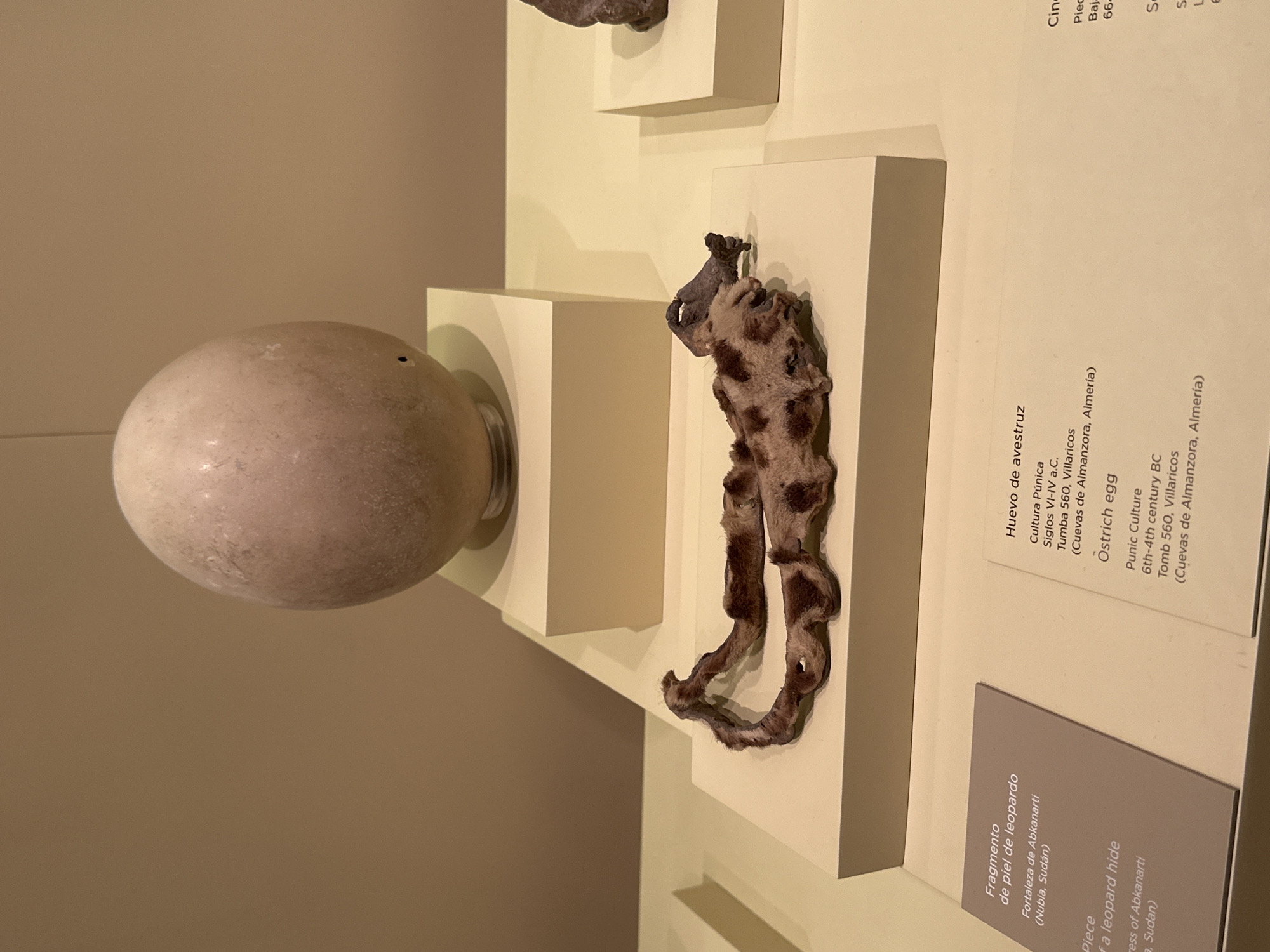
This media file showcases museum exhibits. The main subjects are two artifacts displayed on cream-colored pedestals. The first is a large, pale, egg-shaped object, likely an ostrich egg, positioned to the left. To its right, on a slightly higher pedestal, is a fragment of what appears to be a leopard's hide, with its distinctive spotted pattern visible. The setting is an indoor exhibition space, suggested by the display cases and informative text panels.

Several text panels provide details about the artifacts. One panel, in Spanish, is titled "Huevo de avestruz" (Ostrich egg) and attributes it to the Punic Culture, dating it to the 6th-4th centuries BC, found in Tumba 560, Villaricos (Cuevas de Almanzora, Almería). Another panel, also in Spanish, labels a different artifact as "Fragmento de piel de leopardo" (Fragment of leopard hide), originating from the "Fortaleza de Abkanarti (Nubia, Sudán)". There are also partially visible English translations of these descriptions. The lighting suggests it's daytime within the museum. The overall impression is one of a curated historical exhibition.
Tati

Jun 30, 2026, 11:14 AM

Madrid, Spain

Stake attention in this memory

curiosity
historical
ancient
intrigue
preservation

This media file showcases museum exhibits. The main subjects are two artifacts displayed on cream-colored pedestals. The first is a large, pale, egg-shaped object, likely an ostrich egg, positioned to the left. To its right, on a slightly higher pedestal, is a fragment of what appears to be a leopard's hide, with its distinctive spotted pattern visible. The setting is an indoor exhibition space, suggested by the display cases and informative text panels. Several text panels provide details about the artifacts. One panel, in Spanish, is titled "Huevo de avestruz" (Ostrich egg) and attributes it to the Punic Culture, dating it to the 6th-4th centuries BC, found in Tumba 560, Villaricos (Cuevas de Almanzora, Almería). Another panel, also in Spanish, labels a different artifact as "Fragmento de piel de leopardo" (Fragment of leopard hide), originating from the "Fortaleza de Abkanarti (Nubia, Sudán)". There are also partially visible English translations of these descriptions. The lighting suggests it's daytime within the museum. The overall impression is one of a curated historical exhibition.

Loading AttnAds…

transactions
revenues
stakers
Earliest
Latest
Highest stake

No transactions found

More from this user

More from Madrid

Tati

Jun 30, 2026, 11:14 AM

Madrid, Spain

Licensed under Creative Commons Attribution 4.0 International License. You are free to share and adapt this content with proper attribution.