
Sign in
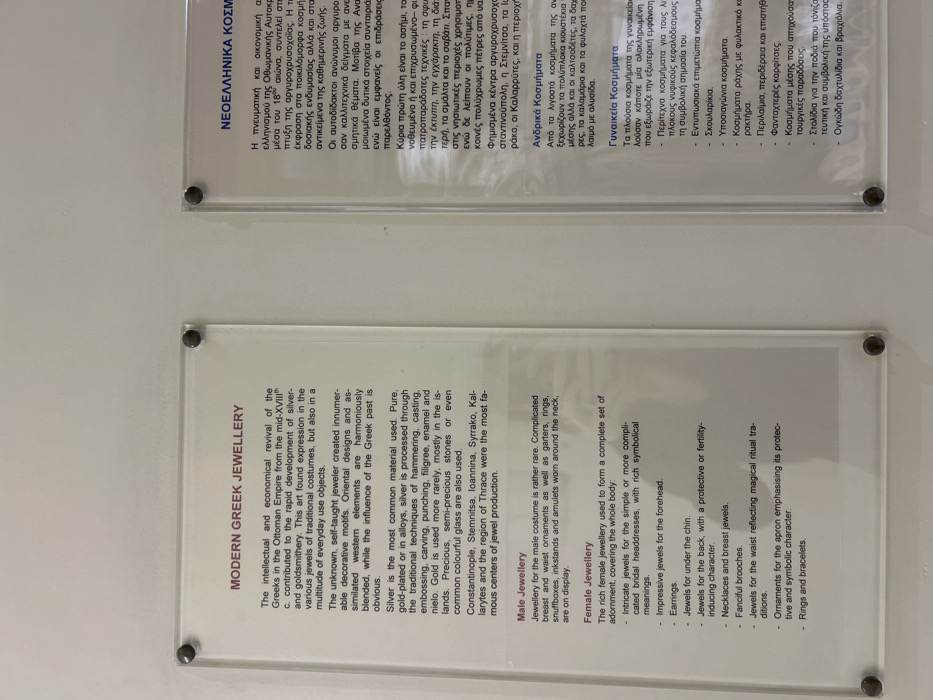
This image captures an indoor scene, likely within a museum or exhibition in Athina, Greece. Two transparent acrylic plaques are prominently displayed on a plain white wall, each secured by four metallic fasteners. These plaques serve as informational panels, with the left plaque presenting text in English and the right one in Greek.

The visible text on both plaques describes "MODERN GREEK JEWELLERY." The English text details the historical development of Greek silver and goldsmithery from the mid-18th century, influenced by the intellectual and economic revival of Greeks in the Ottoman Empire. It discusses materials like silver (pure, gold-plated, or in alloys), gold, and various stones, along with traditional techniques such as hammering, casting, filigree, and enamel. Key production centers like Constantinople, Stemnitsa, and Ioannina are mentioned. The text then categorizes jewellery into "Male Jewellery" (rarer, including breast and waist ornaments, garters, rings, snuffboxes, inkstands, and amulets) and "Female Jewellery" (a rich, complete set covering the body, including bridal headpieces, forehead jewels, earrings, chin and back jewels, necklaces, brooches, waist jewels, apron ornaments, rings, and bracelets, often with symbolic meanings). No people or specific activities are visible, only the informational displays in a clean, well-lit environment.
FM-zLJPr2

Jan 12, 2025

Athina, Greece

Stake attention in this memory

This image captures an indoor scene, likely within a museum or exhibition in Athina, Greece. Two transparent acrylic plaques are prominently displayed on a plain white wall, each secured by four metallic fasteners. These plaques serve as informational panels, with the left plaque presenting text in English and the right one in Greek. The visible text on both plaques describes "MODERN GREEK JEWELLERY." The English text details the historical development of Greek silver and goldsmithery from the mid-18th century, influenced by the intellectual and economic revival of Greeks in the Ottoman Empire. It discusses materials like silver (pure, gold-plated, or in alloys), gold, and various stones, along with traditional techniques such as hammering, casting, filigree, and enamel. Key production centers like Constantinople, Stemnitsa, and Ioannina are mentioned. The text then categorizes jewellery into "Male Jewellery" (rarer, including breast and waist ornaments, garters, rings, snuffboxes, inkstands, and amulets) and "Female Jewellery" (a rich, complete set covering the body, including bridal headpieces, forehead jewels, earrings, chin and back jewels, necklaces, brooches, waist jewels, apron ornaments, rings, and bracelets, often with symbolic meanings). No people or specific activities are visible, only the informational displays in a clean, well-lit environment.

transactions
revenues
stakers
Earliest
Latest
Highest stake

No transactions found

More from this user

More from Athina

FM-zLJPr2

Jan 12, 2025

Athina, Greece

Licensed under Creative Commons Attribution 4.0 International License. You are free to share and adapt this content with proper attribution.