Sign in
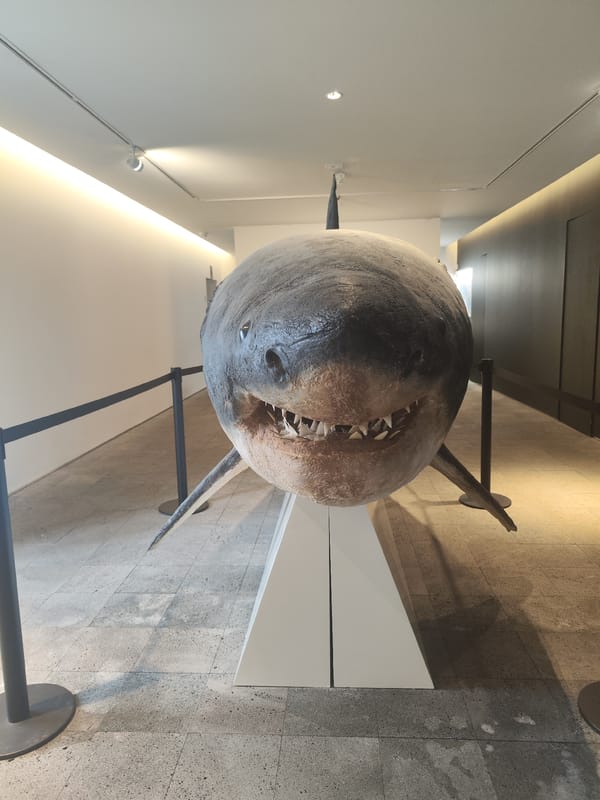
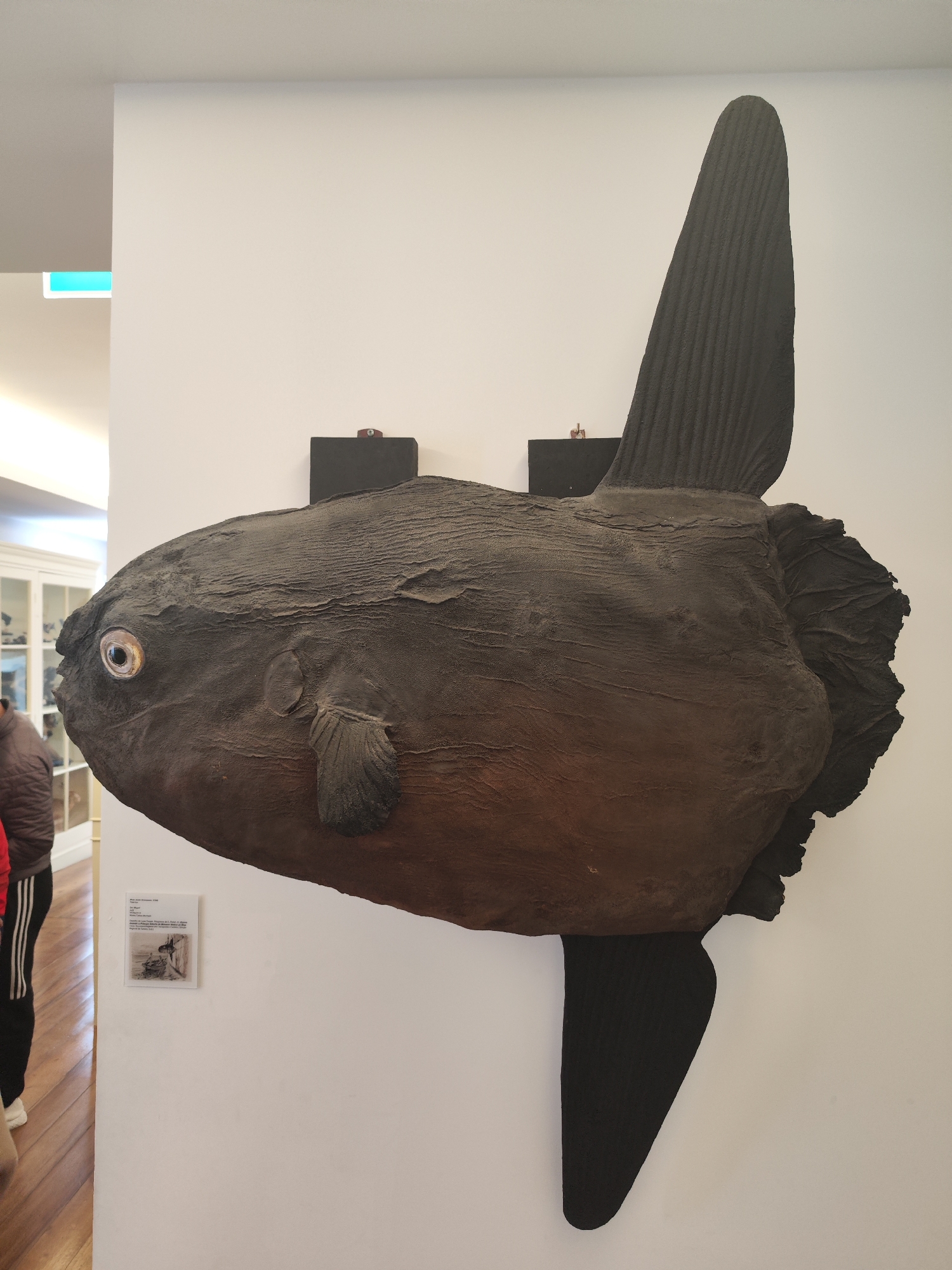
A large, dark-colored taxidermied sunfish (Mola mola), or ocean sunfish, is prominently displayed against a plain white wall in what appears to be a museum or exhibition space in Ponta Delgada, Portugal. The fish, which is mounted to appear as if swimming vertically, has a rough, textured, and weathered dark brown to black skin. Its body is thick and rounded, with a large, bright eye featuring a dark pupil. A small pectoral fin is visible on its side, and two exceptionally large, fan-like fins extend vertically from its dorsal and anal regions. The characteristic truncated caudal fin (tail) of a sunfish, known as a clavus, is also visible at the rear. The fish is secured to the wall by dark, rectangular mounts.

In the left foreground, a person is partially visible, seen from the waist down, wearing dark pants with white stripes, red clothing, and a brown jacket, suggesting they are an attendee walking through the exhibit. Further to the left, another person's leg is briefly visible.

The background features bright, even lighting from overhead, with a faint blue-green glow from what appears to be an exit sign in the upper left. A large, white wooden display cabinet with glass doors, containing various objects, can be seen in the distant background, reinforcing the museum setting. The floor in this area is polished wood.

Below the sunfish, a small informational plaque is affixed to the wall. Although mostly unreadable, discernible text includes "Mola mola" (the scientific name for sunfish), "Pintura sobre cartão (1940)" (Painting on cardboard (1940)), "José Pedro", and phrases like "Espécie rara" (rare species) and "Museu Regional de História Natural," confirming its exhibition context within a natural history museum. The plaque also features a small monochrome illustration of a fishing boat with the fish.
BIOWOMAN

Apr 23, 2026, 11:54 AM

Ponta Delgada, Portugal

Moment

Stake attention in this memory

curious
awe
intriguing
unusual
surreal

A large, dark-colored taxidermied sunfish (Mola mola), or ocean sunfish, is prominently displayed against a plain white wall in what appears to be a museum or exhibition space in Ponta Delgada, Portugal. The fish, which is mounted to appear as if swimming vertically, has a rough, textured, and weathered dark brown to black skin. Its body is thick and rounded, with a large, bright eye featuring a dark pupil. A small pectoral fin is visible on its side, and two exceptionally large, fan-like fins extend vertically from its dorsal and anal regions. The characteristic truncated caudal fin (tail) of a sunfish, known as a clavus, is also visible at the rear. The fish is secured to the wall by dark, rectangular mounts. In the left foreground, a person is partially visible, seen from the waist down, wearing dark pants with white stripes, red clothing, and a brown jacket, suggesting they are an attendee walking through the exhibit. Further to the left, another person's leg is briefly visible. The background features bright, even lighting from overhead, with a faint blue-green glow from what appears to be an exit sign in the upper left. A large, white wooden display cabinet with glass doors, containing various objects, can be seen in the distant background, reinforcing the museum setting. The floor in this area is polished wood. Below the sunfish, a small informational plaque is affixed to the wall. Although mostly unreadable, discernible text includes "Mola mola" (the scientific name for sunfish), "Pintura sobre cartão (1940)" (Painting on cardboard (1940)), "José Pedro", and phrases like "Espécie rara" (rare species) and "Museu Regional de História Natural," confirming its exhibition context within a natural history museum. The plaque also features a small monochrome illustration of a fishing boat with the fish.

Loading AttnAds…

transactions
revenues
stakers
Earliest
Latest
Highest stake

No transactions found

More from this user

More from Ponta Delgada

BIOWOMAN

Apr 23, 2026, 11:54 AM

Ponta Delgada, Portugal

Licensed under Creative Commons Attribution 4.0 International License. You are free to share and adapt this content with proper attribution.