
Sign in
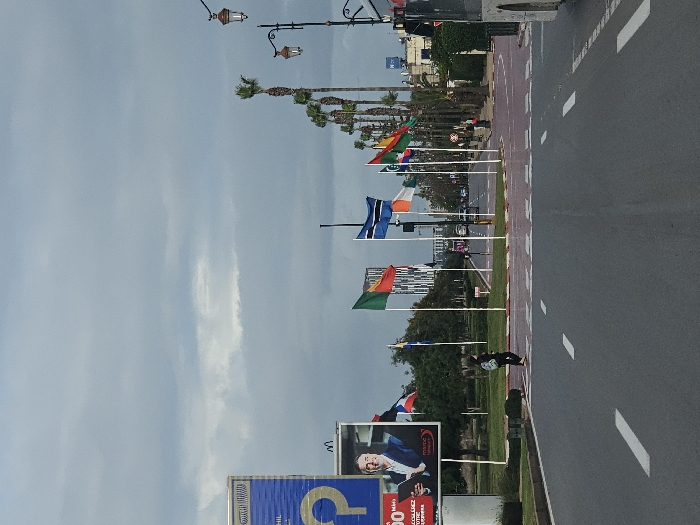
The scene depicts an urban street in Rabat, Morocco, likely a major boulevard or avenue, under a cloudy, overcast sky.

In the foreground, a dark asphalt road extends towards the viewer, featuring solid and dashed white lane markings and a marked pedestrian crossing. A lone individual, dressed in dark clothing and carrying a backpack, is positioned centrally, walking from left to right across the pedestrian crossing.

To the left, a large blue billboard is partially visible, displaying a prominent white "P" symbol and some obscured text. Below and to its right, a second billboard showcases a smiling Caucasian man in a suit holding a tablet or book, with "MAROC" and "300" visible in white and red text respectively.

The midground is dominated by a central grassy median or roundabout containing several small trees and shrubs. Numerous national flags are mounted on white poles along this median. Identifiable flags include those resembling Mali/Guinea (green, yellow, red vertical stripes), Botswana (light blue, black, white horizontal stripes with a black disk), Ireland (orange, white, green vertical stripes), Equatorial Guinea (green, white, red, black horizontal stripes with a blue triangle), and Burkina Faso/Senegal (red, yellow, green horizontal stripes). A red, white, and blue striped flag is partially visible further left.

To the far right, the front section of a grey and white bus is partially visible. Two ornate street lamps with dark poles and bronze-colored lanterns extend into the upper right frame. A line of tall palm trees with slender trunks borders the right side of the road, extending into the distance.

In the background, behind the flags and palm trees, a mix of modern, multi-story buildings and lighter-colored, more traditional structures are visible. Vehicles can be seen on the road in the distance.
Loading...

Jan 4, 2026

Rabat, Morocco

Stake attention in this memory

Patriotism
Calm
Neutrality
Urban
Pensive

The scene depicts an urban street in Rabat, Morocco, likely a major boulevard or avenue, under a cloudy, overcast sky. In the foreground, a dark asphalt road extends towards the viewer, featuring solid and dashed white lane markings and a marked pedestrian crossing. A lone individual, dressed in dark clothing and carrying a backpack, is positioned centrally, walking from left to right across the pedestrian crossing. To the left, a large blue billboard is partially visible, displaying a prominent white "P" symbol and some obscured text. Below and to its right, a second billboard showcases a smiling Caucasian man in a suit holding a tablet or book, with "MAROC" and "300" visible in white and red text respectively. The midground is dominated by a central grassy median or roundabout containing several small trees and shrubs. Numerous national flags are mounted on white poles along this median. Identifiable flags include those resembling Mali/Guinea (green, yellow, red vertical stripes), Botswana (light blue, black, white horizontal stripes with a black disk), Ireland (orange, white, green vertical stripes), Equatorial Guinea (green, white, red, black horizontal stripes with a blue triangle), and Burkina Faso/Senegal (red, yellow, green horizontal stripes). A red, white, and blue striped flag is partially visible further left. To the far right, the front section of a grey and white bus is partially visible. Two ornate street lamps with dark poles and bronze-colored lanterns extend into the upper right frame. A line of tall palm trees with slender trunks borders the right side of the road, extending into the distance. In the background, behind the flags and palm trees, a mix of modern, multi-story buildings and lighter-colored, more traditional structures are visible. Vehicles can be seen on the road in the distance.

transactions
revenues
stakers
Earliest
Latest
Highest stake

No transactions found

More from this user

More from Rabat

Loading...

Jan 4, 2026

Rabat, Morocco

Licensed under Creative Commons Attribution 4.0 International License. You are free to share and adapt this content with proper attribution.