
Stake attention in this memory
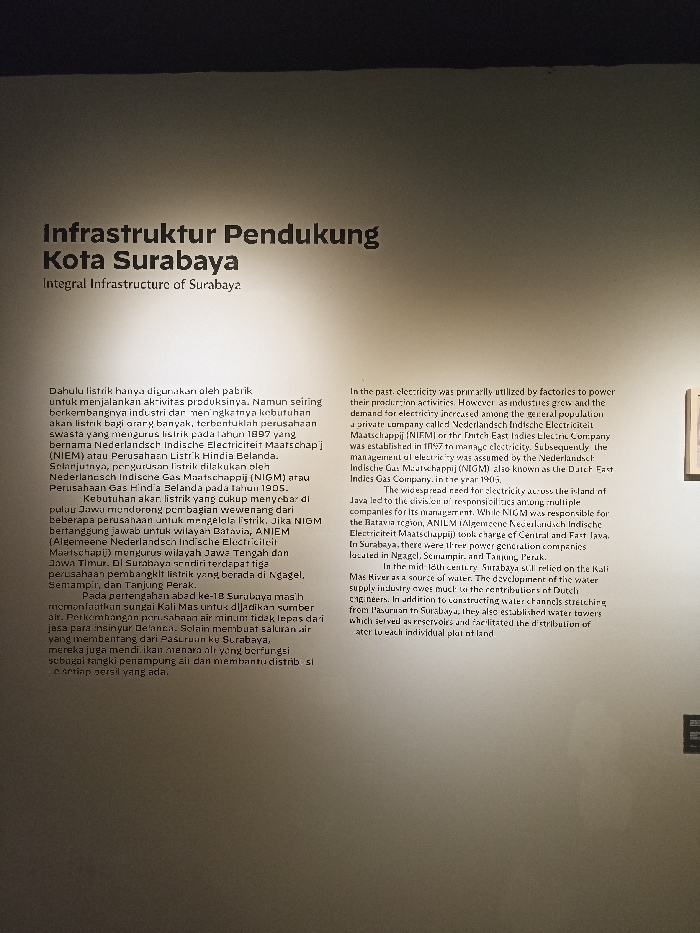
The image shows a text panel inside a museum in Surabaya, Indonesia (latitude: -7.246, longitude: 112.737). The panel, which is part of an exhibit about the city's infrastructure, is titled "Infrastruktur Pendukung Kota Surabaya" (Integral Infrastructure of Surabaya) in large, bold, black lettering. The panel is mounted on a light grey wall. The panel contains text in both Bahasa Indonesia and English, which describes the development of electricity and gas in Surabaya. The Indonesian text on the left side of the panel details the history of electricity in the city, noting how, in the past, factories relied on self-generated power. However, as industries grew and the population increased, the demand for electricity increased. This led to the establishment of a private company, the "Nederlandsch Indische Electriciteit Maatschappij" (NIEM) or the "Dutch East Indies Electric Company" in 1897, to manage electricity. Subsequently, the management of electricity was assumed by the "Nederlandsch Indische Gas Maatschappij" (NIGM) or "Dutch East Indies Gas Company" in the year 1910. The English text on the right side of the panel explains that the NIGM, known as the "Dutch East Indies Gas Company", was responsible for Java's electricity management. It was responsible for the Batavia region, and multiple companies for its management. While NIGM was responsible for Surabaya, there were still other companies who continued to manage electricity in the region. The text goes on to explain that the NIGM located in the middle, south, and east of Java, near the source of water, including the Kali Mas River in Ngawi, Semarang, and Tanjung Perak. The English text goes on to explain that, in addition to constructing water towers to supply industries with much of their water, the Dutch from "Paburan to Surabaya" (Paburan is a district on the outskirts of Surabaya) also established a distribution system for individual plots of land.
Loading AttnAds…
No transactions found