
Stake attention in this memory
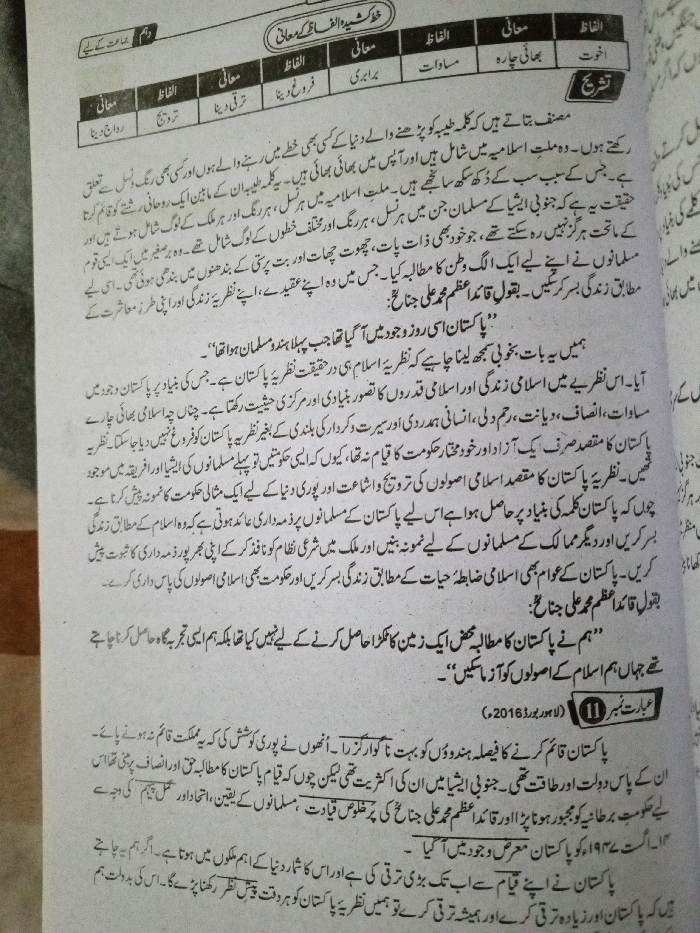
This image displays a well-lit page from an Urdu language book, likely an educational textbook, presented in Renala Khurd, Pakistan. The page features black text printed on off-white paper. At the top, there is a table serving as a glossary, with columns titled "الفاظ" (Words) and "معانی" (Meanings). Highlighted words in this section include "اخوت" (Brotherhood), "مساوات" (Equality), "فروغ دینا" (To promote/develop), and "ترویج" (Promotion/Dissemination), along with their corresponding meanings. The main body of the text discusses the "Nazriya Pakistan" (Ideology of Pakistan), emphasizing its Islamic foundations and the values it represents, such as justice, equality, honesty, compassion, and human empathy. It explains that Pakistan's purpose was not merely to be an independent state but to serve as an exemplary Islamic society globally. The text also recounts the historical opposition from Hindus to Pakistan's creation and attributes the success of the Pakistan Movement to Quaid-e-Azam Muhammad Ali Jinnah's leadership and the unity of Muslims. Two prominent quotes attributed to Quaid-e-Azam Muhammad Ali Jinnah are visible. The first states: "پاکستان اسی روز وجود میں آگیا تھا جب پہلا ہندو مسلمان ہوا تھا۔" (Pakistan came into existence the day the first Hindu became a Muslim.) The second, longer quote reads: "ہم نے پاکستان کا مطالبہ محض ایک زمین کا ٹکڑا حاصل کرنے کے لیے نہیں کیا تھا بلکہ ہم ایسی تجربہ گاہ حاصل کرنا چاہتے تھے جہاں ہم اسلام کے اصولوں کو آزماسکیں۔" (We did not demand Pakistan merely to acquire a piece of land, but we wanted such a laboratory where we could experiment with the principles of Islam.) A textual reference, "عبارت نمبر 11 (لاہور بورڈ 2016ء)" (Passage No. 11, Lahore Board 2016), is present at the bottom, indicating that this content is likely part of an academic curriculum or examination material. The page's content reflects a focus on national history, ideology, and Islamic principles within an educational context.
Loading AttnAds…
No transactions found