Sign in
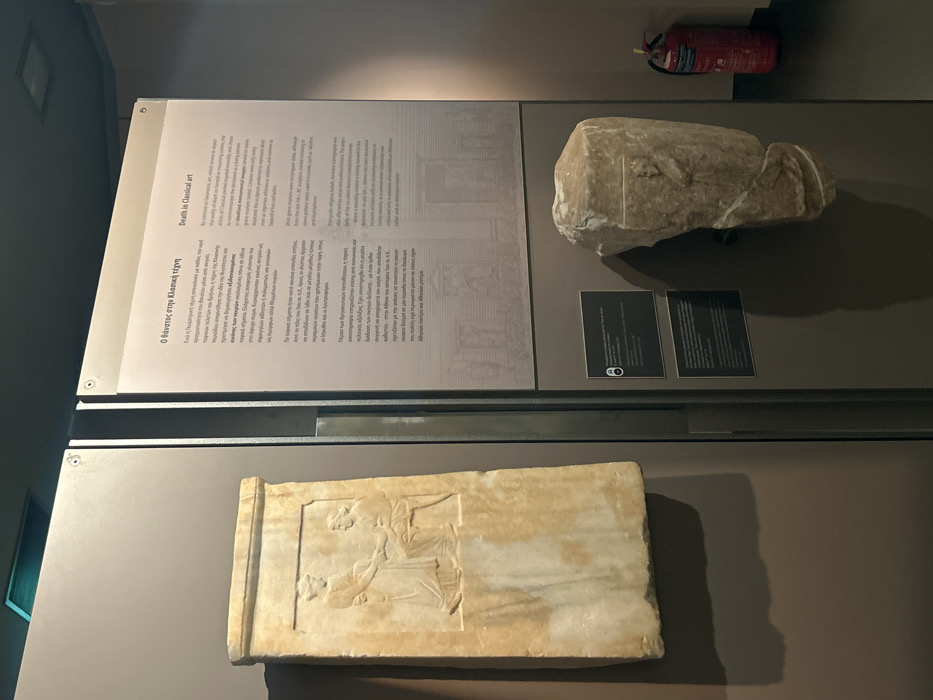
The image captures a museum display featuring ancient Greek artifacts related to death in Classical art, likely located in Athina, Greece. The scene presents two marble pieces and an explanatory information panel against a muted grey background, illuminated by overhead lighting that casts distinct shadows.

At the top right of the display, an irregularly shaped, light-colored marble fragment is mounted, showing rough surfaces and some faint, carved linear details, possibly a remnant of a larger sculpture or architectural element. Below it, two small, dark descriptive plaques are visible, though their text is illegible, one featuring an eye icon. A red fire extinguisher is mounted on the wall above this artifact.

The main information panel, located on the upper left, features a bilingual text. The Greek title reads "Ο θάνατος στην Κλασική τέχνη" and the English title "Death in Classical art." The accompanying text discusses how Geometric art passionately depicted the raw reality of death, while Classical art favored idealized forms and fewer explicit references to death, such as in funerary vessels like lekythoi and loutrophoroi. It also touches upon how funerary iconography was influenced by religious beliefs and political developments, citing the prevalence of symposium scenes with a reclining man in late 5th century BC Athens, linking it to the need to celebrate ancestral bonds.

On the lower display level, a rectangular marble slab with a carved relief is presented. The relief depicts two draped figures, one seated on the right and another standing or bending towards the seated figure on the left, possibly in a pose of mourning or interaction. This piece appears to be a funerary stele or grave marker, exhibiting the typical style of classical marble sculpture. The overall setting creates a somber yet educational atmosphere characteristic of an archaeological museum exhibition.
FM-zLJPr2

Jan 11, 2025

Athina, Greece

Stake attention in this memory

The image captures a museum display featuring ancient Greek artifacts related to death in Classical art, likely located in Athina, Greece. The scene presents two marble pieces and an explanatory information panel against a muted grey background, illuminated by overhead lighting that casts distinct shadows. At the top right of the display, an irregularly shaped, light-colored marble fragment is mounted, showing rough surfaces and some faint, carved linear details, possibly a remnant of a larger sculpture or architectural element. Below it, two small, dark descriptive plaques are visible, though their text is illegible, one featuring an eye icon. A red fire extinguisher is mounted on the wall above this artifact. The main information panel, located on the upper left, features a bilingual text. The Greek title reads "Ο θάνατος στην Κλασική τέχνη" and the English title "Death in Classical art." The accompanying text discusses how Geometric art passionately depicted the raw reality of death, while Classical art favored idealized forms and fewer explicit references to death, such as in funerary vessels like lekythoi and loutrophoroi. It also touches upon how funerary iconography was influenced by religious beliefs and political developments, citing the prevalence of symposium scenes with a reclining man in late 5th century BC Athens, linking it to the need to celebrate ancestral bonds. On the lower display level, a rectangular marble slab with a carved relief is presented. The relief depicts two draped figures, one seated on the right and another standing or bending towards the seated figure on the left, possibly in a pose of mourning or interaction. This piece appears to be a funerary stele or grave marker, exhibiting the typical style of classical marble sculpture. The overall setting creates a somber yet educational atmosphere characteristic of an archaeological museum exhibition.

transactions
revenues
stakers
Earliest
Latest
Highest stake

No transactions found

More from this user

More from Athina

FM-zLJPr2

Jan 11, 2025

Athina, Greece

Licensed under Creative Commons Attribution 4.0 International License. You are free to share and adapt this content with proper attribution.