
Stake attention in this memory
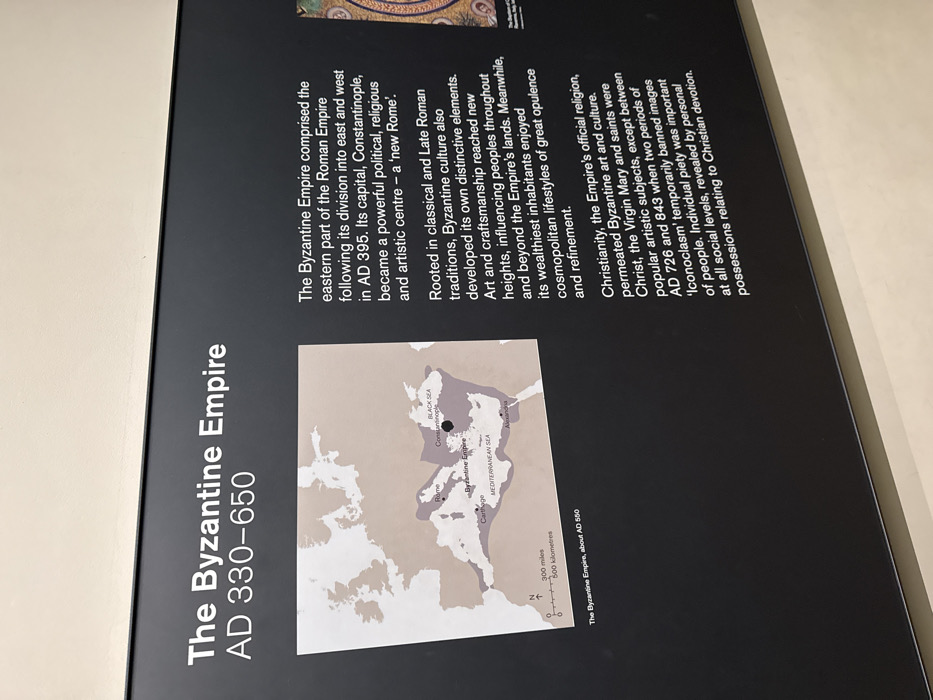
This media file captures an informational display board, likely from a museum or exhibition in London, United Kingdom. The main subject is "The Byzantine Empire AD 330-650," presented on a dark grey panel with white text and a map. The visible text introduces the Byzantine Empire as the eastern part of the Roman Empire after its division in AD 395, with Constantinople serving as its capital and a "new Rome." It describes Byzantine culture as rooted in classical and Late Roman traditions, highlighting its unique elements, advanced art, and craftsmanship that influenced regions beyond the empire. The text also mentions the opulent lifestyles of its wealthiest inhabitants. A significant portion of the text focuses on Christianity as the Empire's official religion, permeating its art and culture. It notes that Christ, the Virgin Mary, and saints were popular artistic subjects, with the exception of two periods of "Iconoclasm" between AD 726 and 843, during which images of people were temporarily banned. Individual piety was expressed through personal possessions related to Christian devotion. Below the main title, a map titled "The Byzantine Empire, about AD 550" illustrates the empire's territorial extent. Key locations labeled include Constantinople (marked with a black dot), Rome, Carthage, the Black Sea, and the Mediterranean Sea. A scale indicates distances of "300 miles" and "500 kilometres." The overall scene suggests an educational display intended for visitors to learn about this historical period.
Loading AttnAds…
No transactions found