
Sign in
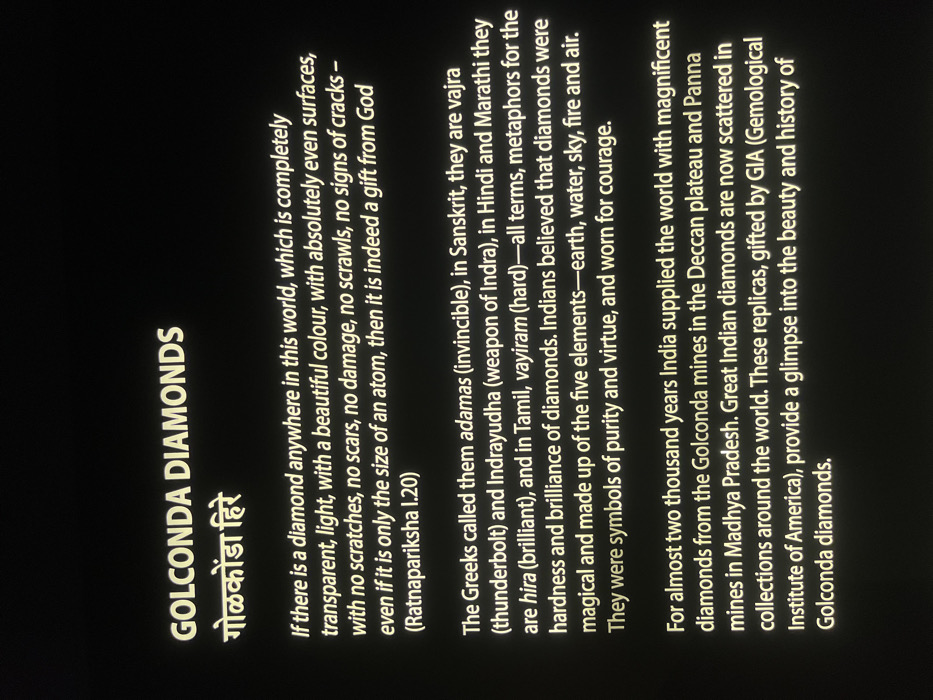
The image displays an informational panel, likely from a museum or exhibition in Mumbai, India, dedicated to "GOLCONDA DIAMONDS." The text is presented in white font against a black background and includes both English and Marathi script ("गोळकोंडा हिरे").

The panel begins with a quote from Ratnapariksha 1.20, describing an ideal diamond as "completely transparent, light, with a beautiful colour, with absolutely even surfaces, with no scratches, no scars, no damage, no scrawls, no signs of cracks," asserting that even an atomic-sized diamond is "a gift from God."

The text then delves into the etymology and cultural significance of diamonds. It notes that the Greeks called them "adamas" (invincible), while in Sanskrit they are "vajra" (thunderbolt) and "Indrayudha" (weapon of Indra). In Hindi and Marathi, they are "hira" (brilliant), and in Tamil, "vayiram" (hard) – all terms highlighting their hardness and brilliance. Indians believed diamonds were magical, composed of the five elements (earth, water, sky, fire, and air), and symbolized purity, virtue, and courage.

Historically, the panel states that for nearly two thousand years, India, specifically the Golconda mines in the Deccan plateau and Panna mines in Madhya Pradesh, supplied the world with magnificent diamonds. It mentions that these "Great Indian diamonds" are now scattered in collections globally. The display features replicas, gifted by the GIA (Gemological Institute of America), which offer visitors a glimpse into the beauty and history of Golconda diamonds.
FM-OhtiC3

Dec 10, 2024

Mumbai, India

Stake attention in this memory

The image displays an informational panel, likely from a museum or exhibition in Mumbai, India, dedicated to "GOLCONDA DIAMONDS." The text is presented in white font against a black background and includes both English and Marathi script ("गोळकोंडा हिरे"). The panel begins with a quote from Ratnapariksha 1.20, describing an ideal diamond as "completely transparent, light, with a beautiful colour, with absolutely even surfaces, with no scratches, no scars, no damage, no scrawls, no signs of cracks," asserting that even an atomic-sized diamond is "a gift from God." The text then delves into the etymology and cultural significance of diamonds. It notes that the Greeks called them "adamas" (invincible), while in Sanskrit they are "vajra" (thunderbolt) and "Indrayudha" (weapon of Indra). In Hindi and Marathi, they are "hira" (brilliant), and in Tamil, "vayiram" (hard) – all terms highlighting their hardness and brilliance. Indians believed diamonds were magical, composed of the five elements (earth, water, sky, fire, and air), and symbolized purity, virtue, and courage. Historically, the panel states that for nearly two thousand years, India, specifically the Golconda mines in the Deccan plateau and Panna mines in Madhya Pradesh, supplied the world with magnificent diamonds. It mentions that these "Great Indian diamonds" are now scattered in collections globally. The display features replicas, gifted by the GIA (Gemological Institute of America), which offer visitors a glimpse into the beauty and history of Golconda diamonds.

transactions
revenues
stakers
Earliest
Latest
Highest stake

No transactions found

More from this user

More from Mumbai

FM-OhtiC3

Dec 10, 2024

Mumbai, India

Licensed under Creative Commons Attribution 4.0 International License. You are free to share and adapt this content with proper attribution.