
Sign in
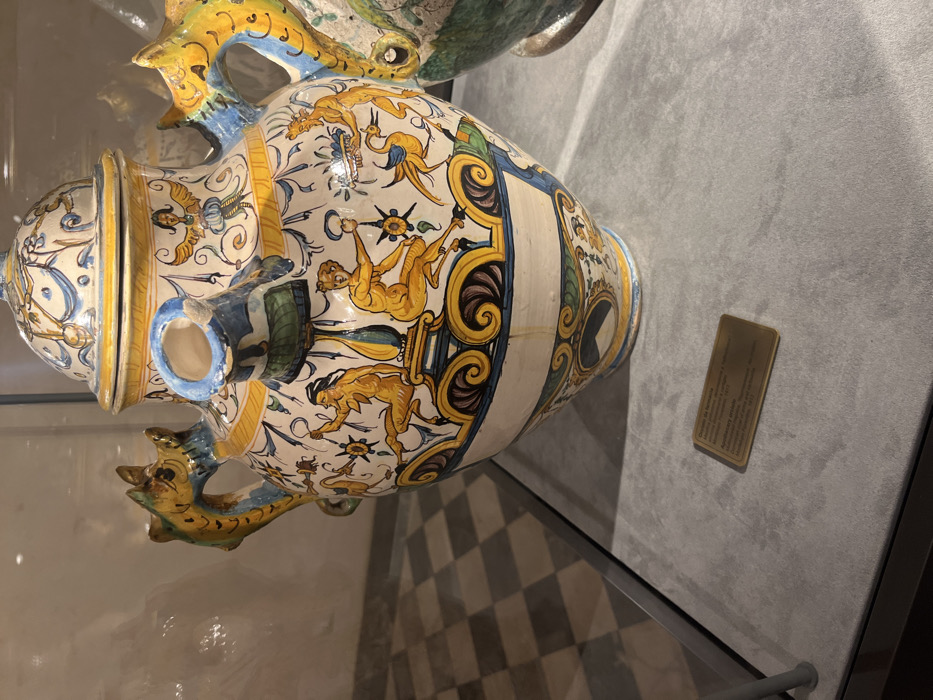
A large, ornate Italian maiolica vase, depicted at an angle within a museum display, is the central subject of the image. The ceramic piece, likely from Urbino, features a white background adorned with vibrant polychrome decorations in yellow, blue, green, brown, and black.

The body of the vase is intricately decorated with grotesque figures, including muscular male nudes in dynamic poses—some appearing to fly, others in more terrestrial stances—interspersed with fantastical birds, scrolling foliage, and abstract patterns. The handles of the vase are shaped like stylized dragons or mythical creatures, glazed in yellow, blue, and green, adding to its elaborate design. A smaller, undecipherable ceramic object is partially visible behind the main vase.

The vase is displayed on a grey, smooth surface, suggesting a modern museum or gallery setting. The polished surface below reflects a black and white checkered floor.

A small, rectangular brass plaque is positioned next to the vase, providing information. The visible text on the plaque reads: "Cantiere di Patanazzi" (Workshop of Patanazzi), "Maiolica policroma a gran fuoco" (Polychrome majolica, high-fired), "Agguagliato e anse a draghi" (Evenly glazed and dragon handles), "Urbino, fine del XVI sec." (Urbino, end of the 16th century), and "Conservatorio di S. Benedetto, inv. 1971 n. 675". This indicates the vase was made by the Patanazzi workshop in Urbino during the late 16th century and belongs to the inventory of the Conservatorio di S. Benedetto. The context of Florence, Italy, suggests it is displayed in a museum there. The indoor lighting creates soft reflections on the glazed surface of the vase.
FM-oNt2k1

Dec 12, 2024, 5:19 PM

Firenze, Italy

Stake attention in this memory

A large, ornate Italian maiolica vase, depicted at an angle within a museum display, is the central subject of the image. The ceramic piece, likely from Urbino, features a white background adorned with vibrant polychrome decorations in yellow, blue, green, brown, and black. The body of the vase is intricately decorated with grotesque figures, including muscular male nudes in dynamic poses—some appearing to fly, others in more terrestrial stances—interspersed with fantastical birds, scrolling foliage, and abstract patterns. The handles of the vase are shaped like stylized dragons or mythical creatures, glazed in yellow, blue, and green, adding to its elaborate design. A smaller, undecipherable ceramic object is partially visible behind the main vase. The vase is displayed on a grey, smooth surface, suggesting a modern museum or gallery setting. The polished surface below reflects a black and white checkered floor. A small, rectangular brass plaque is positioned next to the vase, providing information. The visible text on the plaque reads: "Cantiere di Patanazzi" (Workshop of Patanazzi), "Maiolica policroma a gran fuoco" (Polychrome majolica, high-fired), "Agguagliato e anse a draghi" (Evenly glazed and dragon handles), "Urbino, fine del XVI sec." (Urbino, end of the 16th century), and "Conservatorio di S. Benedetto, inv. 1971 n. 675". This indicates the vase was made by the Patanazzi workshop in Urbino during the late 16th century and belongs to the inventory of the Conservatorio di S. Benedetto. The context of Florence, Italy, suggests it is displayed in a museum there. The indoor lighting creates soft reflections on the glazed surface of the vase.

Loading AttnAds…

transactions
revenues
stakers
Earliest
Latest
Highest stake

No transactions found

More from this user

More from Firenze

FM-oNt2k1

Dec 12, 2024, 5:19 PM

Firenze, Italy

Licensed under Creative Commons Attribution 4.0 International License. You are free to share and adapt this content with proper attribution.