
Stake attention in this memory
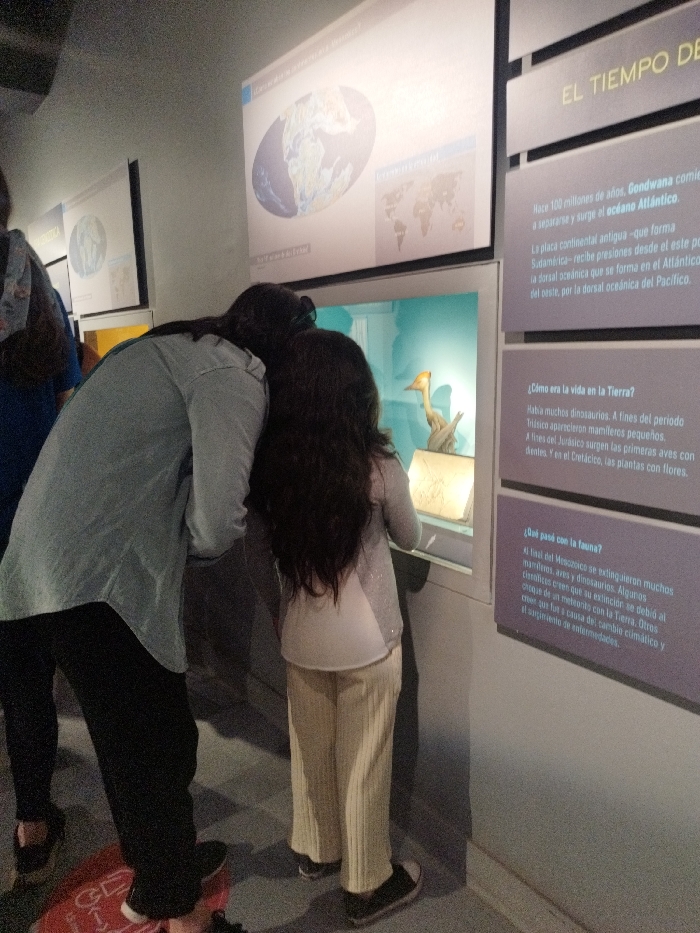
An adult and a child are engrossed in an exhibit within what appears to be a museum or exhibition hall in Santiago, Chile. The subjects are viewed from behind, with the adult on the left, wearing a light blue long-sleeved shirt and dark pants, bending down to look into a display case. The child, with long dark hair, stands next to the adult, also leaning forward and looking into the same case. The child is dressed in a light-colored top and wide-leg cream-colored pants. Inside the well-lit display case, a model of an ancient bird or creature with a prominent beak is visible. Above this display, a large screen projects a dynamic image of the Earth, likely illustrating geological formations or continental drift, accompanied by smaller map graphics. To the right of the display case, a series of vertically stacked, purple-toned informational panels are mounted on the wall, featuring text in Spanish. The top panel has a partial title "EL TIEMPO DE" (THE TIME OF). The first full text section describes the separation of Gondwana 100 million years ago, the emergence of the Atlantic Ocean, and the geological formation of South America. The second panel, titled "¿Cómo era la vida en la Tierra?" (How was life on Earth?), discusses dinosaurs, the appearance of small mammals in the Triassic, early toothed birds in the Jurassic, and flowering plants in the Cretaceous. The third panel, "¿Qué pasó con la fauna?" (What happened to the fauna?), explains the extinction of many mammals, birds, and dinosaurs at the end of the Mesozoic, attributing it to a meteorite impact or climate change and disease. The overall setting is dimly lit, typical of a museum, with focused lighting on the exhibits. A red bag is partially visible on the floor near the adult's feet. The scene captures a moment of curiosity and learning.
No transactions found