
Stake attention in this memory
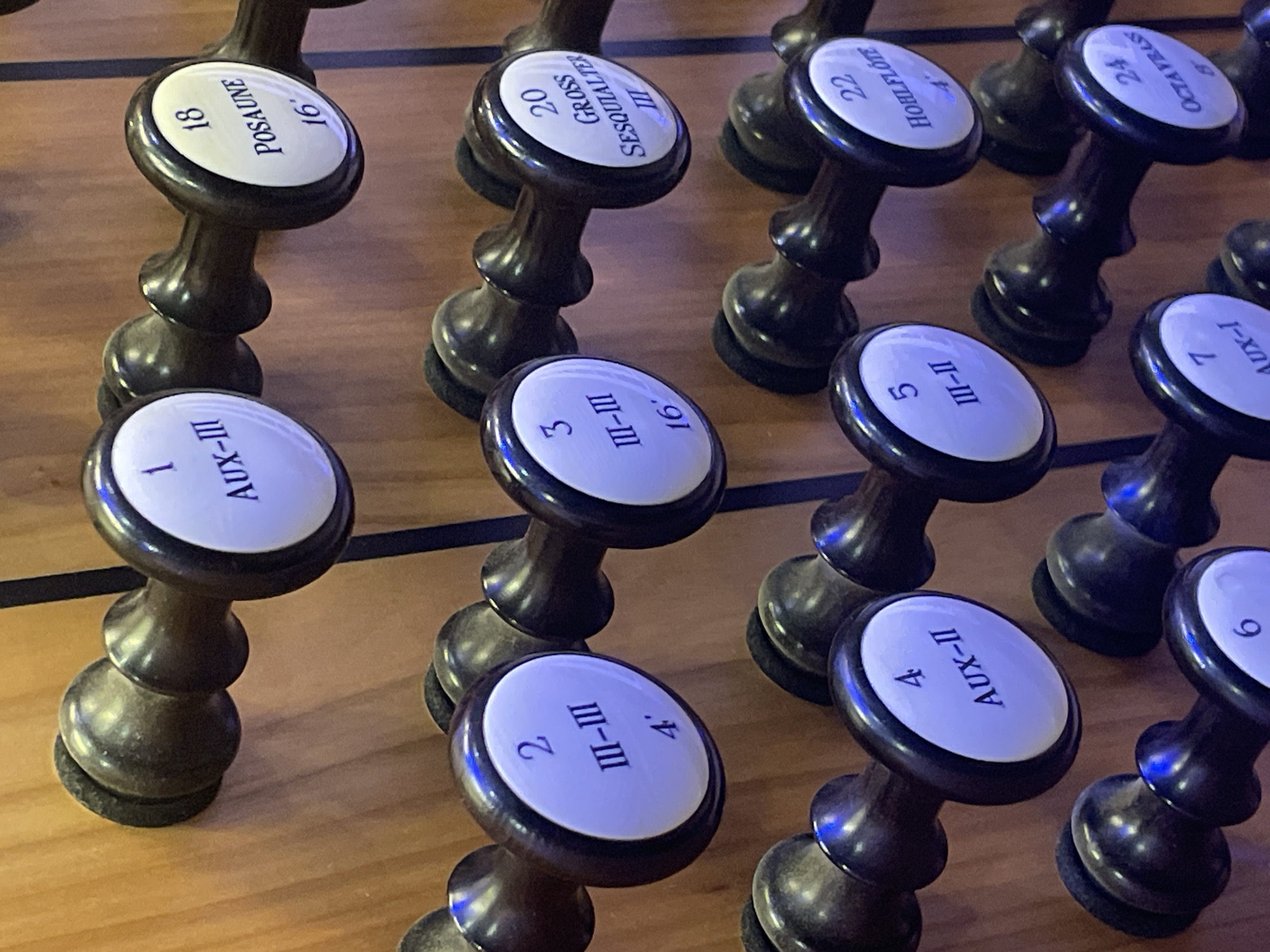
The image captures a detailed close-up of a section of a pipe organ console, specifically showcasing several dark wooden drawknobs, also known as stops, against a warm, light-colored wooden background. No people are visible in the frame. The scene is set in Yekaterinburg, Russia, focusing on the intricate controls of the musical instrument. Each drawknob features a round, white face with black lettering, indicating its specific function, registration, or pipe rank. The lighting gives the white faces a subtle blue tint. The stops are arranged in rows, highlighting the complex array of sound options available to the organist. Visible text on the drawknobs includes: * "18 POSAUNE 16'" * "20 GROSS SESQUIALTER III" * "22 HOHLFLÖTE 4'" * "24 OCTAVBAS 8'" * "1 AUX-III" * "3 III-III 16'" * "5 III-II" * "7 AUX-I" * "2 III-III 4'" * "4 AUX-II" * A partial "6" is visible on a knob in the lower right corner. The inscriptions denote various organ stops, with names like "Posaune" (a reed stop), "Hohlflöte" (a flute stop), "Octavbas" (an octave bass stop), and "Sesquialter" (a mixture stop). The numbers followed by an apostrophe (e.g., "16'", "4'", "8'") indicate the pipe length in feet, determining the pitch. Roman numerals often refer to the number of ranks in a mixture or specific organ divisions. "AUX-I," "AUX-II," and "AUX-III" likely represent auxiliary couplers or functions across different manual or pedal divisions. The image provides a clear view of the control interface of this large and complex musical instrument.
Loading AttnAds…
No transactions found