Sign in
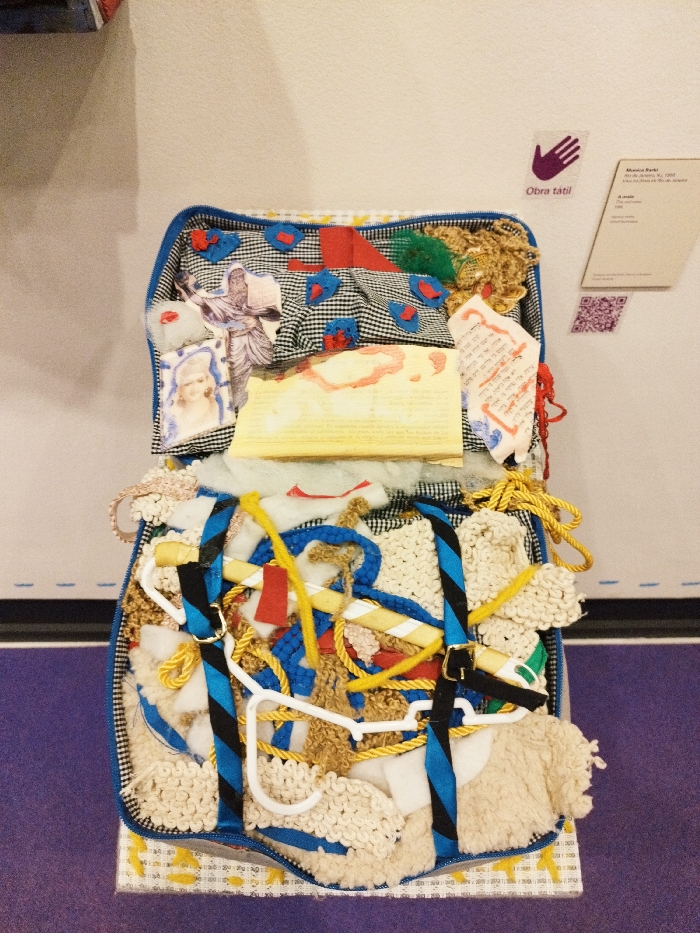
The image depicts an indoor art installation within an exhibition space, identified as an art gallery or museum in São Paulo, Brazil, based on the Portuguese language labels and the identity of the Brazilian artist. The central subject is an open, soft-sided art piece, approximately 1 meter in height, resembling an oversized suitcase, titled "A mala" (The Suitcase) by Monica Belsky, created in 1996.

The artwork is a mixed-media assemblage. Its top compartment (lid) contains a checkered fabric base upon which are arranged red and blue geometric fabric cutouts, a paper cutout of a classical sculpture, a small framed portrait of a woman, a stack of yellowed papers or a book, and a white fabric piece inscribed with orange Hebrew text. Various textured fabric scraps, including a green fuzzy piece and brown looped material, are also present. The bottom compartment is densely packed with diverse materials, including beige looped textiles, tangled blue and yellow ropes or cords, black and blue striped straps with gold-colored buckles, and several white plastic clothes hangers.

The artwork is positioned against a clean, off-white wall. To the upper right of the artwork, a white rectangular informational label is affixed to the wall, displaying "Monica Belsky, 1996, Vivo ou Obra de Mónica Belsky, A mala, mista, coleção particular." Below this label, a purple QR code is visible on a white square. To the left of the rectangular label, a smaller white square label features a purple hand symbol and the text "Obra Tátil" (Tactile Work), indicating the artwork is designed for sensory interaction. The artwork rests on a white surface with a subtle yellow patterned design, which appears to be atop a solid purple floor or pedestal. No individuals are present in the frame; the scene is static, focusing solely on the exhibited artwork and its immediate environment.
Mrv

Jul 24, 2025, 8:35 PM

São Paulo, Brazil

Stake attention in this memory

Curiosity
Confusion
Nostalgia
Intrigue
Complexity

The image depicts an indoor art installation within an exhibition space, identified as an art gallery or museum in São Paulo, Brazil, based on the Portuguese language labels and the identity of the Brazilian artist. The central subject is an open, soft-sided art piece, approximately 1 meter in height, resembling an oversized suitcase, titled "A mala" (The Suitcase) by Monica Belsky, created in 1996. The artwork is a mixed-media assemblage. Its top compartment (lid) contains a checkered fabric base upon which are arranged red and blue geometric fabric cutouts, a paper cutout of a classical sculpture, a small framed portrait of a woman, a stack of yellowed papers or a book, and a white fabric piece inscribed with orange Hebrew text. Various textured fabric scraps, including a green fuzzy piece and brown looped material, are also present. The bottom compartment is densely packed with diverse materials, including beige looped textiles, tangled blue and yellow ropes or cords, black and blue striped straps with gold-colored buckles, and several white plastic clothes hangers. The artwork is positioned against a clean, off-white wall. To the upper right of the artwork, a white rectangular informational label is affixed to the wall, displaying "Monica Belsky, 1996, Vivo ou Obra de Mónica Belsky, A mala, mista, coleção particular." Below this label, a purple QR code is visible on a white square. To the left of the rectangular label, a smaller white square label features a purple hand symbol and the text "Obra Tátil" (Tactile Work), indicating the artwork is designed for sensory interaction. The artwork rests on a white surface with a subtle yellow patterned design, which appears to be atop a solid purple floor or pedestal. No individuals are present in the frame; the scene is static, focusing solely on the exhibited artwork and its immediate environment.

Loading AttnAds…

transactions
revenues
stakers
Earliest
Latest
Highest stake

No transactions found

More from this user

More from São Paulo

Mrv

Jul 24, 2025, 8:35 PM

São Paulo, Brazil

Licensed under Creative Commons Attribution 4.0 International License. You are free to share and adapt this content with proper attribution.