
Sign in
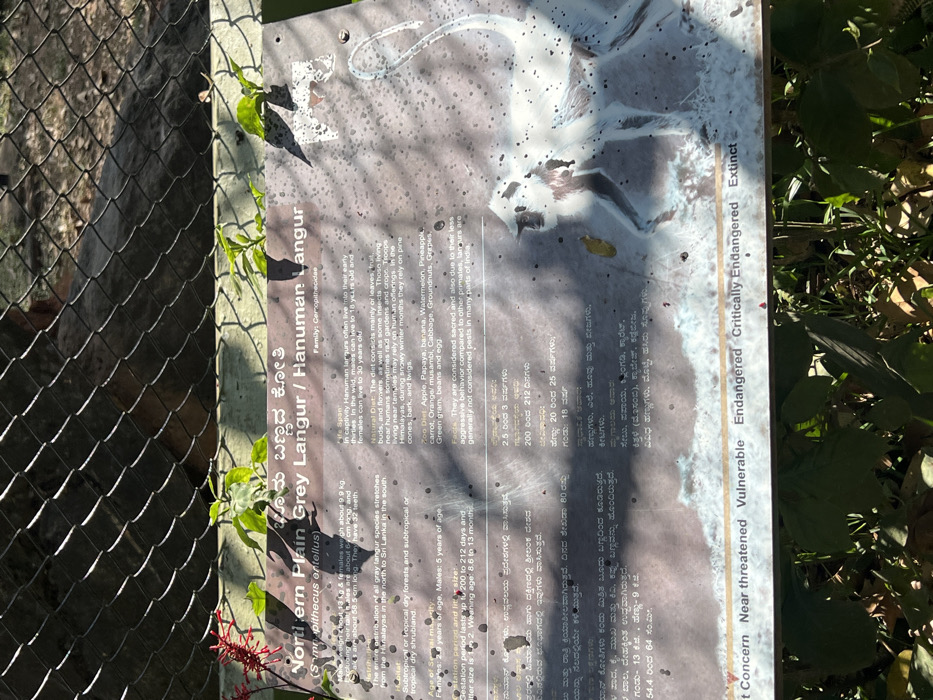
The image shows an informational sign about the "Northern Plain Grey Langur / Hanuman Langur," likely displayed at a zoo or wildlife park in Mysuru, India. The sign is oriented vertically and appears somewhat faded and damaged, with significant glare from bright sunlight obscuring parts of the text and an image of a langur. A chain-link fence is visible on the left side, separating the viewer from what appears to be an enclosure. Lush green vegetation surrounds the sign on the right.

The sign provides details about the langur in both English and Kannada. Visible English text includes:
*   **Name:** "Northern Plain Grey Langur / Hanuman Langur" (scientific name partially visible as "(Sampithecus ontellus)").
*   **Family:** "Cercopithecidae".
*   **Distribution:** Stretches "from the Himalayas in the north to Sri Lanka in the south."
*   **Habitat:** "Subtropical or tropical dry forests and subtropical or tropical dry shrubland."
*   **Reproduction:** "Gestation period lasts up to 200 to 212 days and litter size is 1 or 2. Weaning age: 8.6 to 13 months."
*   **Lifespan:** "In captivity Hanuman langurs often live into their early thirties. In the wild, males can live to 18 years old and females can live to 30 years old."
*   **Diet:** "Natural Diet" includes "leaves, fruit, buds, and flowers, as well as some insects," with notes on raiding gardens and relying on human offerings or pine cones in winter. "Zoo Diet" lists items like "Apple, Papaya, banana, Watermelon, Pineapple, carrot, Orange/ musambi, Cabbage, Groundnuts, Grapes, Green gram, beans and egg."
*   **Facts:** Langurs "are considered sacred and also due to their less aggressive behavior compared to other primates, langurs are generally not considered pests in many parts of India."
*   **Conservation Status:** A bar graph indicates categories from "Not Concern" to "Extinct," with "Near threatened" appearing to be the marked status.

Kannada text also mentions details like "ಬೂದು ಬಣ್ಣದ ಕೋತಿ" (Grey monkey), physical characteristics (e.g., male 13 kg, female 9 kg), lifespan (female 20-25 years, male 18 years), and diet. The time of day is sunny, indicated by harsh light and shadows.
FM-7y8Ft1

Jan 12, 2025

Mysuru, India

Stake attention in this memory

The image shows an informational sign about the "Northern Plain Grey Langur / Hanuman Langur," likely displayed at a zoo or wildlife park in Mysuru, India. The sign is oriented vertically and appears somewhat faded and damaged, with significant glare from bright sunlight obscuring parts of the text and an image of a langur. A chain-link fence is visible on the left side, separating the viewer from what appears to be an enclosure. Lush green vegetation surrounds the sign on the right. The sign provides details about the langur in both English and Kannada. Visible English text includes: * **Name:** "Northern Plain Grey Langur / Hanuman Langur" (scientific name partially visible as "(Sampithecus ontellus)"). * **Family:** "Cercopithecidae". * **Distribution:** Stretches "from the Himalayas in the north to Sri Lanka in the south." * **Habitat:** "Subtropical or tropical dry forests and subtropical or tropical dry shrubland." * **Reproduction:** "Gestation period lasts up to 200 to 212 days and litter size is 1 or 2. Weaning age: 8.6 to 13 months." * **Lifespan:** "In captivity Hanuman langurs often live into their early thirties. In the wild, males can live to 18 years old and females can live to 30 years old." * **Diet:** "Natural Diet" includes "leaves, fruit, buds, and flowers, as well as some insects," with notes on raiding gardens and relying on human offerings or pine cones in winter. "Zoo Diet" lists items like "Apple, Papaya, banana, Watermelon, Pineapple, carrot, Orange/ musambi, Cabbage, Groundnuts, Grapes, Green gram, beans and egg." * **Facts:** Langurs "are considered sacred and also due to their less aggressive behavior compared to other primates, langurs are generally not considered pests in many parts of India." * **Conservation Status:** A bar graph indicates categories from "Not Concern" to "Extinct," with "Near threatened" appearing to be the marked status. Kannada text also mentions details like "ಬೂದು ಬಣ್ಣದ ಕೋತಿ" (Grey monkey), physical characteristics (e.g., male 13 kg, female 9 kg), lifespan (female 20-25 years, male 18 years), and diet. The time of day is sunny, indicated by harsh light and shadows.

transactions
revenues
stakers
Earliest
Latest
Highest stake

No transactions found

More from this user

More from Mysuru

FM-7y8Ft1

Jan 12, 2025

Mysuru, India

Licensed under Creative Commons Attribution 4.0 International License. You are free to share and adapt this content with proper attribution.