
Stake attention in this memory
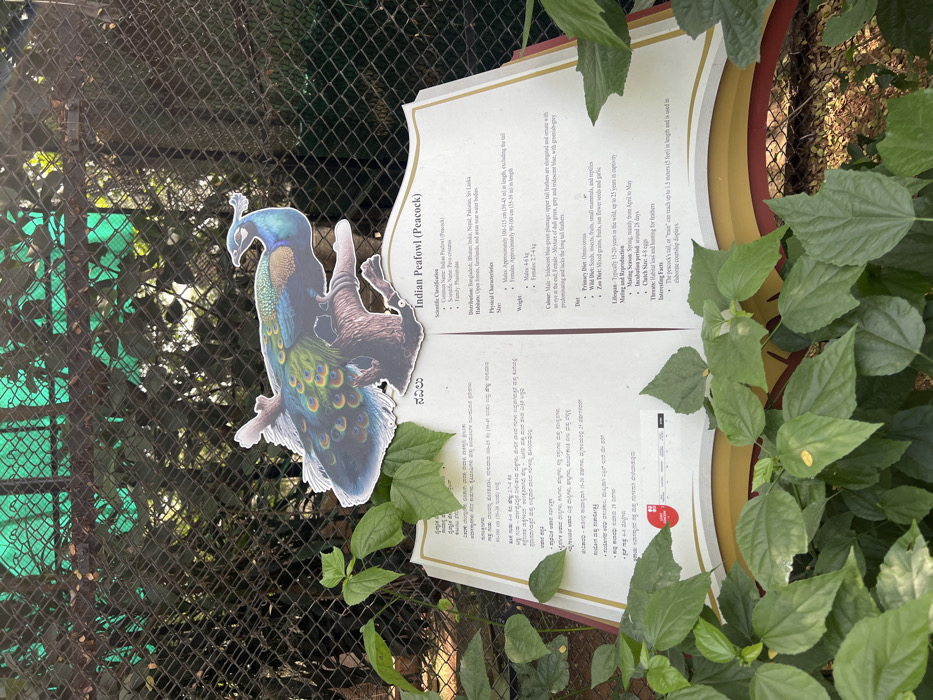
This image captures an informational display sign about the Indian Peafowl (Peacock) in an outdoor setting, likely a zoo or wildlife park in Mysuru, India. The sign is made of two panels, with an illustration of a peacock on the left panel, and descriptive text in English and Kannada on both panels. Green foliage is visible in the foreground and around the sign, with a chain-link fence in the background, suggesting an enclosure. The lighting indicates it is daytime. The visible English text on the right panel provides detailed information about the "Indian Peafowl (Peacock)". It includes: - **Scientific Classification:** Common Name: Indian Peafowl (Peacock), Scientific Name: Pavo cristatus. - **Distribution:** Bangladesh, Bhutan, India, Nepal, Pakistan, Sri Lanka. - **Habitat:** Open forests, farmlands, and near water bodies. - **Physical Characteristics:** Size (males approx. 100-115 cm, females approx. 90-100 cm), Weight (males 4-6 kg, females 2.7-4 kg). - **Colour:** Describes the iridescent blue-green plumage of males and the duller green, grey, and blue mixture of females. - **Diet:** Primary Diet: Omnivore; Wild Diet: Seeds, insects, fruits, small mammals, and reptiles; Zoo Diet: Mixed grains, fruits, sunflower seeds, and "garlic" (likely a misread for 'greens' or similar). - **Lifespan:** Typically 15-20 years in the wild, up to 25 years in captivity. - **Mating and Reproduction:** Mating Season: Spring (April to May); Incubation period: around 28 days; Clutch Size: 4-8 eggs. - **Threats:** Habitat loss and hunting for feathers. - **Interesting Facts:** The peacock's tail, or "train," can reach up to 1.5 meters (5 feet) and is used in elaborate courtship displays. Some Kannada text is also visible on the left panel. The image suggests an educational exhibit for visitors to learn about the peacock.
No transactions found