
Stake attention in this memory
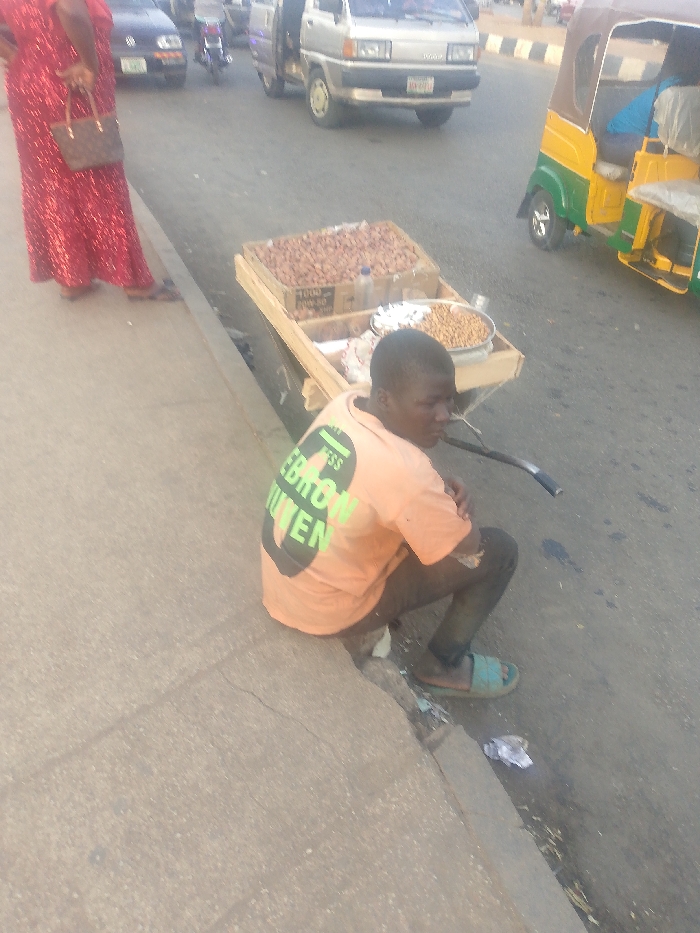
The image captures a vibrant street scene, likely in an urban or semi-urban area, characterized by roadside vending and active traffic. The time of day appears to be bright daylight. In the foreground on the left, a person is partially visible, dressed in a long, flowing red garment that appears to be sequined or heavily embellished. They are holding a small, light brown handbag with a distinct pattern. Their feet, adorned with simple sandals, are also visible. In the center and right foreground, a young boy or man is seated on the edge of a concrete curb, looking towards the right side of the frame. He wears an orange short-sleeved t-shirt with a light green design and text on the back. The text on his shirt is partially visible, reading "ESS" at the top, followed by what appears to be "EBRO" and "UWEN" or a similar word, possibly part of a name or slogan, along with a graphic that resembles a head silhouette. He is wearing dark trousers that appear dusty or soiled, and light blue open-toed slippers. Adjacent to the boy is a rustic, wooden pushcart or stand, which serves as his mobile shop. The cart holds various items for sale. A large, shallow wooden-framed tray on top is filled with a substantial quantity of light brown, elongated nuts, likely groundnuts or peanuts in their shells. Below this tray, a cardboard box is visible with text that reads "1000 NGN" (likely indicating a price in Nigerian Naira) and "09.00". On the cart, next to the main nut display, there are two metal bowls: one containing shelled roasted groundnuts, and another filled with small white items, possibly roasted maize or another type of snack. A clear plastic water bottle is also placed on the cart. A dark, curved handle, resembling a bicycle handlebar or part of the cart's steering mechanism, protrudes near the boy's right arm. The background shows a busy asphalt road with several vehicles. A silver or white small utility van or mini-bus, resembling an older model like a Toyota LiteAce, is prominent in the mid-ground. To its right, a colorful auto-rickshaw, common in many parts of the world (often called Keke Napep or Tuk-tuk), is visible with yellow, green, and black body panels. Further back on the left side of the road, another car (dark-colored) and a motorcycle are partially visible, indicating ongoing traffic. The concrete curb where the boy sits leads to a shallow gutter or drainage channel, where a few pieces of trash, such as crumpled paper or plastic, are scattered. The overall impression is one of daily life and commerce unfolding along a busy thoroughfare.
Loading AttnAds…
No transactions found