Sign in
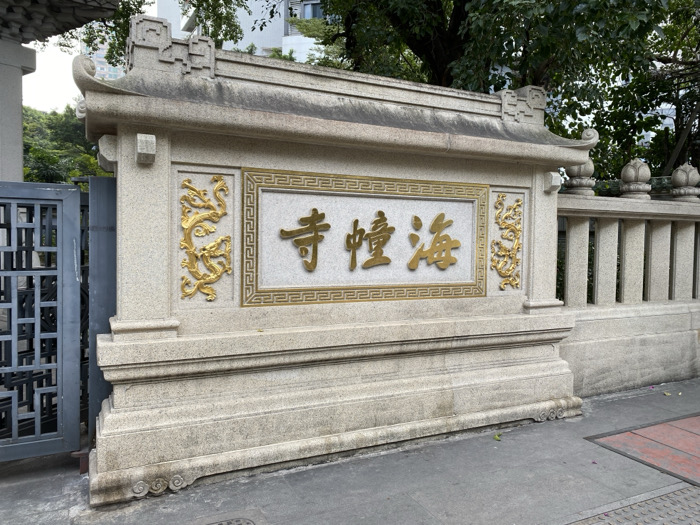
The image displays a substantial stone wall or sign, likely marking the entrance to a temple or traditional building, situated outdoors in Guangzhou, China. The structure is made of light-colored stone, possibly granite, exhibiting traditional Chinese architectural elements.

At the center of the wall is a recessed rectangular panel featuring three prominent golden Chinese characters. These characters, read from right to left, are "海檀寺" (Hǎi Tán Sì), which translates to "Haidan Temple" or "Tanhai Temple." The golden characters are framed by an elaborate golden patterned border. On either side of this central inscription panel, golden relief carvings of stylized dragons are intricately detailed on the stone, adding a decorative and culturally significant touch.

The top of the stone structure features a curved, roof-like design with tiered, decorative embellishments, characteristic of classical Chinese architecture. The base of the wall is broad and includes layered molding. To the left, a dark-colored metal gate with an intricate geometric lattice pattern is partially visible and appears slightly open. To the right, the wall transitions into a lower stone railing, adorned with decorative lotus-shaped finials on its posts.

In the background, lush green foliage from trees is visible, with hints of modern buildings beyond, suggesting an urban or suburban setting. The ground in the foreground is a paved sidewalk of light grey, with some darker reddish-brown square tiles visible on the right side. The lighting indicates it is daytime, possibly under an overcast sky or in a shaded area, as there are no strong shadows. The stone shows signs of weathering and some discoloration, suggesting its age and exposure to the elements. There are no people or explicit activities depicted in the static architectural scene.
F
FM-CaIMM2

Dec 24, 2024, 6:47 AM

Guang Zhou Shi, China

Stake attention in this memory

The image displays a substantial stone wall or sign, likely marking the entrance to a temple or traditional building, situated outdoors in Guangzhou, China. The structure is made of light-colored stone, possibly granite, exhibiting traditional Chinese architectural elements. At the center of the wall is a recessed rectangular panel featuring three prominent golden Chinese characters. These characters, read from right to left, are "海檀寺" (Hǎi Tán Sì), which translates to "Haidan Temple" or "Tanhai Temple." The golden characters are framed by an elaborate golden patterned border. On either side of this central inscription panel, golden relief carvings of stylized dragons are intricately detailed on the stone, adding a decorative and culturally significant touch. The top of the stone structure features a curved, roof-like design with tiered, decorative embellishments, characteristic of classical Chinese architecture. The base of the wall is broad and includes layered molding. To the left, a dark-colored metal gate with an intricate geometric lattice pattern is partially visible and appears slightly open. To the right, the wall transitions into a lower stone railing, adorned with decorative lotus-shaped finials on its posts. In the background, lush green foliage from trees is visible, with hints of modern buildings beyond, suggesting an urban or suburban setting. The ground in the foreground is a paved sidewalk of light grey, with some darker reddish-brown square tiles visible on the right side. The lighting indicates it is daytime, possibly under an overcast sky or in a shaded area, as there are no strong shadows. The stone shows signs of weathering and some discoloration, suggesting its age and exposure to the elements. There are no people or explicit activities depicted in the static architectural scene.

Loading AttnAds…

transactions
revenues
stakers
Earliest
Latest
Highest stake

No transactions found

More from this user

More from Guang Zhou Shi

FFM-CaIMM2

Dec 24, 2024, 6:47 AM

Guang Zhou Shi, China

Licensed under Creative Commons Attribution 4.0 International License. You are free to share and adapt this content with proper attribution.