
Sign in
The image displays a page from a textbook or technical document, likely related to microscopy or optical instruments. The content is divided into sections with accompanying diagrams and a table.

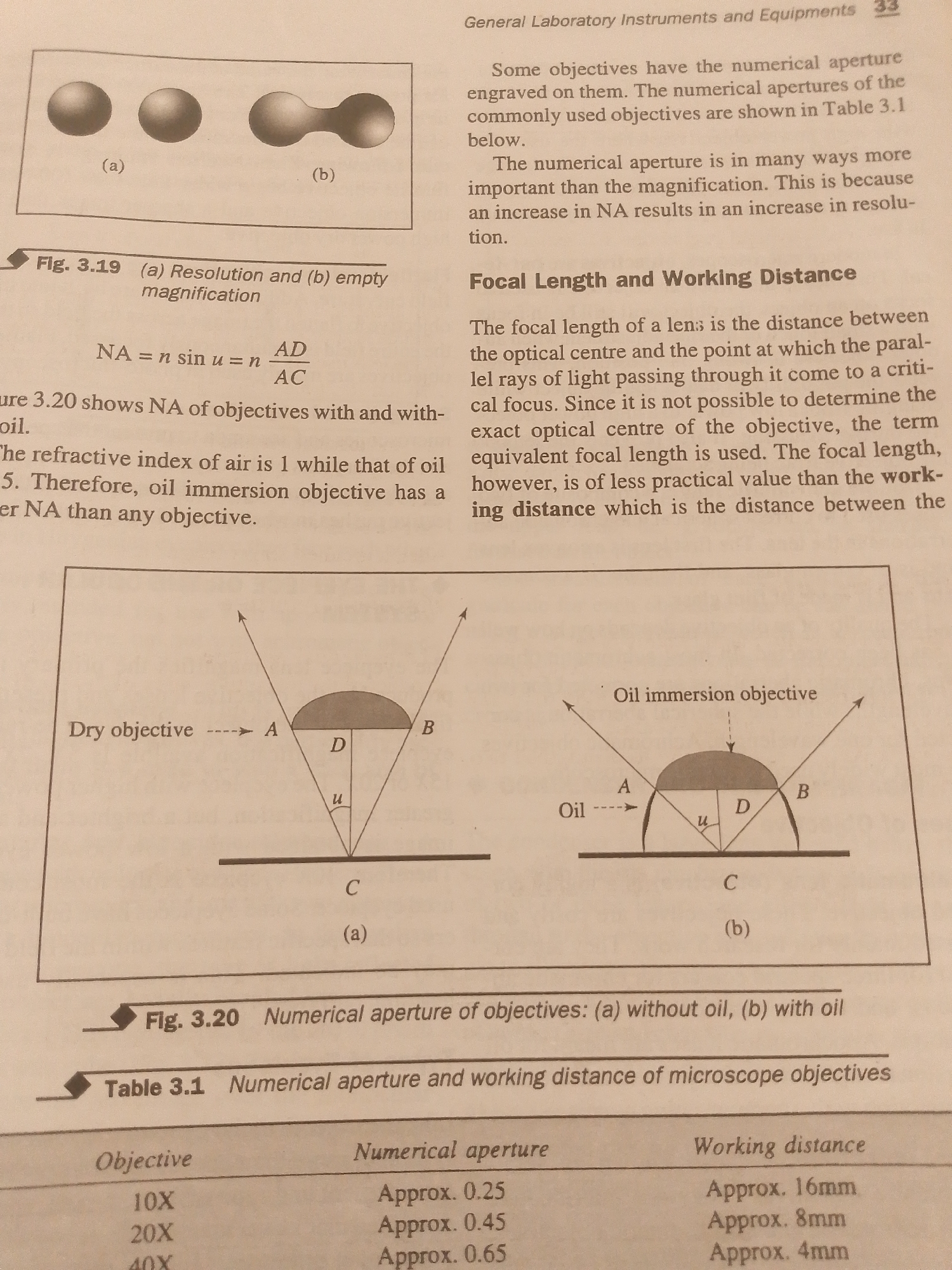
One section discusses "Numerical Aperture" and includes a formula: NA = n sin u = n AD/AC. Another section covers "Focal Length and Working Distance."

The main visual element is Figure 3.20, which illustrates the concept of numerical aperture with two diagrams labeled (a) and (b). Diagram (a) shows a "Dry objective" with light rays entering and exiting a lens system above a surface labeled 'C'. Diagram (b) depicts an "Oil immersion objective," showing a similar lens system but with "Oil" indicated between the objective and the surface. Both diagrams use labels like A, B, C, D, and µ (mu) to denote different points and angles relevant to optical principles.

Below the figures, Table 3.1 is presented, titled "Numerical aperture and working distance of microscope objectives." It lists three objectives: 10X, 20X, and 40X, along with their approximate numerical apertures and working distances.

The text also refers to Figure 3.19, which is partially visible at the top left, showing abstract shapes labeled (a) and (b) and the caption "(a) Resolution and (b) empty magnification."

The overall scene is a technical educational context, explaining concepts in optics and microscopy. There are no people visible, and the setting is a printed page. The time of day, weather, and emotions are not applicable to this document extract. The visible text provides definitions, formulas, and data related to microscope objectives.
FM-qTLKq1

Jun 29, 2026

Jalingo, Nigeria

Stake attention in this memory

academic
analytical
focused
inquisitive
studious

The image displays a page from a textbook or technical document, likely related to microscopy or optical instruments. The content is divided into sections with accompanying diagrams and a table. One section discusses "Numerical Aperture" and includes a formula: NA = n sin u = n AD/AC. Another section covers "Focal Length and Working Distance." The main visual element is Figure 3.20, which illustrates the concept of numerical aperture with two diagrams labeled (a) and (b). Diagram (a) shows a "Dry objective" with light rays entering and exiting a lens system above a surface labeled 'C'. Diagram (b) depicts an "Oil immersion objective," showing a similar lens system but with "Oil" indicated between the objective and the surface. Both diagrams use labels like A, B, C, D, and µ (mu) to denote different points and angles relevant to optical principles. Below the figures, Table 3.1 is presented, titled "Numerical aperture and working distance of microscope objectives." It lists three objectives: 10X, 20X, and 40X, along with their approximate numerical apertures and working distances. The text also refers to Figure 3.19, which is partially visible at the top left, showing abstract shapes labeled (a) and (b) and the caption "(a) Resolution and (b) empty magnification." The overall scene is a technical educational context, explaining concepts in optics and microscopy. There are no people visible, and the setting is a printed page. The time of day, weather, and emotions are not applicable to this document extract. The visible text provides definitions, formulas, and data related to microscope objectives.

transactions
revenues
stakers
Earliest
Latest
Highest stake

No transactions found

More from this user

More from Jalingo

FM-qTLKq1

Jun 29, 2026

Jalingo, Nigeria

Licensed under Creative Commons Attribution 4.0 International License. You are free to share and adapt this content with proper attribution.