
Stake attention in this memory
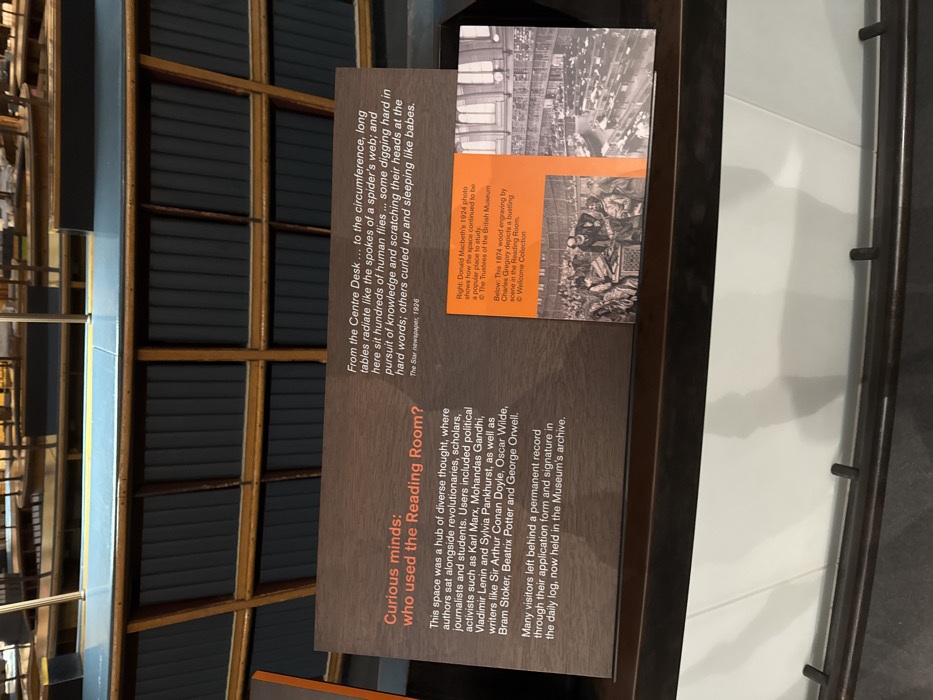
An informational display board, likely in a museum in London, United Kingdom, provides details about a historical "Reading Room." The board, presented on a dark wood-like background, features text in white and orange, and two historical images. The background behind the display shows tiered library shelving or architectural details, possibly part of the original Reading Room or a recreated exhibit. The display is titled "Curious minds: who used the Reading Room?" It describes the space as a "hub of diverse thought" frequented by authors, revolutionaries, scholars, journalists, and students. Notable figures mentioned as users include political activists like Karl Marx, Mohandas Gandhi, Vladimir Lenin, and Sylvia Pankhurst, alongside writers such as Sir Arthur Conan Doyle, Oscar Wilde, Bram Stoker, Beatrix Potter, and George Orwell. The text notes that visitors left a permanent record in a daily log, now held in the Museum's archive. A quote from "The Star newspaper, 1926" describes the Reading Room: "From the Centre Desk... to the circumference, long tables radiate like the spokes of a spider's web; and here sit hundreds of human flies... some digging hard in pursuit of knowledge and scratching their heads at the hard words; others curled up and sleeping like babes." This vivid description evokes a bustling, intellectual atmosphere. Two historical images are present on the right side of the board. The top image is a black and white photograph from 1924 by Donald Macbeth, showing the Reading Room filled with people studying. The caption confirms it illustrates "how the space continued to be a popular place to study." Below it is an 1874 wood engraving by Charles Gregory, depicting an equally busy scene in the Reading Room, described as "a bustling scene." Both images support the text's portrayal of the Reading Room as a vibrant center of learning and activity.
Loading AttnAds…
No transactions found