
Stake attention in this memory
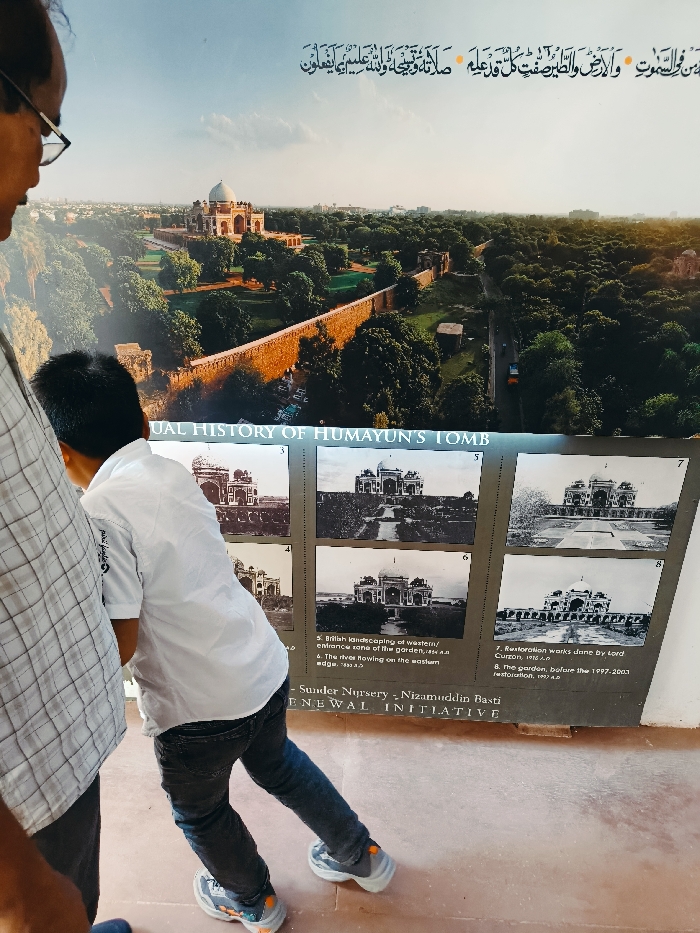
Two people, an adult male and a young boy, are looking at a wall display featuring black and white photos of the Humayun's Tomb, located at 28.593, 77.249 in New Delhi, India. The display is titled "Visual History of Humayun's Tomb". The adult male, wearing a gray plaid shirt, is standing to the left of the display. The boy, wearing a white t-shirt and blue jeans, is standing in front of the display, leaning in to look at the photos. The photos illustrate the history of the Humayun's Tomb. The display is on a white wall, and the ground is a light beige tile. The photos are labeled with numbers 3 through 9, indicating a continuation of the visual history. The photos are in black and white and show different stages of the tomb's construction and restoration. The first photo shows the tomb in the 1500s, the second photo shows the tomb in the 1800s, the third photo shows the tomb in the 1900s, the fourth photo shows the tomb in the 1950s, the fifth photo shows the tomb in the 1970s, the sixth photo shows the tomb in the 1990s, and the seventh photo shows the tomb in the 2000s. The text below the photos describes the changes made to the tomb during each stage. The photos and text are presented in a clear and informative way. The overall appearance of the scene is educational. A large aerial image of the tomb is shown at the top of the wall, with an inscription in Arabic above it. The inscription is in a decorative font, with calligraphy. The inscription is written in Arabic script. The inscription is in a golden yellow color. The aerial image is in color. The image is taken from a high vantage point and shows the entire tomb complex. The tomb is surrounded by green trees and a high wall. The wall is made of red brick and is very tall. The aerial image is a very detailed image. The inscription is a reminder of the Islamic heritage of the tomb.
Loading AttnAds…
No transactions found