Sign in
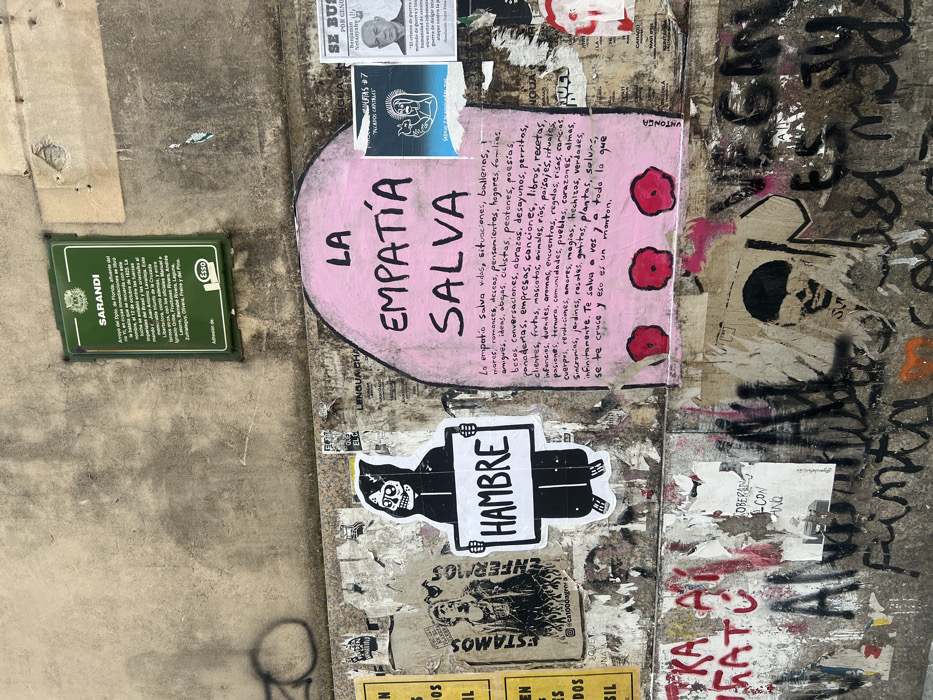
A textured, grimy concrete wall in an urban setting, likely Montevideo, Uruguay, is covered with layered street art, posters, and graffiti. The scene is illuminated by daylight, creating varied textures and shadows on the rough surface.

The central feature is a large, irregularly shaped pink painted area on the wall, roughly heart-like, with black text and three red poppy-style flowers. The prominent text reads "LA EMPATÍA SALVA" (EMPATHY SAVES). Below this, a lengthy paragraph lists numerous nouns associated with empathy, beginning "La empatía salva vidas, situaciones, ballenas, mares, romances..." and concluding "...Te salva a vos y a todo lo que se te cruce y eso es un montón" (It saves you and everything you come across and that's a lot).

To the left, a rectangular green plaque is affixed to the wall. It features the word "SARANDI" at the top, followed by a historical description in white text about the Arroyo Sarandi, mentioning its origin, flow, the battle of October 12, 1825, the war with Brazil, and historical figures like Juan Antonio Lavalleja and Fructuoso Rivera. A small "Esso" logo is visible at the bottom right of the plaque.

Below the pink artwork, a black-and-white sticker depicts a stylized figure with a skull-like face holding a sign that reads "HAMBRE" (HUNGER). Other visible text fragments and graffiti include "UNTONGA," "LENGUA CH," "SE BUSC" (SEEKING), "ENFERMOS" (SICK/ILL), "ESTAMOS" (WE ARE/WE ARE HERE), "KALA RATU," and partially obscured tags.

The wall showcases a mix of public information, artistic expression, and social commentary through paint, paper, and stickers, reflecting a dynamic urban landscape.
F
FM-3Wd0j2

Jan 2, 2025

Montevideo, Uruguay

Stake attention in this memory

A textured, grimy concrete wall in an urban setting, likely Montevideo, Uruguay, is covered with layered street art, posters, and graffiti. The scene is illuminated by daylight, creating varied textures and shadows on the rough surface. The central feature is a large, irregularly shaped pink painted area on the wall, roughly heart-like, with black text and three red poppy-style flowers. The prominent text reads "LA EMPATÍA SALVA" (EMPATHY SAVES). Below this, a lengthy paragraph lists numerous nouns associated with empathy, beginning "La empatía salva vidas, situaciones, ballenas, mares, romances..." and concluding "...Te salva a vos y a todo lo que se te cruce y eso es un montón" (It saves you and everything you come across and that's a lot). To the left, a rectangular green plaque is affixed to the wall. It features the word "SARANDI" at the top, followed by a historical description in white text about the Arroyo Sarandi, mentioning its origin, flow, the battle of October 12, 1825, the war with Brazil, and historical figures like Juan Antonio Lavalleja and Fructuoso Rivera. A small "Esso" logo is visible at the bottom right of the plaque. Below the pink artwork, a black-and-white sticker depicts a stylized figure with a skull-like face holding a sign that reads "HAMBRE" (HUNGER). Other visible text fragments and graffiti include "UNTONGA," "LENGUA CH," "SE BUSC" (SEEKING), "ENFERMOS" (SICK/ILL), "ESTAMOS" (WE ARE/WE ARE HERE), "KALA RATU," and partially obscured tags. The wall showcases a mix of public information, artistic expression, and social commentary through paint, paper, and stickers, reflecting a dynamic urban landscape.

transactions
revenues
stakers
Earliest
Latest
Highest stake

No transactions found

More from this user

More from Montevideo

FFM-3Wd0j2

Jan 2, 2025

Montevideo, Uruguay

Licensed under Creative Commons Attribution 4.0 International License. You are free to share and adapt this content with proper attribution.