
Sign in
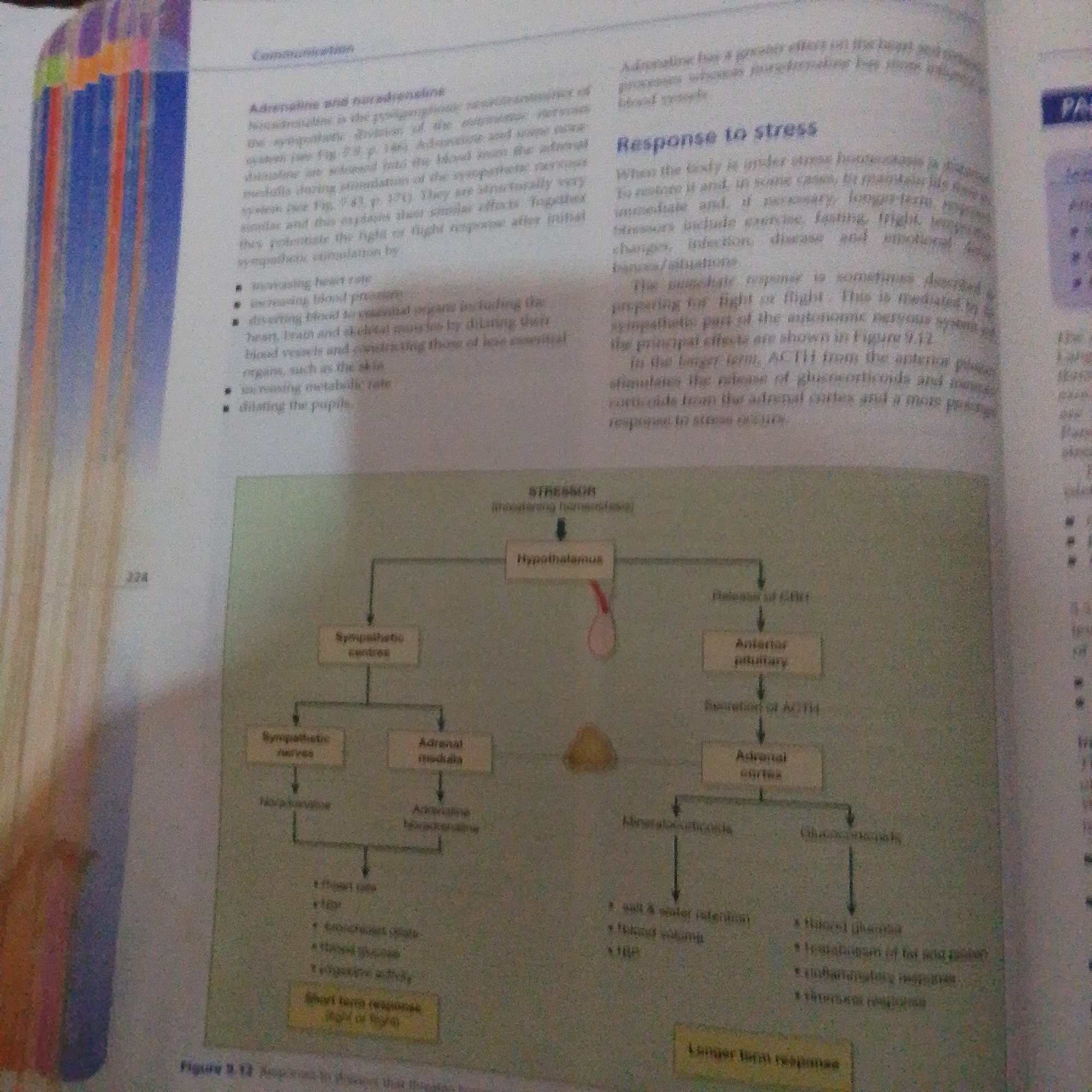
The image is a close-up shot of an open textbook, with a portion of the right page visible. The page is filled with text and a diagram. The text discusses the "Adrenal and noradrenaline" and the "Response to stress" in the human body, explaining physiological reactions to stressors. The diagram, labeled "Figure 9.12," illustrates the body's response to stress, detailing the roles of the hypothalamus, adrenal medulla, anterior pituitary, and adrenal cortex. It differentiates between short-term responses, like the "fight or flight" response, and longer-term responses.

Visible text includes headings like "Communication," "Response to stress," "STRESSOR (threatening homeostasis)," "Hypothalamus," "Sympathetic centres," "Adrenal medulla," "Adrenal cortex," "Release of CRH," "Anterior pituitary," "Secretion of ACTH," and "Short term response (fight or flight)," as well as "Longer term response." Bullet points detailing physiological effects are also present, such as "increasing heart rate," "increasing blood pressure," "diverting blood to essential organs," "increasing metabolic rate," and "dilating the pupils." The text also mentions hormones like adrenaline, noradrenaline, ACTH, glucocorticoids, and mineralocorticoids.

The overall impression is educational, likely from a biology or physiology textbook, focused on explaining the neuroendocrine system's role in stress response. There are no people, objects other than the book, or any specific scene or setting cues, apart from the book being open, implying it's being read or studied. The lighting suggests an indoor environment. The page numbers "224" and "PA" are also visible.
FM-66btC3

Jun 30, 2026, 1:27 PM

Jalingo, Nigeria

Stake attention in this memory

anxious
intense
stressed
focused
alert

The image is a close-up shot of an open textbook, with a portion of the right page visible. The page is filled with text and a diagram. The text discusses the "Adrenal and noradrenaline" and the "Response to stress" in the human body, explaining physiological reactions to stressors. The diagram, labeled "Figure 9.12," illustrates the body's response to stress, detailing the roles of the hypothalamus, adrenal medulla, anterior pituitary, and adrenal cortex. It differentiates between short-term responses, like the "fight or flight" response, and longer-term responses. Visible text includes headings like "Communication," "Response to stress," "STRESSOR (threatening homeostasis)," "Hypothalamus," "Sympathetic centres," "Adrenal medulla," "Adrenal cortex," "Release of CRH," "Anterior pituitary," "Secretion of ACTH," and "Short term response (fight or flight)," as well as "Longer term response." Bullet points detailing physiological effects are also present, such as "increasing heart rate," "increasing blood pressure," "diverting blood to essential organs," "increasing metabolic rate," and "dilating the pupils." The text also mentions hormones like adrenaline, noradrenaline, ACTH, glucocorticoids, and mineralocorticoids. The overall impression is educational, likely from a biology or physiology textbook, focused on explaining the neuroendocrine system's role in stress response. There are no people, objects other than the book, or any specific scene or setting cues, apart from the book being open, implying it's being read or studied. The lighting suggests an indoor environment. The page numbers "224" and "PA" are also visible.

Loading AttnAds…

transactions
revenues
stakers
Earliest
Latest
Highest stake

No transactions found

More from this user

More from Jalingo

FM-66btC3

Jun 30, 2026, 1:27 PM

Jalingo, Nigeria

Licensed under Creative Commons Attribution 4.0 International License. You are free to share and adapt this content with proper attribution.