
Sign in
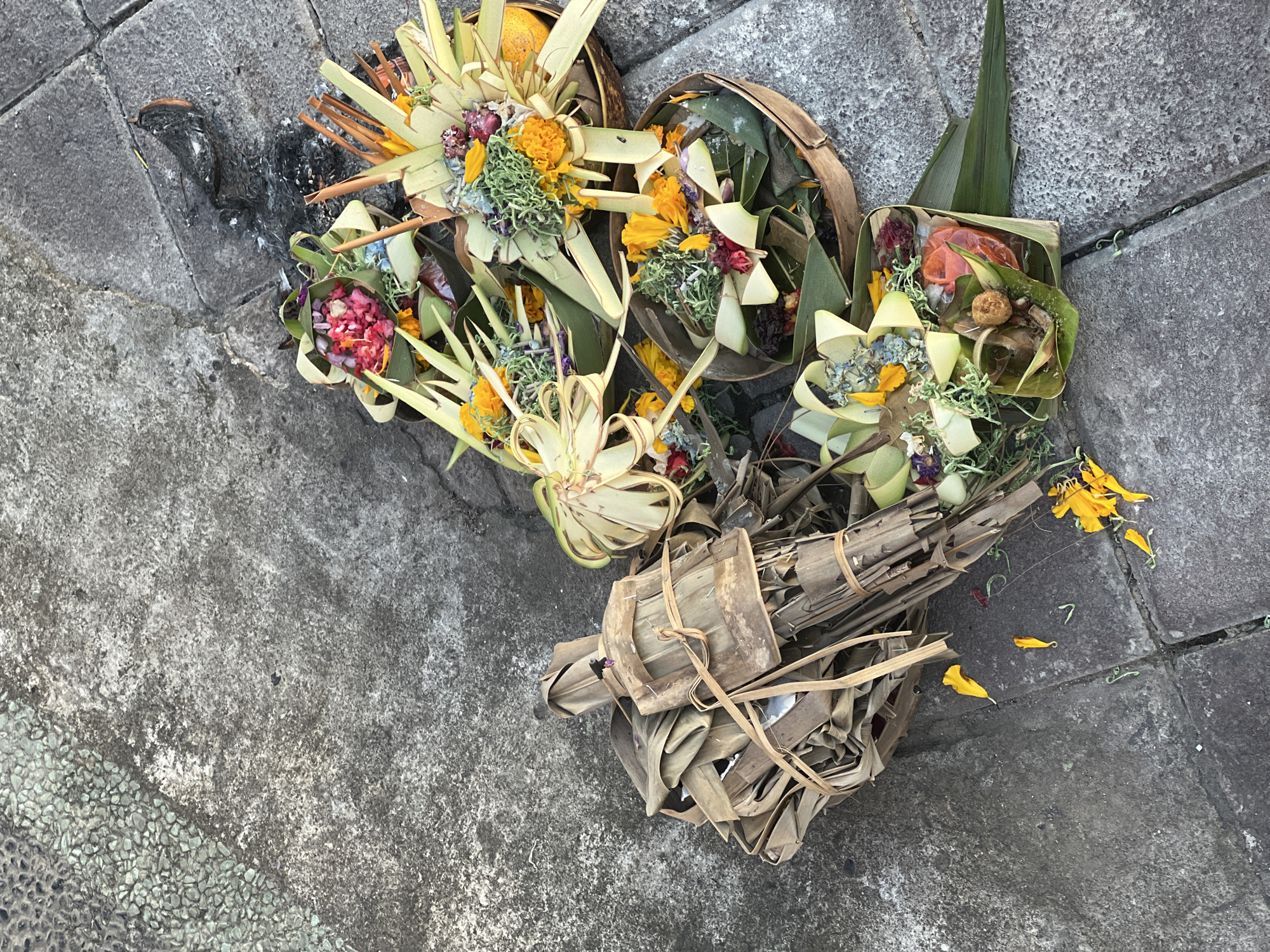
The image displays a collection of Balinese offerings, known as "Canang Sari," arranged on a textured concrete surface. These offerings are typical in Hindu ceremonies in Bali, Indonesia, and are meant to express gratitude to the gods.

The subjects are the offerings themselves, which consist of woven palm leaves forming small containers and decorative elements. These containers hold various items including colorful flowers (yellow, red, and blue), rice, and possibly fruit or other food items. Some offerings are placed within woven baskets, while others are more simply arranged. A larger, more elaborate offering wrapped in dried leaves and tied with string is also prominent. The arrangement suggests they have been placed on the ground, possibly as part of a ritual or as an offering that has been discarded after use.

The setting is an outdoor paved area, likely a sidewalk or pathway, with visible seams between the concrete slabs. The texture of the concrete varies, with some areas appearing smoother and others rougher, possibly due to weathering or material composition. In the upper left corner, a dark, amorphous shape is visible on the ground, which appears to be ash or charcoal from a fire, possibly related to a past offering or ritual. Scattered yellow flower petals and some small green plant matter are also visible on the ground around the offerings, indicating they may have been recently placed or disturbed.

The time of day appears to be daytime, with natural light illuminating the scene. There are no people visible in the image. The overall mood is one of quiet ritual and a glimpse into the cultural practices of the location. While no text is visible, the style and composition of the offerings strongly suggest a Balinese cultural context, consistent with the provided location cue of Mengwi, Indonesia.
Antoni

Jun 27, 2026

Mengwi, Indonesia

Stake attention in this memory

spiritual
cultural
offering
traditional
devotional

The image displays a collection of Balinese offerings, known as "Canang Sari," arranged on a textured concrete surface. These offerings are typical in Hindu ceremonies in Bali, Indonesia, and are meant to express gratitude to the gods. The subjects are the offerings themselves, which consist of woven palm leaves forming small containers and decorative elements. These containers hold various items including colorful flowers (yellow, red, and blue), rice, and possibly fruit or other food items. Some offerings are placed within woven baskets, while others are more simply arranged. A larger, more elaborate offering wrapped in dried leaves and tied with string is also prominent. The arrangement suggests they have been placed on the ground, possibly as part of a ritual or as an offering that has been discarded after use. The setting is an outdoor paved area, likely a sidewalk or pathway, with visible seams between the concrete slabs. The texture of the concrete varies, with some areas appearing smoother and others rougher, possibly due to weathering or material composition. In the upper left corner, a dark, amorphous shape is visible on the ground, which appears to be ash or charcoal from a fire, possibly related to a past offering or ritual. Scattered yellow flower petals and some small green plant matter are also visible on the ground around the offerings, indicating they may have been recently placed or disturbed. The time of day appears to be daytime, with natural light illuminating the scene. There are no people visible in the image. The overall mood is one of quiet ritual and a glimpse into the cultural practices of the location. While no text is visible, the style and composition of the offerings strongly suggest a Balinese cultural context, consistent with the provided location cue of Mengwi, Indonesia.

transactions
revenues
stakers
Earliest
Latest
Highest stake

No transactions found

More from this user

More from Mengwi

Antoni

Jun 27, 2026

Mengwi, Indonesia

Licensed under Creative Commons Attribution 4.0 International License. You are free to share and adapt this content with proper attribution.