Sign in
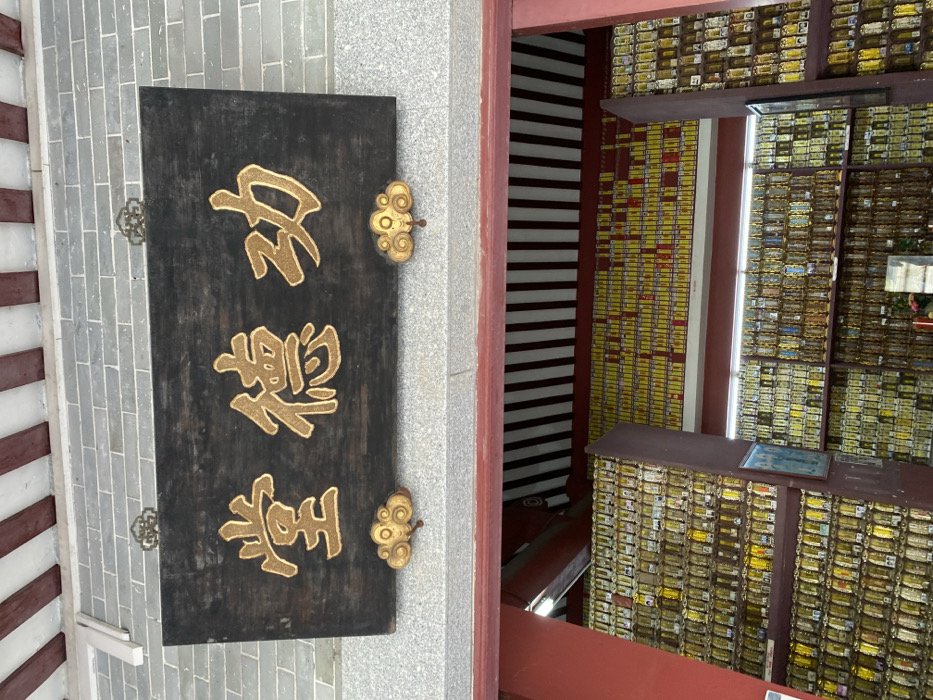
The image displays the entrance and a partial interior view of a traditional Chinese building in Guangzhou, China. On the left, a dark, weathered wooden plaque with three ornate golden Chinese characters is vertically mounted on a grey brick wall. Two decorative golden brass fasteners, resembling stylized clouds or auspicious symbols, secure the plaque.

The three characters on the plaque read, from top to bottom: "同德堂" (Tóng Dé Táng), which translates to "Tong De Hall" or "Hall of United Virtue." This naming convention is common for traditional establishments, such as Chinese medicine shops, ancestral halls, or cultural institutions.

Through an open doorway on the right, the building's interior is revealed. It features an extensive and highly organized system of numerous small, rectangular compartments, resembling drawers or cubbyholes. These compartments, predominantly yellow and brown, are stacked in neat rows, extending from floor level upwards, creating a grid-like pattern across the visible walls. The arrangement strongly suggests a traditional Chinese medicine dispensary for herbs or ingredients, or perhaps a specialized archive for small items or records. No people are present, and no specific activity is taking place. The scene conveys a sense of historical preservation and meticulous organization, with even lighting suggesting daytime or well-lit indoor conditions.
F
FM-CaIMM2

Dec 24, 2024, 7:06 AM

Guang Zhou Shi, China

Stake attention in this memory

The image displays the entrance and a partial interior view of a traditional Chinese building in Guangzhou, China. On the left, a dark, weathered wooden plaque with three ornate golden Chinese characters is vertically mounted on a grey brick wall. Two decorative golden brass fasteners, resembling stylized clouds or auspicious symbols, secure the plaque. The three characters on the plaque read, from top to bottom: "同德堂" (Tóng Dé Táng), which translates to "Tong De Hall" or "Hall of United Virtue." This naming convention is common for traditional establishments, such as Chinese medicine shops, ancestral halls, or cultural institutions. Through an open doorway on the right, the building's interior is revealed. It features an extensive and highly organized system of numerous small, rectangular compartments, resembling drawers or cubbyholes. These compartments, predominantly yellow and brown, are stacked in neat rows, extending from floor level upwards, creating a grid-like pattern across the visible walls. The arrangement strongly suggests a traditional Chinese medicine dispensary for herbs or ingredients, or perhaps a specialized archive for small items or records. No people are present, and no specific activity is taking place. The scene conveys a sense of historical preservation and meticulous organization, with even lighting suggesting daytime or well-lit indoor conditions.

Loading AttnAds…

transactions
revenues
stakers
Earliest
Latest
Highest stake

No transactions found

More from this user

More from Guang Zhou Shi

FFM-CaIMM2

Dec 24, 2024, 7:06 AM

Guang Zhou Shi, China

Licensed under Creative Commons Attribution 4.0 International License. You are free to share and adapt this content with proper attribution.