
Stake attention in this memory
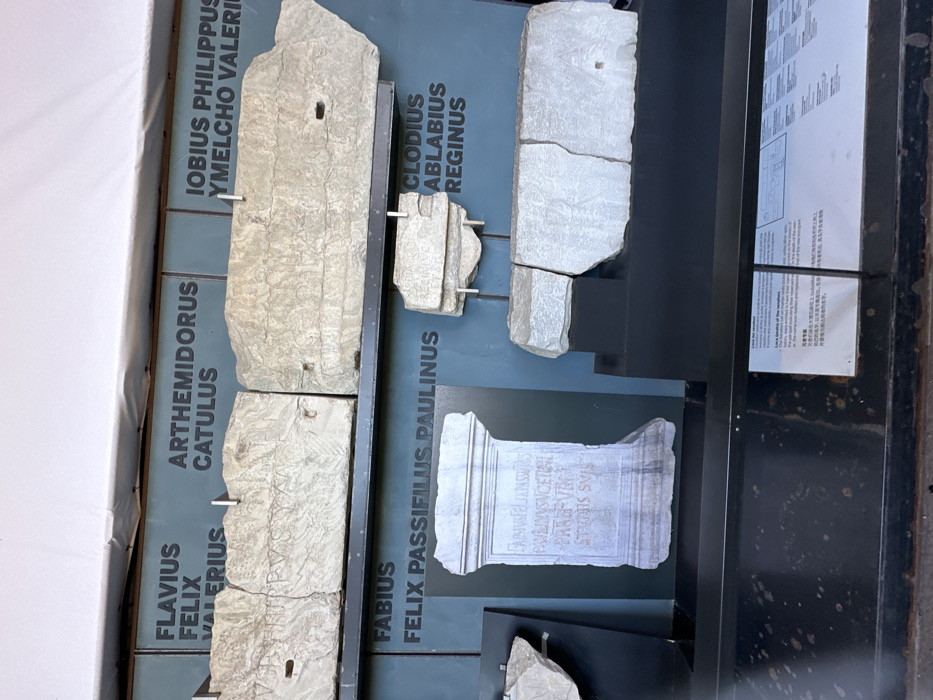
The image depicts an indoor exhibition display showcasing multiple fragmented ancient Roman stone inscriptions and architectural elements. The setting is a well-lit exhibition hall, likely an archaeological museum or a visitor center for an archaeological site in Rome, Italy. The artifacts are presented against dark blue panels, which serve as a backdrop, and are supported by black shelves and display stands. A white ceiling or canopy is visible at the top of the frame. The bottom portion of the image shows a black surface, possibly a display case or barrier, with a white informational plaque visible on the right, containing text in English ("Locus loculi" and "The Loculi") and potentially other languages, confirming a public exhibition context. Six primary fragments of light-colored stone, consistent with marble or limestone, are the central subjects. 1. **Top Row (left to right):** Three irregular, roughly rectangular stone slabs exhibit faint, incised Latin text. Each is positioned beneath a label in black uppercase sans-serif font: "FLAVIUS FELIX VALERIUS", "ARTHEMIDORUS CATULUS", and "IOBIUS PHILIPPUS YMELCHO VALERIUS". These appear to be parts of larger monuments or grave markers. 2. **Bottom Row (left to right):** * A larger, more intact pedestal-shaped stone fragment with clearer incised Latin inscriptions across several lines. Visible text includes "PASSIFILius...", "PAULINUS...", "PRAES. VIM...", and "STUDIIS SVIS...". This piece is placed on a black stand, with a printed image of the artifact behind it. It is labeled "FABIUS FELIX PASSIFILUS PAULINUS". * A smaller, irregular rectangular stone fragment with faded text, supported by two slender metal rods, labeled "CLODIUS ABLABIUS REGINUS". * Two conjoined irregular stone fragments, forming a larger, elongated piece, resting on a black stand. The surface shows texture but no legible inscription from this perspective. No people are visible in the scene. The implied action is the viewing and study of these historical artifacts by visitors. No direct interactions are depicted. The objects are static displays of ancient Roman epigraphy, offering insight into names and possibly roles of individuals from antiquity.
No transactions found