
Sign in
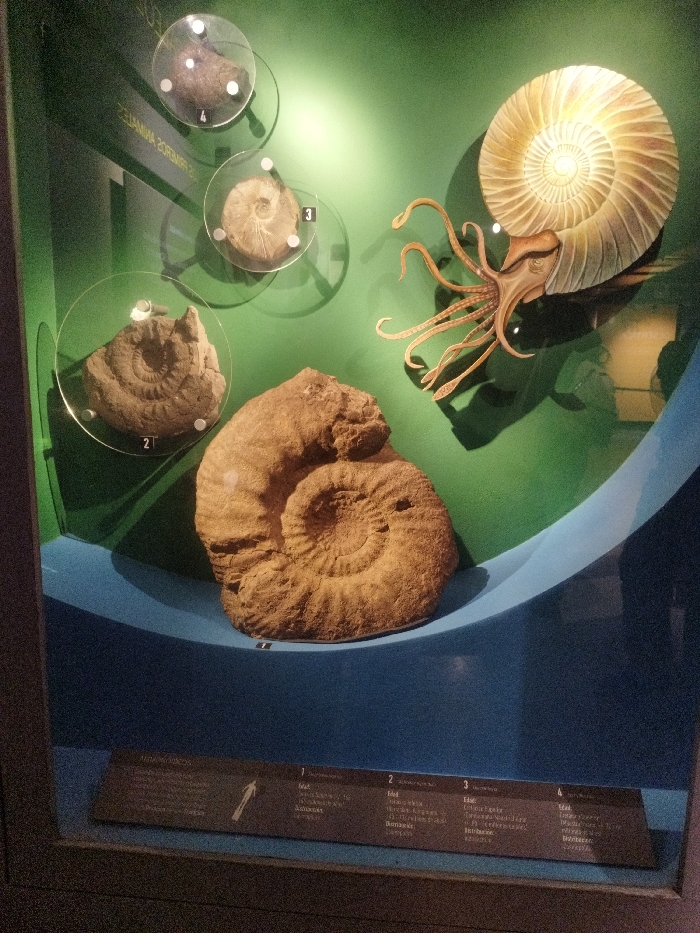
This image depicts a brightly lit museum exhibit, likely showcasing paleontological specimens. The scene features a green back wall and a curved, dark blue display base.

The main subjects are several ammonite fossils and a model of an ancient cephalopod. A large, intricately coiled ammonite fossil, roughly spherical, is prominently displayed on the blue base in the foreground. Above and to its left, three smaller ammonite fossils are mounted on clear circular stands on the green wall, labeled '2', '3', and '4'. Fossil '2' is larger and more detailed than the other two on the wall.

To the right, a detailed model of a shelled cephalopod, resembling a Nautilus or an Ammonite reconstruction, is affixed to the green wall. It features a large, cream-colored spiral shell and multiple reddish-brown tentacles extending forward. The model is dramatically lit, casting a distinct shadow on the wall.

Visible text includes partially obscured, inverted lettering on the green wall, which appears to read "...PRIMEROS ANIMALES..." (First Animals). Along the bottom edge of the display, a dark information plaque provides details for the numbered items. For item '1' (corresponding to the large fossil), "Ammonites" is visible. For items '2', '3', and '4', the plaque lists "Época" (Epoch), "Cretácico" (Cretaceous), and "Distribución" (Distribution), along with "Ammonites". Another section of the plaque includes the word "AMMONITES" and an arrow pointing to the left.

The exhibit's lighting highlights the textures of the fossils and the details of the model. No people are visible, and the controlled environment suggests an indoor museum setting, likely a natural history museum in Santiago, Chile, given the Spanish text.
Melani

Jan 7, 2025

Santiago, Chile

Stake attention in this memory

This image depicts a brightly lit museum exhibit, likely showcasing paleontological specimens. The scene features a green back wall and a curved, dark blue display base. The main subjects are several ammonite fossils and a model of an ancient cephalopod. A large, intricately coiled ammonite fossil, roughly spherical, is prominently displayed on the blue base in the foreground. Above and to its left, three smaller ammonite fossils are mounted on clear circular stands on the green wall, labeled '2', '3', and '4'. Fossil '2' is larger and more detailed than the other two on the wall. To the right, a detailed model of a shelled cephalopod, resembling a Nautilus or an Ammonite reconstruction, is affixed to the green wall. It features a large, cream-colored spiral shell and multiple reddish-brown tentacles extending forward. The model is dramatically lit, casting a distinct shadow on the wall. Visible text includes partially obscured, inverted lettering on the green wall, which appears to read "...PRIMEROS ANIMALES..." (First Animals). Along the bottom edge of the display, a dark information plaque provides details for the numbered items. For item '1' (corresponding to the large fossil), "Ammonites" is visible. For items '2', '3', and '4', the plaque lists "Época" (Epoch), "Cretácico" (Cretaceous), and "Distribución" (Distribution), along with "Ammonites". Another section of the plaque includes the word "AMMONITES" and an arrow pointing to the left. The exhibit's lighting highlights the textures of the fossils and the details of the model. No people are visible, and the controlled environment suggests an indoor museum setting, likely a natural history museum in Santiago, Chile, given the Spanish text.

transactions
revenues
stakers
Earliest
Latest
Highest stake

No transactions found

More from this user

More from Santiago

Melani

Jan 7, 2025

Santiago, Chile

Licensed under Creative Commons Attribution 4.0 International License. You are free to share and adapt this content with proper attribution.