
Stake attention in this memory
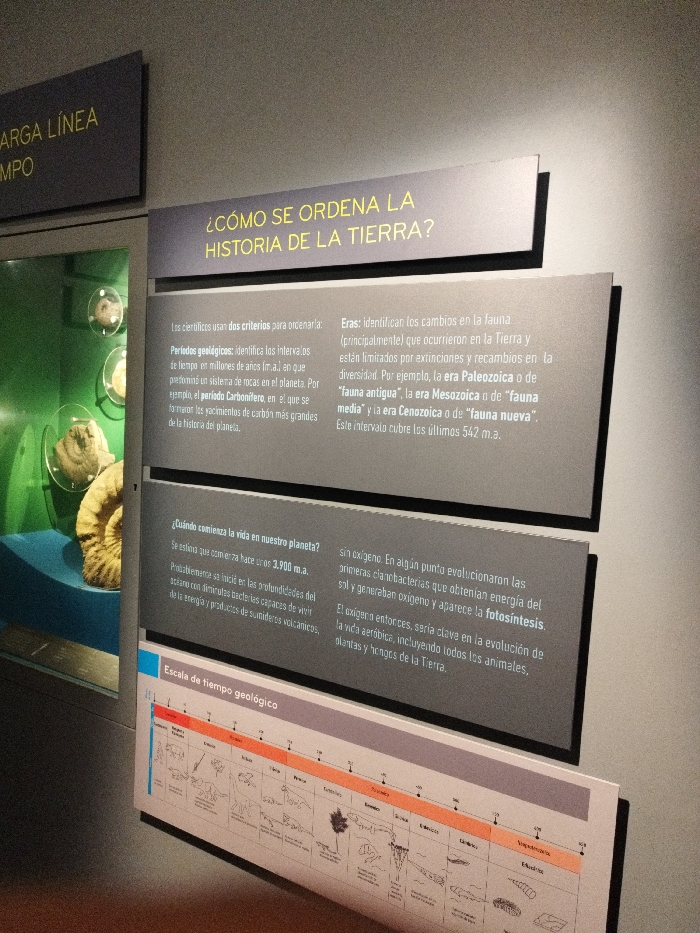
A museum exhibit display, likely in Santiago, Chile, focuses on the history and geological timeline of Earth. The scene features multiple rectangular panels mounted on a light gray wall, illuminated by artificial lighting that casts soft shadows. No people are visible. The main title asks, "¿CÓMO SE ORDENA LA HISTORIA DE LA TIERRA?" (How is the history of the Earth ordered?). The first large panel explains that scientists use "Períodos geológicos" (Geological periods) and "Eras" to categorize Earth's history. It cites examples like the Carboniferous period, Paleozoic, Mesozoic, and Cenozoic eras, covering the last 542 million years. Below, another panel addresses "¿Cuándo comienza la vida en nuestro planeta?" (When does life begin on our planet?), estimating its origin around 3,900 million years ago, possibly in deep-ocean volcanic vents without oxygen. It then describes the evolution of cyanobacteria, photosynthesis, and the crucial role of oxygen in aerobic life. To the left, an illuminated display case showcases geological specimens, including a prominent spiral-shaped fossil, likely an ammonite, and several smaller, round samples. Beneath the text panels, a colorful "Escala de tiempo geológico" (Geological time scale) chart, featuring illustrations of ancient life forms and geological periods, extends across the lower portion of the display. The overall exhibit uses dark gray panels with yellow titles and white body text for readability.
No transactions found