
Sign in
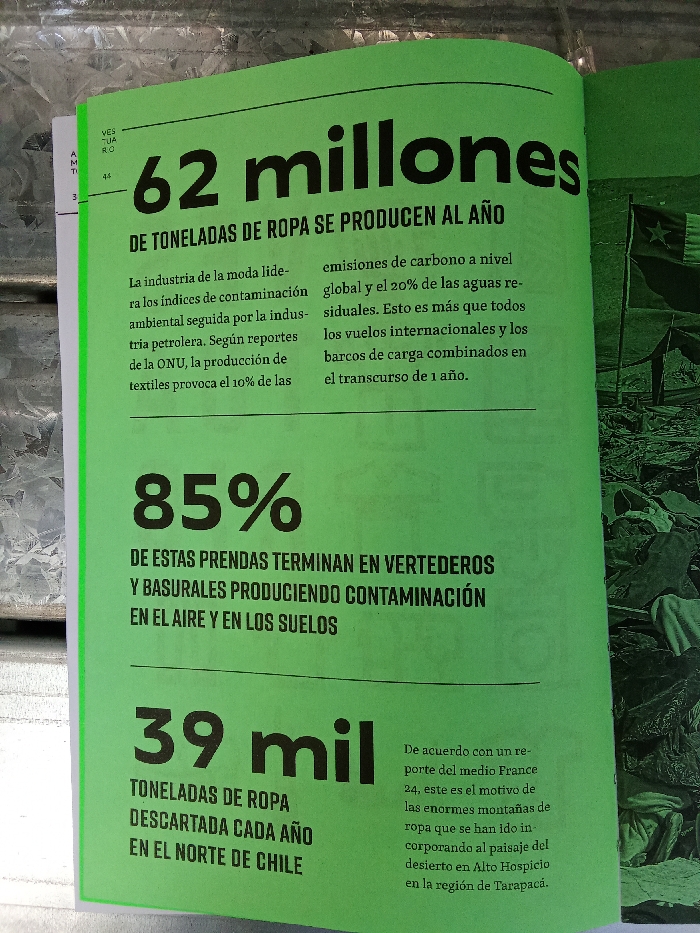
An open, bright green magazine page is displayed from an elevated, slightly angled perspective. The page features prominent black Spanish text and a partially visible desaturated image on the right margin. The primary headline reads "62 millones DE TONELADAS DE ROPA SE PRODUCEN AL AÑO" (62 million tons of clothes are produced annually). Subsequent text details that the fashion industry leads in environmental contamination, followed by the petroleum industry, citing UN reports that textile production causes 10% of global carbon emissions and 20% of wastewater. Below, a large "85%" is displayed, followed by "DE ESTAS PRENDAS TERMINAN EN VERTEDEROS Y BASURALES PRODUCIENDO CONTAMINACIÓN EN EL AIRE Y EN LOS SUELOS" (85% of these garments end up in landfills and dumps producing contamination in the air and in the soils). A final statistic, "39 mil TONELADAS DE ROPA DESCARTADA CADA AÑO EN EL NORTE DE CHILE" (39 thousand tons of clothing discarded annually in the North of Chile), is presented. Adjacent smaller text references a France 24 report stating this is the reason for the enormous mountains of clothes found in the Alto Hospicio desert in the Tarapacá region. The right edge of the page reveals a grayscale photograph of a landscape littered with discarded textiles, with a partially visible Chilean flag planted amidst the debris. The magazine rests on a textured, metallic surface, possibly corrugated metal or diamond plate, which is visible in the upper left and lower left portions of the image. The content explicitly references the Atacama Desert in the Tarapacá region, Northern Chile, and does not depict or mention any specific location within the city of Santiago, Chile.
Mel Navala

Sep 28, 2025, 1:21 PM

Santiago, Chile

Stake attention in this memory

Concern
Alarming
Distressing
Disappointment
Urgency

An open, bright green magazine page is displayed from an elevated, slightly angled perspective. The page features prominent black Spanish text and a partially visible desaturated image on the right margin. The primary headline reads "62 millones DE TONELADAS DE ROPA SE PRODUCEN AL AÑO" (62 million tons of clothes are produced annually). Subsequent text details that the fashion industry leads in environmental contamination, followed by the petroleum industry, citing UN reports that textile production causes 10% of global carbon emissions and 20% of wastewater. Below, a large "85%" is displayed, followed by "DE ESTAS PRENDAS TERMINAN EN VERTEDEROS Y BASURALES PRODUCIENDO CONTAMINACIÓN EN EL AIRE Y EN LOS SUELOS" (85% of these garments end up in landfills and dumps producing contamination in the air and in the soils). A final statistic, "39 mil TONELADAS DE ROPA DESCARTADA CADA AÑO EN EL NORTE DE CHILE" (39 thousand tons of clothing discarded annually in the North of Chile), is presented. Adjacent smaller text references a France 24 report stating this is the reason for the enormous mountains of clothes found in the Alto Hospicio desert in the Tarapacá region. The right edge of the page reveals a grayscale photograph of a landscape littered with discarded textiles, with a partially visible Chilean flag planted amidst the debris. The magazine rests on a textured, metallic surface, possibly corrugated metal or diamond plate, which is visible in the upper left and lower left portions of the image. The content explicitly references the Atacama Desert in the Tarapacá region, Northern Chile, and does not depict or mention any specific location within the city of Santiago, Chile.

Loading AttnAds…

transactions
revenues
stakers
Earliest
Latest
Highest stake

No transactions found

More from this user

More from Santiago

Mel Navala

Sep 28, 2025, 1:21 PM

Santiago, Chile

Licensed under Creative Commons Attribution 4.0 International License. You are free to share and adapt this content with proper attribution.