
Sign in
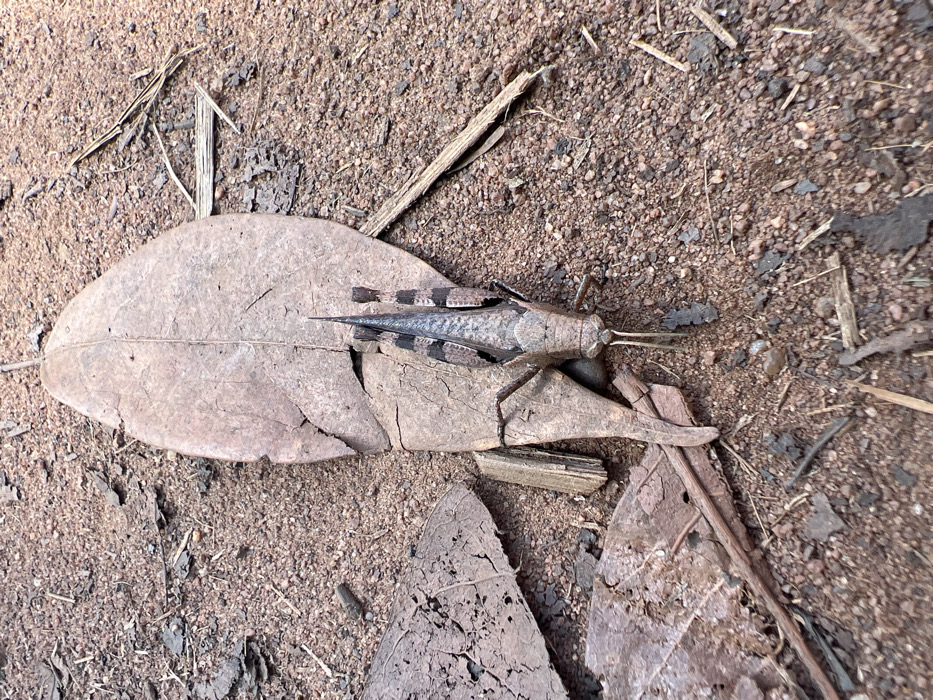
The scene depicts a close-up, ground-level view of a large insect, consistent with a grasshopper or locust species, expertly camouflaged against reddish-brown soil and dried organic debris. The location is reportedly within the city of Alor, Nigeria, though specific geographical markers for the city itself are not discernible from the image.

The insect, positioned centrally and oriented with its head facing the lower portion of the frame, exhibits a mottled coloration of grey, brown, and dark brown or black, precisely matching the surrounding environment. Its body is elongated and appears flattened dorsally, with a distinct, somewhat pointed head or pronotal shield that tapers towards the anterior. Visible features include two slender antennae extending forward and compound eyes. Darker, irregular transversal bands are evident on its dorsal surface, contributing to its cryptic appearance. The insect's forelegs are visible, tucked close to its body.

The ground consists of granular, reddish-brown soil, characteristic of lateritic earth. Scattered across this soil are numerous pieces of dried organic matter. Dominant among these are several dried leaves of varying sizes and shapes, predominantly in shades of brown and tan, some exhibiting cracks or partial decay. One large, ovate-shaped dried leaf is situated directly behind the insect, slightly overlapping its posterior section. Additionally, smaller twigs, fibrous plant fragments, and other debris are interspersed throughout the soil, forming a textured ground cover. The overall environment appears dry and terrestrial.
Nkuzizuruoke

Dec 19, 2025, 1:18 PM

Alor, Nigeria

Stake attention in this memory

Camouflage
Natural
Stillness
Subtlety
Observation

The scene depicts a close-up, ground-level view of a large insect, consistent with a grasshopper or locust species, expertly camouflaged against reddish-brown soil and dried organic debris. The location is reportedly within the city of Alor, Nigeria, though specific geographical markers for the city itself are not discernible from the image. The insect, positioned centrally and oriented with its head facing the lower portion of the frame, exhibits a mottled coloration of grey, brown, and dark brown or black, precisely matching the surrounding environment. Its body is elongated and appears flattened dorsally, with a distinct, somewhat pointed head or pronotal shield that tapers towards the anterior. Visible features include two slender antennae extending forward and compound eyes. Darker, irregular transversal bands are evident on its dorsal surface, contributing to its cryptic appearance. The insect's forelegs are visible, tucked close to its body. The ground consists of granular, reddish-brown soil, characteristic of lateritic earth. Scattered across this soil are numerous pieces of dried organic matter. Dominant among these are several dried leaves of varying sizes and shapes, predominantly in shades of brown and tan, some exhibiting cracks or partial decay. One large, ovate-shaped dried leaf is situated directly behind the insect, slightly overlapping its posterior section. Additionally, smaller twigs, fibrous plant fragments, and other debris are interspersed throughout the soil, forming a textured ground cover. The overall environment appears dry and terrestrial.

Loading AttnAds…

transactions
revenues
stakers
Earliest
Latest
Highest stake

No transactions found

More from this user

More from Alor

Nkuzizuruoke

Dec 19, 2025, 1:18 PM

Alor, Nigeria

Licensed under Creative Commons Attribution 4.0 International License. You are free to share and adapt this content with proper attribution.