
Stake attention in this memory
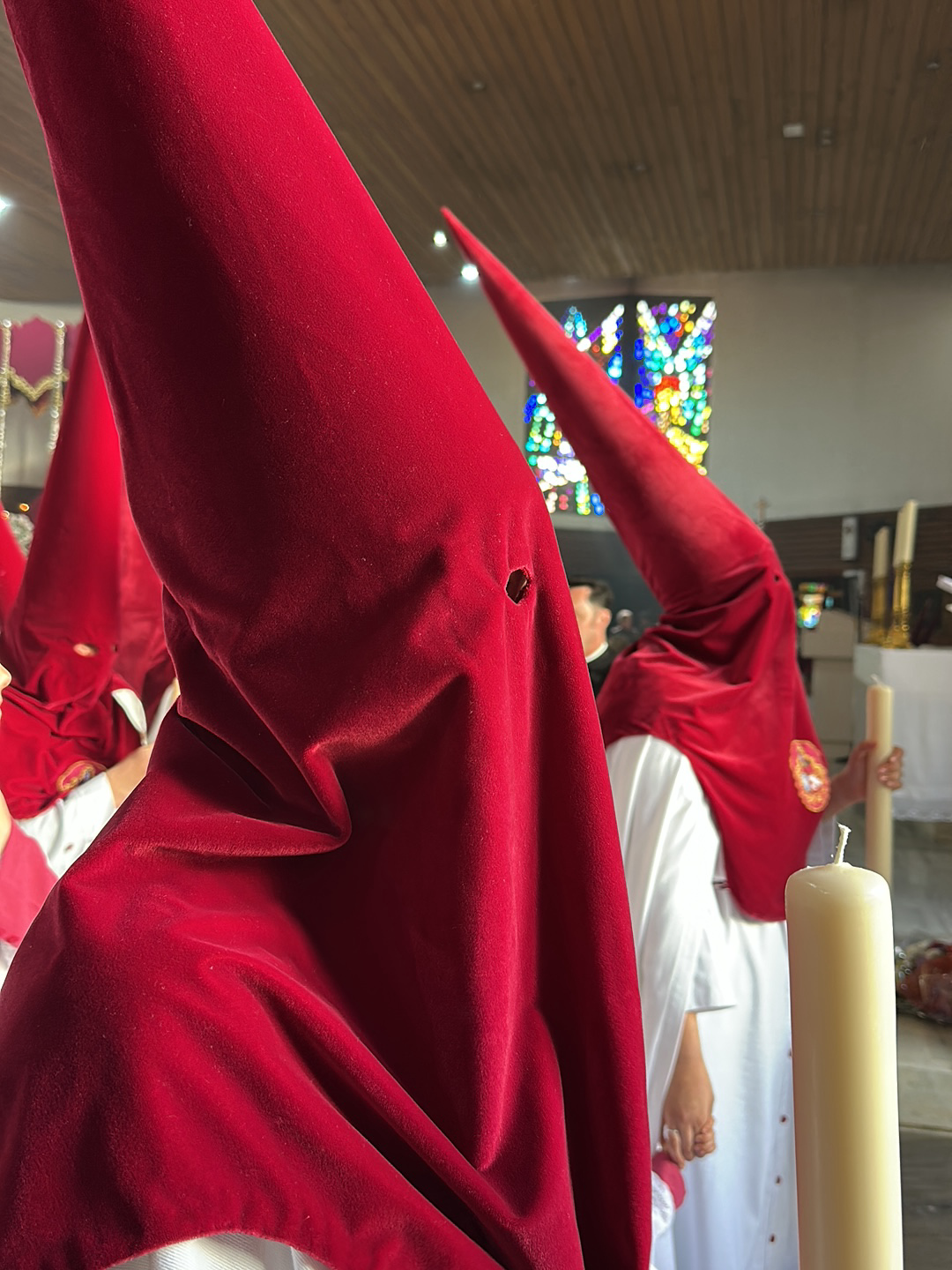
The image captures a scene indoors, likely within a church or religious building, featuring several individuals dressed in traditional attire, most prominently red velvet capirotes (conical hoods). The perspective is from behind and slightly to the side of one of these individuals, making them the central focus of the foreground. The person in the immediate foreground wears a deep red, velvety capirote that covers their entire head and face, descending over their shoulders. The fabric shows soft folds and creases, indicating its plush texture. A small, circular eye-hole is visible on the right side of the capirote, providing a glimpse into the person's hidden face. Beneath the red hood, a white robe or tunic is visible, peeking out at the bottom of the hood and extending downwards. Behind and to the right of the foreground figure, another individual is similarly dressed in a red velvet capirote and a white robe. This person's capirote also features a visible emblem or patch on the side, possibly embroidered, though the details are not clearly discernible. They are holding a tall, unlit white candle upright in their right hand. Further in the background, parts of other hooded figures can be seen, suggesting a group gathering or procession. A prominent, tall, unlit white candle stands upright in the lower right corner of the foreground, partially obscuring the second hooded figure. The background elements strongly suggest a religious setting. A large, vibrant stained-glass window with various colorful panes is visible in the middle distance, behind the hooded figures. The ceiling above is composed of neatly arranged wooden panels, adding to the architectural detail of the interior. To the far right, what appears to be part of an altar or decorated platform with religious items can be glimpsed. Faintly, other people not in costume are visible in the deeper background, behind the stained glass window area and the altar, including one person whose face is partially visible between the two main hooded figures. The overall scene strongly implies a solemn religious event, characteristic of Holy Week (Semana Santa) processions or ceremonies, where participants (often referred to as Nazarenos or penitents) wear these distinctive habits and carry candles. The atmosphere appears reverent and traditional.
No transactions found