Sign in
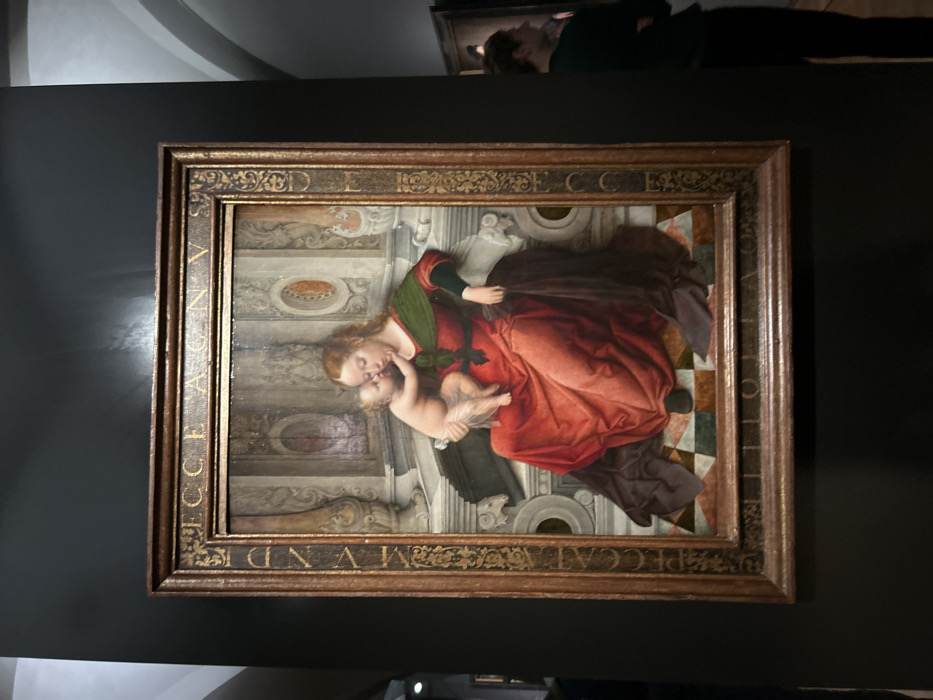
The image features a Renaissance-style painting displayed in a museum setting. The painting depicts a woman with reddish-brown hair, adorned in a flowing red gown with a green sash, tenderly holding a nude infant. Their faces are close, with the woman's eyes gently closed, conveying a sense of deep affection and intimacy. The baby is reaching towards her face.

The background of the painting showcases intricate architectural details, including elaborate stone carvings, vaulted sections, and a geometrically tiled floor in shades of brown, green, and white.

The artwork is encased in an ornate gilded frame, featuring detailed relief patterns. Along the bottom edge of the frame, the Latin inscription "PECCAT MUNDI" is visible in capital letters. On the left vertical edge of the frame, "ECCE AGNU" can be read. These fragments likely form part of the phrase "Ecce Agnus Dei, qui tollit peccata mundi" (Behold the Lamb of God, who takes away the sins of the world), identifying the figures as the Virgin Mary and the Christ Child.

The photograph is taken in a dimly lit exhibition space, possibly in Amsterdam, Netherlands, with the painting well-lit, causing some reflections on its protective surface. The painting is mounted on a dark, plain wall. In the upper part of the image, reflections reveal parts of a vaulted ceiling and a blurred figure of a person observing, further indicating a museum environment.
F
FM-uqmbw2

Dec 30, 2024

Amsterdam, Netherlands

Stake attention in this memory

The image features a Renaissance-style painting displayed in a museum setting. The painting depicts a woman with reddish-brown hair, adorned in a flowing red gown with a green sash, tenderly holding a nude infant. Their faces are close, with the woman's eyes gently closed, conveying a sense of deep affection and intimacy. The baby is reaching towards her face. The background of the painting showcases intricate architectural details, including elaborate stone carvings, vaulted sections, and a geometrically tiled floor in shades of brown, green, and white. The artwork is encased in an ornate gilded frame, featuring detailed relief patterns. Along the bottom edge of the frame, the Latin inscription "PECCAT MUNDI" is visible in capital letters. On the left vertical edge of the frame, "ECCE AGNU" can be read. These fragments likely form part of the phrase "Ecce Agnus Dei, qui tollit peccata mundi" (Behold the Lamb of God, who takes away the sins of the world), identifying the figures as the Virgin Mary and the Christ Child. The photograph is taken in a dimly lit exhibition space, possibly in Amsterdam, Netherlands, with the painting well-lit, causing some reflections on its protective surface. The painting is mounted on a dark, plain wall. In the upper part of the image, reflections reveal parts of a vaulted ceiling and a blurred figure of a person observing, further indicating a museum environment.

transactions
revenues
stakers
Earliest
Latest
Highest stake

No transactions found

More from this user

More from Amsterdam

FFM-uqmbw2

Dec 30, 2024

Amsterdam, Netherlands

Licensed under Creative Commons Attribution 4.0 International License. You are free to share and adapt this content with proper attribution.