
Sign in
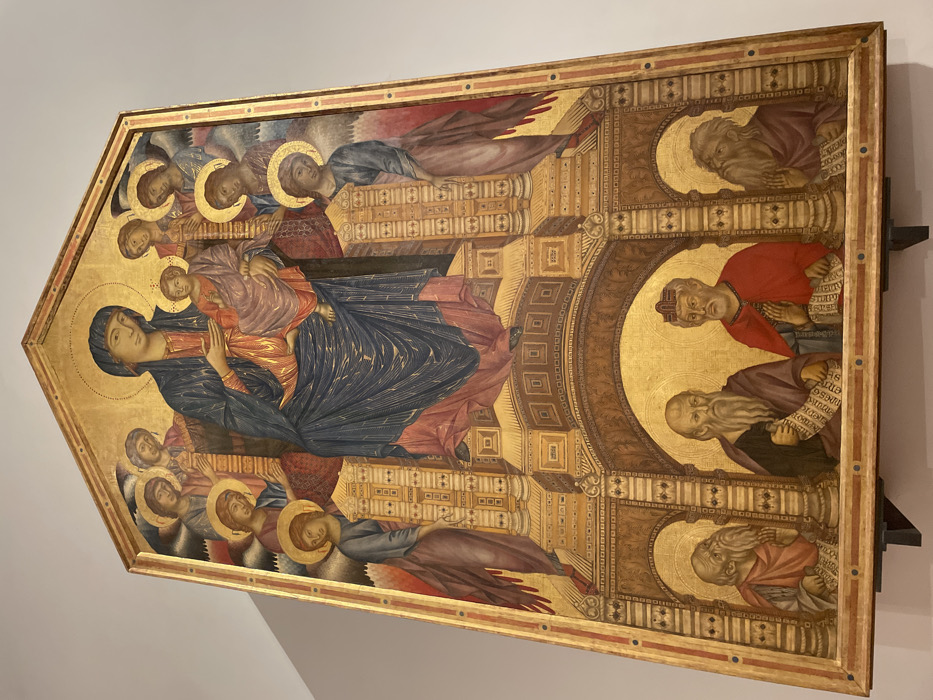
This image displays Cimabue's *Maestà* (also known as the *Santa Trinita Maestà*), a large panel painting from the late 13th century, located in the Uffizi Gallery in Florence, Italy.

The artwork depicts the Virgin Mary and Christ Child enthroned, flanked by angels, with four biblical figures below. The central figure, the Virgin Mary, is seated frontally on an elaborate, ornate architectural throne, wearing a dark blue mantle over a red garment. She holds the Christ Child, clad in a pink-mauve tunic, in her left arm. The Christ Child holds a scroll in his left hand and raises his right hand in a gesture of blessing. Both figures have golden halos.

Six winged angels, each with a golden halo, are arranged vertically in three pairs behind the throne, seemingly supporting it. They wear tunics in varying shades of blue, red, and brown. The throne itself is an intricate, multi-tiered structure with columns, arches, and geometric patterns, rendered in a brownish-gold tone. The Virgin's feet rest upon a footstool. The entire background of the upper section is a luminous gold, indicative of a divine setting.

Below the main scene, an architectural base frames four bearded male figures, likely prophets or patriarchs, within individual arched niches. From left to right, these figures hold scrolls, some with visible script, and wear robes of red, brown, and grey. One figure, second from the right, wears a red cape and a crown-like headpiece.

The painting is housed in a museum setting, observed against a plain, light-colored wall. The panel itself is tall and vertically oriented, tapering to a pointed, trefoil-arch top. It is displayed on a dark support structure.
Tatti

Feb 27, 2026

Florence, Italy

Stake attention in this memory

Reverence
Awe
Serenity
Solemnity
Devotion

This image displays Cimabue's *Maestà* (also known as the *Santa Trinita Maestà*), a large panel painting from the late 13th century, located in the Uffizi Gallery in Florence, Italy. The artwork depicts the Virgin Mary and Christ Child enthroned, flanked by angels, with four biblical figures below. The central figure, the Virgin Mary, is seated frontally on an elaborate, ornate architectural throne, wearing a dark blue mantle over a red garment. She holds the Christ Child, clad in a pink-mauve tunic, in her left arm. The Christ Child holds a scroll in his left hand and raises his right hand in a gesture of blessing. Both figures have golden halos. Six winged angels, each with a golden halo, are arranged vertically in three pairs behind the throne, seemingly supporting it. They wear tunics in varying shades of blue, red, and brown. The throne itself is an intricate, multi-tiered structure with columns, arches, and geometric patterns, rendered in a brownish-gold tone. The Virgin's feet rest upon a footstool. The entire background of the upper section is a luminous gold, indicative of a divine setting. Below the main scene, an architectural base frames four bearded male figures, likely prophets or patriarchs, within individual arched niches. From left to right, these figures hold scrolls, some with visible script, and wear robes of red, brown, and grey. One figure, second from the right, wears a red cape and a crown-like headpiece. The painting is housed in a museum setting, observed against a plain, light-colored wall. The panel itself is tall and vertically oriented, tapering to a pointed, trefoil-arch top. It is displayed on a dark support structure.

transactions
revenues
stakers
Earliest
Latest
Highest stake

No transactions found

More from this user

More from Florence

Tatti

Feb 27, 2026

Florence, Italy

Licensed under Creative Commons Attribution 4.0 International License. You are free to share and adapt this content with proper attribution.