
Sign in
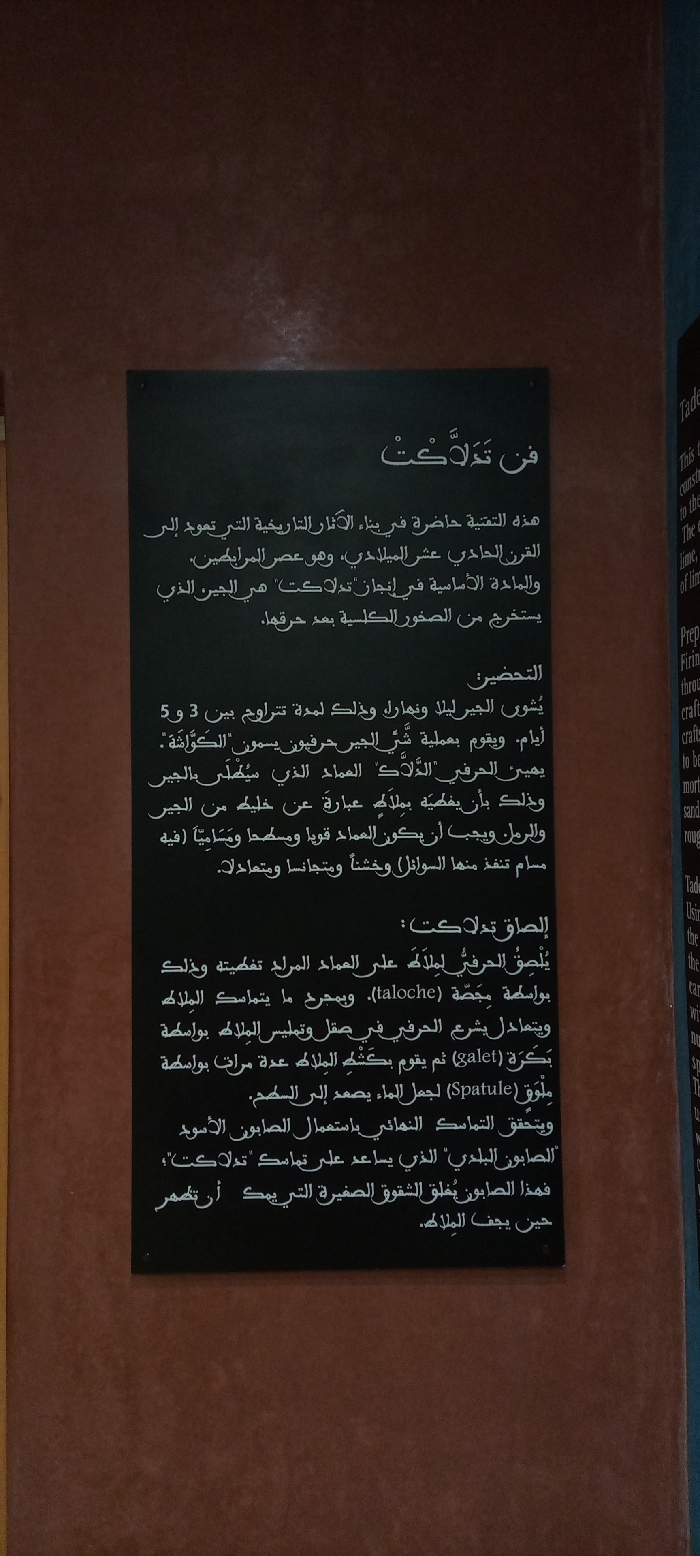
This image captures a dark green informational plaque with white Arabic text, displayed on a reddish-brown wall, likely in a museum or cultural exhibition in Casablanca, Morocco. To the right, a sliver of a second, lighter-colored plaque with English text is partially visible.

The main plaque's Arabic title reads "من تادلاكت" (Min Tadelakt), meaning "About Tadelakt." The text describes Tadelakt as an ancient Moroccan building technique, dating back to the 11th-century Almoravid era. It explains that the primary material is lime, extracted from calcined limestone. The preparation process involves firing the lime for 3 to 5 days, a task performed by artisans known as "Kouacha." This prepared lime is then used to cover a strong, flat, and porous base, a mixture of lime and sand.

The application, or "الصاق تدلاكت" (Tadelakt Application), details how artisans apply the mortar to the desired surface using a "taloche" (trowel). Once the mortar starts to set, it is polished and smoothed with a "galet" (stone polisher), then scraped repeatedly with a "spatule" to bring water to the surface. The final, crucial step for adhesion involves using "Saboun Beldi" (traditional black soap), which enhances the Tadelakt's cohesion and seals small cracks that might appear as the mortar dries. The partially visible English text on the adjacent plaque appears to be a translation or summary of this information. The overall setting suggests a focus on Moroccan history, architecture, and traditional craftsmanship.
AYOUB

Jan 10, 2025, 3:55 PM

Casablanca, Morocco

Stake attention in this memory

This image captures a dark green informational plaque with white Arabic text, displayed on a reddish-brown wall, likely in a museum or cultural exhibition in Casablanca, Morocco. To the right, a sliver of a second, lighter-colored plaque with English text is partially visible. The main plaque's Arabic title reads "من تادلاكت" (Min Tadelakt), meaning "About Tadelakt." The text describes Tadelakt as an ancient Moroccan building technique, dating back to the 11th-century Almoravid era. It explains that the primary material is lime, extracted from calcined limestone. The preparation process involves firing the lime for 3 to 5 days, a task performed by artisans known as "Kouacha." This prepared lime is then used to cover a strong, flat, and porous base, a mixture of lime and sand. The application, or "الصاق تدلاكت" (Tadelakt Application), details how artisans apply the mortar to the desired surface using a "taloche" (trowel). Once the mortar starts to set, it is polished and smoothed with a "galet" (stone polisher), then scraped repeatedly with a "spatule" to bring water to the surface. The final, crucial step for adhesion involves using "Saboun Beldi" (traditional black soap), which enhances the Tadelakt's cohesion and seals small cracks that might appear as the mortar dries. The partially visible English text on the adjacent plaque appears to be a translation or summary of this information. The overall setting suggests a focus on Moroccan history, architecture, and traditional craftsmanship.

Loading AttnAds…

transactions
revenues
stakers
Earliest
Latest
Highest stake

No transactions found

More from this user

More from Casablanca

AYOUB

Jan 10, 2025, 3:55 PM

Casablanca, Morocco

Licensed under Creative Commons Attribution 4.0 International License. You are free to share and adapt this content with proper attribution.