
Sign in
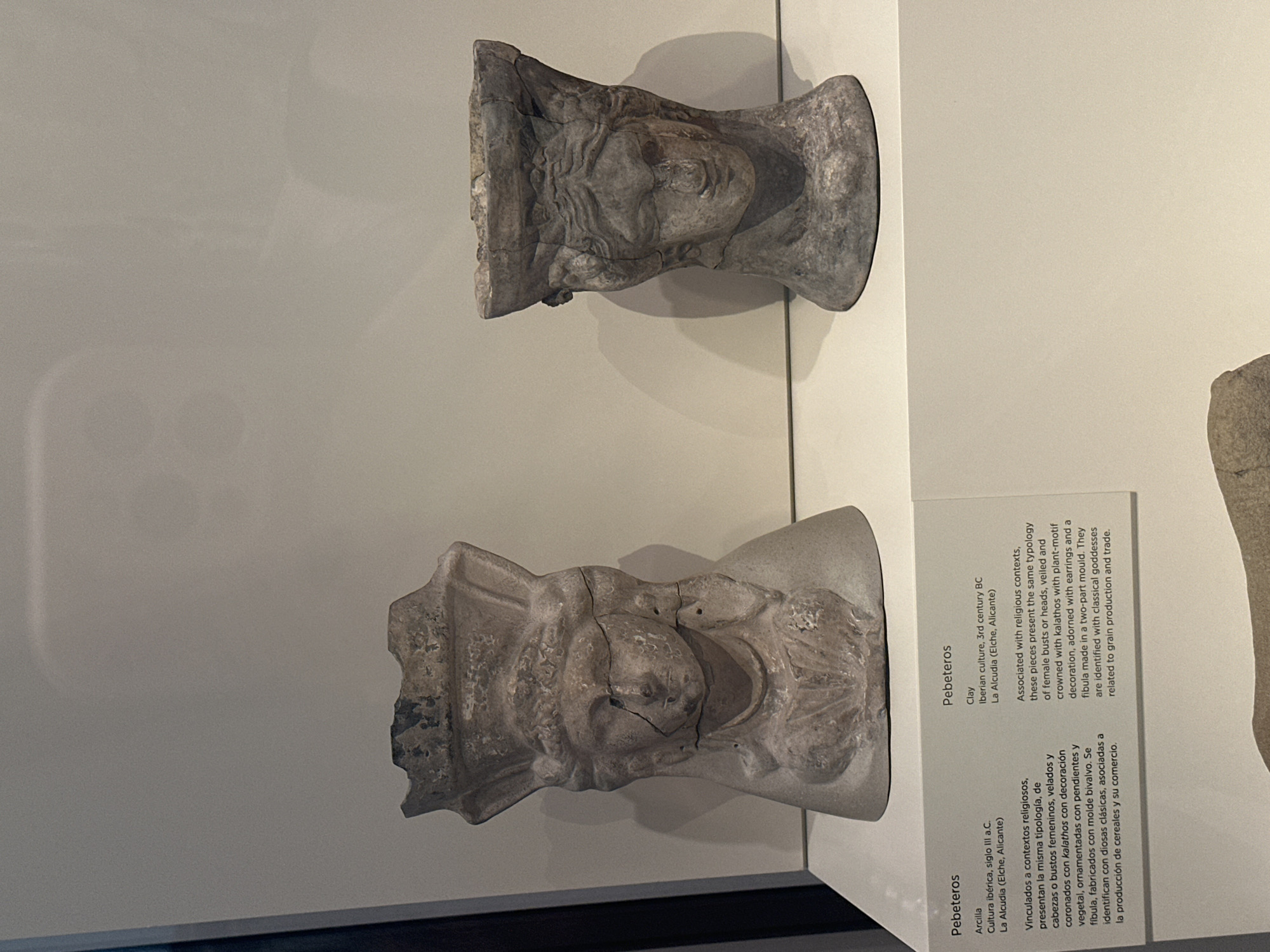
The image shows two ancient clay busts, likely from a museum exhibition. Both busts depict female figures with stylized faces, veiled heads, and elaborate headdresses. The bust on the left is larger and appears to be more damaged, with significant cracks on its face and headdress. The bust on the right is smaller and shows less visible damage. Both objects are placed on a white display surface.

To the left of the busts, there is a descriptive plaque with text in Spanish. The plaque's title is "Pebeteros." Below the title, it states "Arcilla," "Cultura ibérica, siglo III a.C.," and "La Alcudia (Elche, Alicante)." The text describes the busts as being linked to religious contexts, presenting the same typology of female busts or heads, veiled and crowned with kalathos with plant decoration, ornamented with earrings and a fibula, manufactured with molds. They are identified with classical goddesses associated with grain production and trade.

To the right of the busts, there is another descriptive plaque, this time with text in English, also titled "Pebeteros." It describes the objects as being made of "Clay," belonging to the "Iberian culture, 3rd century BC," and originating from "La Alcudia (Elche, Alicante)." The English description is consistent with the Spanish text, detailing the religious context, female busts or heads with veiled and crowned kalathos, plant-motif decoration, earrings, fibula in a two-part mould, and their identification with classical goddesses related to grain production and trade.

The background consists of a light-colored wall. The lighting in the scene appears to be artificial, likely from museum exhibition lights, casting soft shadows. The overall environment suggests an indoor exhibition space, possibly within a museum in Madrid, Spain, although the specific location within Madrid is not provided by the visible text.
Tati

Jun 30, 2026, 9:55 AM

Madrid, Spain

Moment

Stake attention in this memory

reverent
contemplative
solemn
nostalgic
mysterious

The image shows two ancient clay busts, likely from a museum exhibition. Both busts depict female figures with stylized faces, veiled heads, and elaborate headdresses. The bust on the left is larger and appears to be more damaged, with significant cracks on its face and headdress. The bust on the right is smaller and shows less visible damage. Both objects are placed on a white display surface. To the left of the busts, there is a descriptive plaque with text in Spanish. The plaque's title is "Pebeteros." Below the title, it states "Arcilla," "Cultura ibérica, siglo III a.C.," and "La Alcudia (Elche, Alicante)." The text describes the busts as being linked to religious contexts, presenting the same typology of female busts or heads, veiled and crowned with kalathos with plant decoration, ornamented with earrings and a fibula, manufactured with molds. They are identified with classical goddesses associated with grain production and trade. To the right of the busts, there is another descriptive plaque, this time with text in English, also titled "Pebeteros." It describes the objects as being made of "Clay," belonging to the "Iberian culture, 3rd century BC," and originating from "La Alcudia (Elche, Alicante)." The English description is consistent with the Spanish text, detailing the religious context, female busts or heads with veiled and crowned kalathos, plant-motif decoration, earrings, fibula in a two-part mould, and their identification with classical goddesses related to grain production and trade. The background consists of a light-colored wall. The lighting in the scene appears to be artificial, likely from museum exhibition lights, casting soft shadows. The overall environment suggests an indoor exhibition space, possibly within a museum in Madrid, Spain, although the specific location within Madrid is not provided by the visible text.

Loading AttnAds…

transactions
revenues
stakers
Earliest
Latest
Highest stake

No transactions found

More from this user

More from Madrid

Tati

Jun 30, 2026, 9:55 AM

Madrid, Spain

Licensed under Creative Commons Attribution 4.0 International License. You are free to share and adapt this content with proper attribution.